Abstract
Among the most destructive pests affecting plant growth and yield worldwide are root-knot nematodes (Meloidogyne spp.). Currently, the shift from the use of chemical nematicides is trangressing globally towards choices such as organic nematicides extracted from plant substances. Plant secondary metabolites have been identified as compounds responsible for nematicidal activities in different plant species and are favored nematicidal agents because of their safe environmental record and affordability. Phytochemical screening, DPPH● scavenging capacity and nematicidal properties of eight different plant extracts under in vitro and greenhouse conditions were investigated against the egg mass hatching of the nematode, M. incognita. Four concentrations (0.2, 0.4, 0.6 and 0.8 mg/mL) with distilled water serving as a control were replicated three times and arranged in a completely randomized design (CRD) in an incubator at 25 ± 3 °C. The phytochemical analysis showed that the highest total flavonoids, condensed tannins and phenolic contents were found in Vernonia colorata (88.71 mg/g QE), Searsia lancea (406.16 mg/g CCE) and Pelargonium sidoides (175.95 mg/g GAE), respectively, with DPPH● scavenging IC50 values of 84.94, 14.40 and 6.64 µg/mL respectively. Our results further revealed that all treatments with increasing concentrations suppressed egg mass hatching after 72 h. Cucurbita maxima methanolic crude extract with DPPH● scavenging IC50 value of 168.20 µg/mL significantly reduced egg mass hatchability by 77–96% after 72 h. Under greenhouse conditions, results showed a significant (P < 0.01) inhibition of 97% on second-stage-juveniles penetration/establishment on tomato roots, with 100% root gall development inhibition on seedlings treated with V. colorata methanolic crude extract. In conclusion, all eight plant extracts showed promising nematicidal activity at 0.8 mg/mL.
Abstract from the paper’s OpenAlex record; open copy licensed cc-by. Read at the source ↗
The text the model read, with the source record’s inline markup (italics, sub- and superscripts) rendered and its character entities decoded; quote offsets refer to the raw text.
Claims 7
Claim · model-written summary
Vernonia colorata had the highest total flavonoids at 88.71 mg/g QE.
- Taxon
- Vernonia colorata
 Gymnanthemum coloratume0
- Outcome
- total flavonoidse0
- Direction
- higheste0
- Value
- 88.71 mg/g QEe0
Organisms pictured · Representative pictures of the matched species, not figures from the paper.

Verbatim
e0“the highest total flavonoids, condensed tannins and phenolic contents were found in Vernonia colorata (88.71 mg/g QE), Searsia lancea (406.16 mg/g CCE) and Pelargonium sidoides (175.95 mg/g GAE), respectively”
Claim · model-written summary
Searsia lancea had the highest condensed tannins at 406.16 mg/g CCE.
- Taxon
- Searsia lancea
 Searsia lanceae0
- Outcome
- condensed tanninse0
- Direction
- higheste0
- Value
- 406.16 mg/g CCEe0
Organisms pictured · Representative pictures of the matched species, not figures from the paper.

Verbatim
e0“the highest total flavonoids, condensed tannins and phenolic contents were found in Vernonia colorata (88.71 mg/g QE), Searsia lancea (406.16 mg/g CCE) and Pelargonium sidoides (175.95 mg/g GAE), respectively”
Claim · model-written summary
Pelargonium sidoides had the highest phenolic contents at 175.95 mg/g GAE.
- Taxon
- Pelargonium sidoides
 Pelargonium sidoidese0
- Outcome
- phenolic contentse0
- Direction
- higheste0
- Value
- 175.95 mg/g GAEe0
Organisms pictured · Representative pictures of the matched species, not figures from the paper.

Verbatim
e0“the highest total flavonoids, condensed tannins and phenolic contents were found in Vernonia colorata (88.71 mg/g QE), Searsia lancea (406.16 mg/g CCE) and Pelargonium sidoides (175.95 mg/g GAE), respectively”
Claim · model-written summary
Increasing extract concentrations suppressed nematode egg mass hatching after 72 h.
- Taxon
- plantt0
- Treatment
- increasing concentrationse0
- Interactor
- M. incognita
 Meloidogyne incognitae1pest
- Outcome
- egg mass hatchinge0
- Direction
- suppressede0
- Qualifier
- after 72 he0
Not reportedComparator
Organisms pictured · Representative pictures of the matched species, not figures from the paper.

Verbatim
e0“all treatments with increasing concentrations suppressed egg mass hatching after 72 h”
e1“M. incognita”
t0“plant extracts”
Claim · model-written summary
Cucurbita maxima extract reduced nematode egg mass hatchability by 77–96%.
- Taxon
- Cucurbita maxima
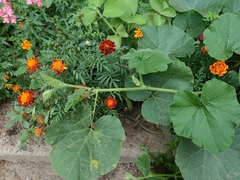 Cucurbita maximae0
- Treatment
- Cucurbita maxima methanolic crude extracte0
- Outcome
- egg mass hatchabilitye0
- Direction
- reducede0
- Value
- 77–96%e0
- Qualifier
- after 72 he0
Not reportedComparator
Organisms pictured · Representative pictures of the matched species, not figures from the paper.

Verbatim
e0“Cucurbita maxima methanolic crude extract with DPPH● scavenging IC50 value of 168.20 µg/mL significantly reduced egg mass hatchability by 77–96% after 72 h.”
Claim · model-written summary
V. colorata extract inhibited juvenile penetration or establishment on tomato roots by 97%.
- Taxon
- tomato
 Solanum lycopersicume0
- Treatment
- V. colorata methanolic crude extracte0
- Interactor
- M. incognitaMeloidogyne incognitae1pest
- Outcome
- second-stage-juveniles penetration/establishment on tomato rootse0
- Direction
- inhibitione0
- Value
- 97%e0
Not reportedComparator
Organisms pictured · Representative pictures of the matched species, not figures from the paper.

Verbatim
e0“a significant (P < 0.01) inhibition of 97% on second-stage-juveniles penetration/establishment on tomato roots, with 100% root gall development inhibition on seedlings treated with V. colorata methanolic crude extract”
e1“M. incognita”
Claim · model-written summary
V. colorata extract inhibited root gall development by 100%.
- Taxon
- tomatoSolanum lycopersicume1
- Treatment
- V. colorata methanolic crude extracte0
- Outcome
- root gall developmente0
- Direction
- inhibitione0
- Value
- 100%e0
Not reportedComparator
Organisms pictured · Representative pictures of the matched species, not figures from the paper.
Verbatim
e0“100% root gall development inhibition on seedlings treated with V. colorata methanolic crude extract”
e1“on tomato roots, with 100% root gall development inhibition”
The same questions in other papers
botanical · pest · Solanum lycopersicum (tomato)Positive and negative results
89 papers in the same direction as this paper · 14 in the opposite direction
- no effect
- negative
- no effect
100 papers more in this group
See all 104 papers →botanical · Meloidogyne incognita · Solanum lycopersicum (tomato)Positive and negative results
114 papers in the same direction as this paper · 2 in the opposite direction
- no effect
- negative
- positive
113 papers more in this group
See all 117 papers →Claims are grouped by organism, treatment and what was measured or targeted. A paper counts as positive when any of its claims in the group is positive.