Abstract
Long-term no-till (NT) systems in the semiarid central Great Plains of the United States require flexible management strategies to minimize the impacts of herbicide resistant (HR) kochia (Kochia scoparia L.) and tumble windmill grass (Chloris verticillata Nutt.) as well as nutrient stratification on soil and crop productivity. This study examined strategic tillage (ST) to control HR weeds and improve crop yields in an otherwise long-term NT cropping system. Treatments were three crop rotations: (1) continuous winter wheat (Triticum aestivum L.) (WW); (2) wheat-fallow (WF); and (3) wheat-grain sorghum (Sorghum bicolor L.)-fallow (WSF); as main plots. Subplots were reduced tillage (RT), continuous NT, and ST of NT. Results showed ST and RT treatments provided significant control of HR weeds. Soil water content at wheat planting was significantly less with RT compared to NT or ST. Strategic tillage did not affect wheat or grain sorghum yields, but RT decreased sorghum yields by 15% compared to NT. Increasing cropping intensity reduced wheat yields. Strategic tillage reduced bulk density and had no effect on aggregate size distribution or mean weight diameter (MWD) compared to NT though RT reduced the proportion of large macroaggregates and MWD. Similarly, ST compared to NT had no effect on soil organic carbon (SOC) or nitrogen (N) concentrations. Soil phosphorus (P) was not different among the tillage treatments though RT increased potassium (K) concentration near the soil surface. The SOC, MWD, and micronutrient availability were greatest with WW though it had significantly lower pH and K concentration. Our results suggest ST could provide a mitigation option for HR weeds in NT systems with little impact on crop yields and soil properties.
Abstract from the paper’s OpenAlex record; open copy licensed cc-by. Read at the source ↗
The text the model read, with the source record’s inline markup (italics, sub- and superscripts) rendered and its character entities decoded; quote offsets refer to the raw text.
Claims 15
Claim · model-written summary
Strategic tillage and reduced tillage provided significant control of herbicide-resistant kochia and tumble windmill grass
- Taxon
- winter wheat
 Triticum aestivume0
- Treatment
- strategic tillage (ST)e1
- Interactor
- kochia (Kochia scoparia L.)
 Bassia scopariae3weed
- Second interactor
- tumble windmill grass (Chloris verticillata Nutt.)
 Chloris verticillatae3weed
- Outcome
- control of HR weedse2
- Direction
- decreaseinferrede2
Not reportedComparator
Organisms pictured · Representative pictures of the matched species, not figures from the paper.


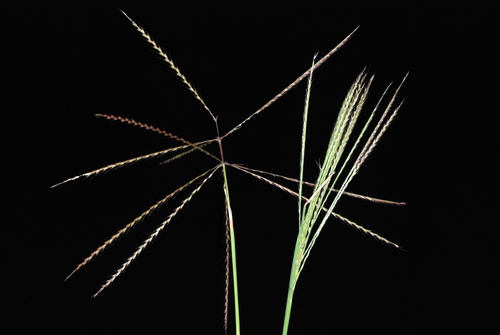
Verbatim
e0“(1) continuous winter wheat (Triticum aestivum L.) (WW)”
e1“This study examined strategic tillage (ST) to control HR weeds”
e2“Results showed ST and RT treatments provided significant control of HR weeds”
e3“herbicide resistant (HR) kochia (Kochia scoparia L.) and tumble windmill grass (Chloris verticillata Nutt.)”
Claim · model-written summary
Reduced tillage significantly decreased soil water content at wheat planting compared with no-tillage or strategic tillage
- Taxon
- wheatTriticum aestivume1
- Treatment
- RTe1
- Outcome
- Soil water content at wheat plantinge1
- Direction
- lesse1
- Comparator
- NT or STe1
Organisms pictured · Representative pictures of the matched species, not figures from the paper.
Verbatim
e1“Soil water content at wheat planting was significantly less with RT compared to NT or ST”
Claim · model-written summary
Strategic tillage did not affect wheat yields
- Taxon
- wheatTriticum aestivume1
- Treatment
- Strategic tillagee1
- Outcome
- yieldse1
- Direction
- no_changeinferrede1
Not reportedComparator
Organisms pictured · Representative pictures of the matched species, not figures from the paper.
Verbatim
e1“Strategic tillage did not affect wheat or grain sorghum yields, but RT decreased sorghum yields by 15% compared to NT”
Claim · model-written summary
Reduced tillage decreased grain sorghum yields by 15% compared with no-tillage
- Taxon
- grain sorghum
 Sorghum bicolore1
- Treatment
- RTe1
- Outcome
- sorghum yieldse1
- Direction
- decreasede1
- Value
- 15%e1
- Comparator
- NTe1
Organisms pictured · Representative pictures of the matched species, not figures from the paper.

Verbatim
e1“Strategic tillage did not affect wheat or grain sorghum yields, but RT decreased sorghum yields by 15% compared to NT”
Claim · model-written summary
Strategic tillage did not affect grain sorghum yields
- Taxon
- grain sorghumSorghum bicolore1
- Treatment
- Strategic tillagee1
- Outcome
- yieldse1
- Direction
- no_changeinferrede1
Not reportedComparator
Organisms pictured · Representative pictures of the matched species, not figures from the paper.
Verbatim
e1“Strategic tillage did not affect wheat or grain sorghum yields, but RT decreased sorghum yields by 15% compared to NT”
Claim · model-written summary
Increasing cropping intensity reduced wheat yields
- Taxon
- wheatTriticum aestivume1
- Treatment
- Increasing cropping intensitye1
- Outcome
- wheat yieldse1
- Direction
- reducede1
Not reportedComparator
Organisms pictured · Representative pictures of the matched species, not figures from the paper.
Verbatim
e1“Increasing cropping intensity reduced wheat yields”
Claim · model-written summary
Strategic tillage reduced soil bulk density compared with no-tillage
- Taxon
- winter wheatTriticum aestivume0
- Treatment
- Strategic tillagee1
- Outcome
- bulk densitye1
- Direction
- reducede1
- Comparator
- NTe1
Organisms pictured · Representative pictures of the matched species, not figures from the paper.
Verbatim
e0“(1) continuous winter wheat (Triticum aestivum L.) (WW)”
e1“Strategic tillage reduced bulk density and had no effect on aggregate size distribution or mean weight diameter (MWD) compared to NT”
Claim · model-written summary
Strategic tillage had no effect on aggregate size distribution or mean weight diameter compared with no-tillage
- Taxon
- winter wheatTriticum aestivume0
- Treatment
- Strategic tillagee1
- Outcome
- aggregate size distribution or mean weight diameter (MWD)e1
- Direction
- no_changeinferrede1
- Comparator
- NTe1
Organisms pictured · Representative pictures of the matched species, not figures from the paper.
Verbatim
e0“(1) continuous winter wheat (Triticum aestivum L.) (WW)”
e1“Strategic tillage reduced bulk density and had no effect on aggregate size distribution or mean weight diameter (MWD) compared to NT”
Claim · model-written summary
Reduced tillage reduced the proportion of large macroaggregates and mean weight diameter compared with no-tillage
- Taxon
- winter wheatTriticum aestivume0
- Treatment
- RTe2
- Outcome
- proportion of large macroaggregates and MWDe2
- Direction
- reducede2
- Comparator
- NTe1
Organisms pictured · Representative pictures of the matched species, not figures from the paper.
Verbatim
e0“(1) continuous winter wheat (Triticum aestivum L.) (WW)”
e1“Strategic tillage reduced bulk density and had no effect on aggregate size distribution or mean weight diameter (MWD) compared to NT”
e2“though RT reduced the proportion of large macroaggregates and MWD”
Claim · model-written summary
Strategic tillage had no effect on soil organic carbon or nitrogen concentrations compared with no-tillage
- Taxon
- winter wheatTriticum aestivume0
- Treatment
- STe1
- Outcome
- soil organic carbon (SOC) or nitrogen (N) concentrationse1
- Direction
- no_changeinferrede1
- Comparator
- NTe1
Organisms pictured · Representative pictures of the matched species, not figures from the paper.
Verbatim
e0“(1) continuous winter wheat (Triticum aestivum L.) (WW)”
e1“Similarly, ST compared to NT had no effect on soil organic carbon (SOC) or nitrogen (N) concentrations”
Claim · model-written summary
Soil phosphorus did not differ among the tillage treatments
- Taxon
- winter wheatTriticum aestivume0
- Treatment
- tillage treatmentse1
- Outcome
- Soil phosphorus (P)e1
- Direction
- no_changeinferrede1
Not reportedComparator
Organisms pictured · Representative pictures of the matched species, not figures from the paper.
Verbatim
e0“(1) continuous winter wheat (Triticum aestivum L.) (WW)”
e1“Soil phosphorus (P) was not different among the tillage treatments”
Claim · model-written summary
Reduced tillage increased potassium concentration near the soil surface
- Taxon
- winter wheatTriticum aestivume0
- Organ / stage
- near the soil surfacee1
- Treatment
- RTe1
- Outcome
- potassium (K) concentratione1
- Direction
- increasede1
Not reportedComparator
Organisms pictured · Representative pictures of the matched species, not figures from the paper.
Verbatim
e0“(1) continuous winter wheat (Triticum aestivum L.) (WW)”
e1“RT increased potassium (K) concentration near the soil surface”
Claim · model-written summary
Continuous winter wheat had the greatest soil organic carbon, mean weight diameter and micronutrient availability
- Taxon
- winter wheatTriticum aestivume0
- Treatment
- WWe1
- Outcome
- SOC, MWD, and micronutrient availabilitye1
- Direction
- greateste1
Not reportedComparator
Organisms pictured · Representative pictures of the matched species, not figures from the paper.
Verbatim
e0“(1) continuous winter wheat (Triticum aestivum L.) (WW)”
e1“The SOC, MWD, and micronutrient availability were greatest with WW though it had significantly lower pH and K concentration”
Claim · model-written summary
Continuous winter wheat had significantly lower soil pH and potassium concentration
- Taxon
- winter wheatTriticum aestivume0
- Treatment
- WWe1
- Outcome
- pH and K concentratione1
- Direction
- lowere1
Not reportedComparator
Organisms pictured · Representative pictures of the matched species, not figures from the paper.
Verbatim
e0“(1) continuous winter wheat (Triticum aestivum L.) (WW)”
e1“The SOC, MWD, and micronutrient availability were greatest with WW though it had significantly lower pH and K concentration”
Claim · model-written summary
Strategic tillage could be a mitigation option for herbicide-resistant weeds in no-till systems with little impact on crop yields and soil properties
- Taxon
- winter wheatTriticum aestivume0
- Outcome
- mitigation option for HR weedse1
Organisms pictured · Representative pictures of the matched species, not figures from the paper.
Verbatim
e0“(1) continuous winter wheat (Triticum aestivum L.) (WW)”
e1“Our results suggest ST could provide a mitigation option for HR weeds in NT systems with little impact on crop yields and soil properties”
The same questions in other papers
tillage · yield · Sorghum bicolor (sorghum)Positive and negative results
18 papers in the same direction as this paper · 29 in the opposite direction
- positive
- positive
- positive
44 papers more in this group
See all 48 papers →tillage · soil: chemistry · Triticum aestivum (wheat)Positive and negative results
5 papers in the same direction as this paper · 50 in the opposite direction
- positive
- positive
- positive
52 papers more in this group
See all 56 papers →tillage · growth · Triticum aestivum (wheat)Positive and negative results
58 papers in the same direction as this paper · 208 reporting no difference from an alternative
- negative
- positive
- positive
263 papers more in this group
See all 267 papers →tillage · yield · Triticum aestivum (wheat)Positive and negative results
297 papers in the same direction as this paper · 1,116 in the opposite direction
- positive
- no effect
- no effect
1,410 papers more in this group
See all 1,414 papers →Claims are grouped by organism, treatment and what was measured or targeted. A paper counts as positive when any of its claims in the group is positive.