View: List Claim type Research area Organism Taxon as written Decade Paper Observation observed original result measured Claim · model-written summary
Stomatal density tended to decrease .
Stomatal density e0 Verbatim
e0 “Stomatal density tended to decrease ”
✓ located verbatim in the source · abstract, characters 1029–1064 t0 “Rice Cultivar KDML105 ”
✓ located verbatim in the source · title, characters 93–114 Other claims from this paper (10) Observation observed original result no effect measured Claim · model-written summary
Appressed membrane particle density did not decrease at 1°C.
density of particles on the appressed exoplasmic fracture face e0 Verbatim
e0 “no decrease in the density of particles on the appressed exoplasmic fracture face ”
✓ located verbatim in the source · abstract, characters 657–738 t0 “Attached leaves of pumpkin (Cucurbita pepo L. cv. Jattiläismeloni) ”
✓ located verbatim in the source · abstract, characters 0–66 Other claims from this paper (8) Observation observed original result positive measured Claim · model-written summary
G + 1SSW + 1FW gave the maximum bulk density decrease .
G + 1SSW + 1FW e0 maximum decrease e0 Not reported Comparator
Verbatim
t0 “Rice–Wheat Cropping System ”
✓ located verbatim in the source · title, characters 135–161 e0 “maximum decrease in bulk density and in crease in in filtration rate was observed with G + 1SSW + 1FW ”
✓ located verbatim in the source · abstract, characters 1186–1285 Other claims from this paper (10) Observation observed original result positive simulated Claim · model-written summary
The model finds a logarithmic decrease in root length density with depth most beneficial for water uptake efficiency.
efficient water uptake e0 most beneficial e0 logarithmic decrease of root length density with depth e0 Not reported Taxon
Verbatim
e0 “Our theory finds a logarithmic decrease of root length density with depth to be most beneficial for efficient water uptake ”
✓ located verbatim in the source · abstract, characters 486–608 Other claims from this paper (2) Observation observed review summary basis n/a Claim · model-written summary
Chilling, planting density , rubbing, cutting and repeated subculture generally decrease plant DNA methylation.
chilling, planting density, rubbing, cutting, and successive rounds of subculture e0 levels of DNA methylation e0 Verbatim
e0 “Abiotic stresses such as chilling, planting density , rubbing, cutting, and successive rounds of subculture generally decrease the levels of DNA methylation ”
✓ located verbatim in the source · abstract, characters 140–295 t0 “Plant genomic DNA methylation ”
✓ located verbatim in the source · title, characters 0–29 Other claims from this paper (5) Observation observed original result measured Claim · model-written summary
Entry II TPT 30 showed the greatest decrease in bulk density .
Entry II TPT 30 e1 1.02 kg/mm3-0.60 kg/mm3 e1 Verbatim
e0 “winged bean seed ”
✓ located verbatim in the source · abstract, characters 28–44 e1 “Entry II TPT 30 had the highest percentage bulk density (1.02 kg/mm3-0.60 kg/mm3) decrease ”
✓ located verbatim in the source · abstract, characters 641–731 Other claims from this paper (9) Observation observed original result measured Claim · model-written summary
Treated peach showed decrease density of carbondioxide.
density of carbondioxide e0 Not reported Direction
Verbatim
e0 “The density of oxygen surrounded treated peach was always higher , the density of carbondioxide was in reverse;whereas the in ner carbondioxide was more and more by days ”
✓ located verbatim in the source · abstract, characters 403–571 Other claims from this paper (9) Observation observed original result measured Claim · model-written summary
Hydrogen ion density tended to decrease during processing and simulated processing.
Rehmannia Glutinosa Liboscht0 process and simulated process e0 Verbatim
e0 “The density of H+had been demonstrated that it had a decrease d tendency during the process and simulated process ”
✓ located verbatim in the source · abstract, characters 261–373 t0 “Rehmannia Glutinosa Libosch
✓ located verbatim in the source · title, characters 28–55 Other claims from this paper (5) Observation hypothesis original result projected Claim · model-written summary
Authors project Euphrasia population density will decrease under warming.
Population densities e0 due to lower disturbance levels by frost heave and increased vegetation cover e0 Verbatim
e0 “Population densities, however, are likely to decrease under elevated temperatures, due to lower disturbance levels by frost heave and in creased vegetation cover. ”
✓ located verbatim in the source · abstract, characters 1007–1168 t0 “Euphrasia frigida
✓ located verbatim in the source · title, characters 129–146 Other claims from this paper (6) Observation observed original result negative measured Claim · model-written summary
Polluted leaves had reduced leaf density .
Not reported Taxon
Verbatim
e0 “the decrease of leaf density is due probably to (i) a decrease in in tercellular spaces, (ii) a decline of vascular bundles number and (iii) a gradual sclerotization of collenchyma cells occurring jointly with a thickening of their walls. ”
✓ located verbatim in the source · abstract, characters 886–1123 Other claims from this paper (8) Lexical search (BM25). All words must match; if nothing does, any word. Organism names also match every spelling of the same organism. No semantic search yet.
 Oryza sativat0
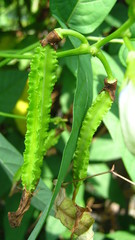 Psophocarpus tetragonolobus
 Prunus persica
 Euphrasia frigida