View: List Claim type Research area Organism Taxon as written Decade Paper Intervention effect observed original result no effect not significant (as stated) measured Claim · model-written summary
In creasing orchard density did not significantly decrease yield.
increasing the density e0 does not decrease e0 Not reported Comparator
Verbatim
t0 “SOUR CHERRY ”
✓ located verbatim in the source · title, characters 80–91 e0 “in creasing the density in the orchard, the yield does not decrease significantly ”
✓ located verbatim in the source · abstract, characters 1858–1938 Other claims from this paper (13) Association observed original result negative significant (as stated) measured Claim · model-written summary
In creasing nutsedge density was associated with a significant linear decrease in seed cotton yield
Increasing nutsedge density e0 seed cotton yield e0 Verbatim
t0 “yellow nutsedge (Cyperus esculentus ) density on cotton (Gossypium hirsutum ) ”
✓ located verbatim in the source · title, characters 29–104 e0 “In creasing nutsedge density caused a significant linear decrease in seed cotton yield ”
✓ located verbatim in the source · abstract, characters 230–315 Other claims from this paper (9) Observation observed original result no effect not significant (as stated) measured Claim · model-written summary
Nutrient density unit under ORD did not decrease significantly.
nutrient density unit (NDU) e0 did not decrease e0 Verbatim
e0 “its nutrient density unit (NDU) did not decrease significantly due to the additional duck yield ”
✓ located verbatim in the source · abstract, characters 540–635 t0 “rice–duck coculture ”
✓ located verbatim in the source · title, characters 93–112 Other claims from this paper (5) Association observed original result measured Claim · model-written summary
Amylopectin content continued to decrease with in creasing machine transplanting density .
increase in machine transplanting density e4 amylopectin content e6 continued to decrease e6 Verbatim
e1 “good taste rice cultivars (GTRC) ”
✓ located verbatim in the source · abstract, characters 73–105 e4 “with the in crease in machine transplanting density ”
✓ located verbatim in the source · abstract, characters 969–1019 e6 “while the amylopectin content continued to decrease ”
✓ located verbatim in the source · abstract, characters 1021–1072 Other claims from this paper (12) Intervention effect observed original result positive measured Claim · model-written summary
Management relaxation was associated with a decrease in vegetation density .
management relaxation e1 vegetation density e1 Not reported Comparator
Verbatim
t0 “mountain grasslands ”
✓ located verbatim in the source · title, characters 69–88 e1 “A higher butterfly abundance and species richness following management relaxation was mostly driven by a decrease in vegetation density and an in crease in forb cover. ”
✓ located verbatim in the source · abstract, characters 1208–1374 Other claims from this paper (2) Intervention effect observed original result no effect not significant (as stated) measured Claim · model-written summary
At low versus high sowing density , grain yield in modern wheat cultivars did not decrease significantly.
modern cultivars e0 low sowing density e0 did not decrease e0 high sowing density e0 Verbatim
e0 “Compared to high sowing density , in modern cultivars grain yield did not decrease significantly with low sowing density ”
✓ located verbatim in the source · abstract, characters 905–1024 t0 “common wheat ”
✓ located verbatim in the source · title, characters 73–85 Other claims from this paper (8) Observation observed original result measured Claim · model-written summary
Grain density tended to decrease across years.
Verbatim
e0 “The grain density was relative high in recent 4 years and 80 percent of all varieties came up to the second national standard,while there was a decrease tendency among years. ”
✓ located verbatim in the source · abstract, characters 399–573 t0 “Maize ”
✓ located verbatim in the source · title, characters 27–32 Other claims from this paper (7) Intervention effect author interpretation original result negative measured Claim · model-written summary
Ear length and small panicles per ear might decrease under high density and low fertilizer.
high-density with low-fertilizer e0 Yield and Its Related Traits t0 Not reported Comparator
Verbatim
e0 “decrease in high- density with low-fertilizer. ”
✓ located verbatim in the source · abstract, characters 1005–1050 t0 “Yield and Its Related Traits in Nude Barley ”
✓ located verbatim in the source · title, characters 49–92 Other claims from this paper (13) Intervention effect observed original result negative measured Claim · model-written summary
Simazine caused moderate in jury to ball clover and small hop clover, with more than 32% decrease in leaf density .
ball clover and small hop clover e1 Not reported Comparator
Verbatim
e1 “yet moderate in jury to ball clover and small hop clover was observed (> 32% decrease in leaf density and > 27% decrease in flower density ) ”
✓ located verbatim in the source · abstract, characters 764–902 e2 “Simazine was well tolerated by white clover ”
✓ located verbatim in the source · abstract, characters 677–720 Other claims from this paper (12) Intervention effect Bentazon was moderately tolerated by the three Trifolium species, with less than 35% decrease in leaf density, height or flowering. Intervention effect Simazine was well tolerated by white clover, with less than 5% decrease in all response variables. Intervention effect Simazine caused moderate injury to ball clover and small hop clover, with more than 27% decrease in flower density. Intervention effect Pronamide was well tolerated by white and ball clovers, with no effect on the measured response variables. Intervention effect Pronamide decreased small hop clover height and flower density by 38 and 42%, respectively. Intervention effect Imazethapyr was moderately well tolerated by white clover and small hop clover, with less than 39% decrease in all response variables. Intervention effect Imazamox was moderately well tolerated by white clover and small hop clover, with less than 39% decrease in all response variables. Intervention effect Ball clover may be more susceptible to imazethapyr and imazamox than anticipated from previously reported tolerance. Intervention effect The herbicides 2,4-DB, halosulfuron and metribuzin were well tolerated by white clover, with no effect on the measured response variables. Intervention effect Results suggest that ball and small hop clovers are less tolerant to 2,4-DB, halosulfuron and metribuzin. Intervention effect Clopyralid, 2,4-D, glyphosate, imazaquin, metsulfuron-methyl and nicosulfuron caused varying degrees of injury across clover species and response variables. Recommendation These herbicides may not be viable options for maintaining any of the three clover species tested. Intervention effect observed original result negative measured Claim · model-written summary
Simazine caused moderate in jury to ball clover and small hop clover, with more than 27% decrease in flower density .
ball clover and small hop clover e1 Not reported Comparator
Verbatim
e1 “yet moderate in jury to ball clover and small hop clover was observed (> 32% decrease in leaf density and > 27% decrease in flower density ) ”
✓ located verbatim in the source · abstract, characters 764–902 e2 “Simazine was well tolerated by white clover ”
✓ located verbatim in the source · abstract, characters 677–720 Other claims from this paper (12) Intervention effect Bentazon was moderately tolerated by the three Trifolium species, with less than 35% decrease in leaf density, height or flowering. Intervention effect Simazine was well tolerated by white clover, with less than 5% decrease in all response variables. Intervention effect Simazine caused moderate injury to ball clover and small hop clover, with more than 32% decrease in leaf density. Intervention effect Pronamide was well tolerated by white and ball clovers, with no effect on the measured response variables. Intervention effect Pronamide decreased small hop clover height and flower density by 38 and 42%, respectively. Intervention effect Imazethapyr was moderately well tolerated by white clover and small hop clover, with less than 39% decrease in all response variables. Intervention effect Imazamox was moderately well tolerated by white clover and small hop clover, with less than 39% decrease in all response variables. Intervention effect Ball clover may be more susceptible to imazethapyr and imazamox than anticipated from previously reported tolerance. Intervention effect The herbicides 2,4-DB, halosulfuron and metribuzin were well tolerated by white clover, with no effect on the measured response variables. Intervention effect Results suggest that ball and small hop clovers are less tolerant to 2,4-DB, halosulfuron and metribuzin. Intervention effect Clopyralid, 2,4-D, glyphosate, imazaquin, metsulfuron-methyl and nicosulfuron caused varying degrees of injury across clover species and response variables. Recommendation These herbicides may not be viable options for maintaining any of the three clover species tested. Lexical search (BM25). All words must match; if nothing does, any word. Organism names also match every spelling of the same organism. No semantic search yet.
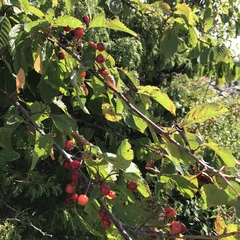 Prunus cerasust0
 Gossypium hirsutum
 Oryza sativa
 Triticum aestivum
 Zea mays