View: List Claim type Research area Organism Taxon as written Decade Paper Observation observed original result measured Claim · model-written summary
Seed surface ultrastructure distinguishes Spergula maxima from Spergula arvensis subsp. arvensis , supporting Spergula arvensis subsp. maxima .
Spergula arvensis subsp. maxima e0 Verbatim
e0 “between Spergula maxima and Spergula arvensis subsp. arvensis , accordingly we propose — Spergula arvensis subsp. maxima
✓ located verbatim in the source · abstract, characters 1538–1657 Other claims from this paper (7) Observation observed original result measured Claim · model-written summary
No seedlings were found within established G. maxima infestations.
No seedlings were found e1 Verbatim
e1 “No seedlings were found within established G. maxima infestations ”
✓ located verbatim in the source · abstract, characters 522–587 Other claims from this paper (6) Observation observed original result basis n/a Claim · model-written summary
A new species, M. maxima , was described from Northern Peru.
Verbatim
e0 “M. maxima
✓ located verbatim in the source · abstract, characters 53–62 t0 “Muhlenbergia and Uniola
✓ located verbatim in the source · title, characters 21–44 e1 “Northern Peru ”
✓ located verbatim in the source · abstract, characters 103–116 Other claims from this paper (2) Observation observed original result positive measured Claim · model-written summary
C. maxima showed high genotypic variability.
genotypic variability e0 Verbatim
e0 “This study proved the existence of high genotypic variability in C. maxima
✓ located verbatim in the source · abstract, characters 1087–1161 Other claims from this paper (3) Observation observed original result measured Claim · model-written summary
Spring nodular activity maxima were 8-250 times summer minima.
native Australian legumes t0 8-250 times summer minima e0 Verbatim
e0 “spring maxima 8-250 times summer minima ”
✓ located verbatim in the source · abstract, characters 455–494 t0 “Native Australian Legumes ”
✓ located verbatim in the source · title, characters 21–46 Other claims from this paper (4) Observation observed original result measured Claim · model-written summary
Briza maxima was classified as a horthophyte and ergasiofigophyte.
horthophyte and ergasiofigophyte e0 Verbatim
e0 “B. maxima as horthophyte and ergasiofigophyte ”
✓ located verbatim in the source · abstract, characters 1168–1213 e1 “Briza maxima L. ”
✓ located verbatim in the source · abstract, characters 466–481 Other claims from this paper (9) Observation observed original result measured Claim · model-written summary
Among the 60 collected accessions, 3 were Cucurbita maxima .
Verbatim
e1 “All the 60 accessions ”
✓ located verbatim in the source · abstract, characters 671–692 e2 “Cucurbita maxima (3) ”
✓ located verbatim in the source · abstract, characters 779–799 Other claims from this paper (12) Observation observed original result measured Claim · model-written summary
Aneura maxima is newly reported from Thailand.
Verbatim
e0 “one hepatic (Aneura maxima ) ”
✓ located verbatim in the source · abstract, characters 76–103 Other claims from this paper (1) Intervention effect observed original result positive measured Claim · model-written summary
Fertilization had a more positive effect on Glyceria maxima .
Not reported Comparator
Verbatim
e0 “fertilization had a more positive effect on G. maxima
✓ located verbatim in the source · abstract, characters 1839–1892 t0 “Carex acuta and Glyceria maxima
✓ located verbatim in the source · title, characters 70–101 Other claims from this paper (9) Observation observed original result basis n/a Claim · model-written summary
Porella maxima is a new combination.
Verbatim
e7 “P. maxima (Steph.) M. L. So, comb. nov. ”
✓ located verbatim in the source · abstract, characters 312–351 Other claims from this paper (10) Lexical search (BM25). All words must match; if nothing does, any word. Organism names also match every spelling of the same organism. No semantic search yet.
 Glyceria maxima
 Citrus maxima
 Briza maxima
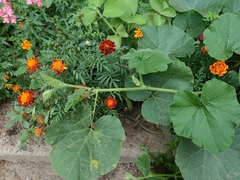 Cucurbita maxima
 Aneura maxima