View: List Claim type Research area Organism Taxon as written Decade Paper Observation observed original result measured Claim · model-written summary
Laboratory germination maxima preceded field emergence maxima by 12 to 26 days.
laboratory germination test maxima e0 field emergence maxima e0 Verbatim
e0 “laboratory germination test maxima preceded field emergence maxima by 12 to 26 d. ”
✓ located verbatim in the source · abstract, characters 1050–1131 t0 “Sweet Corn ”
✓ located verbatim in the source · title, characters 81–91 Other claims from this paper (16) Method / resource observed original result negative simulated Claim · model-written summary
That adjustment gave predicted maxima about 25% below observations.
predicted maxima e0 observed maxima e0 Not reported Taxon
Verbatim
e0 “predicted maxima approximately 25% less than the observed maxima ”
✓ located verbatim in the source · abstract, characters 1308–1372 Other claims from this paper (5) Observation observed original result basis n/a Claim · model-written summary
A new species, M. maxima , was described from Northern Peru.
Verbatim
e0 “M. maxima
✓ located verbatim in the source · abstract, characters 53–62 t0 “Muhlenbergia and Uniola
✓ located verbatim in the source · title, characters 21–44 e1 “Northern Peru ”
✓ located verbatim in the source · abstract, characters 103–116 Other claims from this paper (2) Observation observed original result basis n/a Claim · model-written summary
Key characters distinguish Aneura maxima from A. pinguis
key characters distinguishing A. maxima from A. pinguis e2 Verbatim
e1 “Aneura maxima (Schiffn.) Steph. has been discovered for the first time in Europe in the Belgian part of the Ardennes Massif ”
✓ located verbatim in the source · abstract, characters 9–132 e2 “key characters distinguishing A. maxima from A. pinguis are summarized ”
✓ located verbatim in the source · abstract, characters 321–391 Other claims from this paper (2) Observation observed original result measured Claim · model-written summary
The PCB adduct had blue-shifted absorption maxima .
absorption maxima e0 Verbatim
e0 “the PCB adduct exhibiting blue-shifted absorption maxima . ”
✓ located verbatim in the source · abstract, characters 912–969 t0 “Oat ”
✓ located verbatim in the source · title, characters 73–76 Other claims from this paper (9) Observation observed original result basis n/a Claim · model-written summary
The correct name for Thysanolaena maxima is T. latifolia .
Verbatim
e1 “The correct name for Thysanolaena maxima (Roxb.) O. Ktze is T. latifolia (Roxb. ex Hornem.) Honda ”
✓ located verbatim in the source · abstract, characters 944–1041 Other claims from this paper (7) Observation author interpretation original result basis n/a Claim · model-written summary
The two Thapsia maxima types represent one chemotype within the genus Thapsia .
one chemotype within the genus Thapsia e3 Verbatim
e3 “indicating that T. maxima I and II represent one chemotype within the genus Thapsia ”
✓ located verbatim in the source · abstract, characters 434–517 Other claims from this paper (4) Observation observed original result measured Claim · model-written summary
C. maxima Prize Winner yielded well across all locations.
Verbatim
e0 “The C. maxima `Prize Winner' yielded well in all locations ”
✓ located verbatim in the source · abstract, characters 1177–1235 Other claims from this paper (9) Mechanism observed original result negative measured Claim · model-written summary
Glyceria maxima suppressed potential nitrifying activities through ammonium uptake.
Potential nitrifying activities e0 ammonium uptake by the plants e0 Verbatim
e0 “Potential nitrifying activities were suppressed by G. maxima due to ammonium uptake by the plants ”
✓ located verbatim in the source · abstract, characters 773–870 Other claims from this paper (8) Observation observed original result measured Claim · model-written summary
Cucurbita maxima sporopollenin structure changed only slightly during pollen wall development.
sporopollenin structure e0 slight changes e0 Verbatim
e0 “Only slight changes in sporopollenin structure could be recognized during pollen wall development of Cucurbita maxima . ”
✓ located verbatim in the source · abstract, characters 478–596 Other claims from this paper (3) Lexical search (BM25). All words must match; if nothing does, any word. Organism names also match every spelling of the same organism. No semantic search yet.
 Aneura maxima
 Avena sativa
 Thysanolaena latifolia
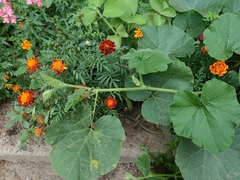 Cucurbita maxima
 Glyceria maxima