View: List Claim type Research area Organism Taxon as written Decade Paper Observation observed original result measured Claim · model-written summary
Silica accumulated in knobs and a thin layer below the cuticula.
knobs and in a thin layer below the cuticula e0 Accumulation of silica e0 Verbatim
t0 “Equisetum hyemale
✓ located verbatim in the source · title, characters 42–59 e0 “Accumulation of silica was imaged in the knobs and in a thin layer below the cuticula ”
✓ located verbatim in the source · abstract, characters 877–962 Other claims from this paper (8) Observation observed original result measured Claim · model-written summary
Michaux's plant lists and landscape descriptions are most thorough in the Bluegrass, Knobs and Pennyroyal Regions.
plant lists and landscape descriptions e1 Bluegrass, Knobs, and Pennyroyal Regions e1 Verbatim
e1 “spent in the Bluegrass, Knobs , and Pennyroyal Regions where his plant lists and landscape descriptions are the most thorough ”
✓ located verbatim in the source · abstract, characters 167–291 Other claims from this paper (1) Observation observed original result measured Claim · model-written summary
39 plant communities of Estonian inland sand knobs were described and classified into 7 syntaxonomic units.
classified into 7 syntaxonomic units e1 39 plant communities e1 South-Eastern Estonia e0 Verbatim
e0 “Vegetation of inland sand knobs in South-Eastern Estonia was studied ”
✓ located verbatim in the source · abstract, characters 51–119 e1 “39 plant communities were described and thereafter classified into 7 syntaxonomic units ”
✓ located verbatim in the source · abstract, characters 121–208 Other claims from this paper (7) Mechanism author interpretation original result measured Claim · model-written summary
Maize knobs may be considered megatransposable elements.
maize knob may be consider as megatransposable elements e0 knob polymorphism and complex structure e0 Verbatim
e0 “knob polymorphism and complex structure suggest that maize knob may be consider as megatransposable elements ”
✓ located verbatim in the source · abstract, characters 1773–1881 t0 “maize ”
✓ located verbatim in the source · title, characters 54–59 Other claims from this paper (13) Observation observed original result measured Claim · model-written summary
Primula egaliksensis lacked the ITS-bearing heterochromatic knobs of the maternal parent P. mistassinica .
ITS-bearing heterochromatic knobs e4 characteristic of the maternal parent P. mistassinica e4 Verbatim
e4 “Primula egaliksensis lacked the ITS-bearing heterochromatic knobs characteristic of the maternal parent P. mistassinica and maintained only the rDNA loci of P. nutans ”
✓ located verbatim in the source · abstract, characters 1165–1331 Other claims from this paper (8) Observation observed original result measured Claim · model-written summary
Fruits are straight with green-white skin, few knobs and spines, and a podgy caput.
podgy fruit caput, green-white skin, few small knobs and spines e0 Verbatim
e0 “Fruits are straight with 30 cm in length, 5 cm in diameter, 280 gram in single fruit, with podgy fruit caput, green-white skin, few small knobs and spines ”
✓ located verbatim in the source · abstract, characters 221–375 t0 “Cucumber Cultivar ”
✓ located verbatim in the source · title, characters 21–38 Other claims from this paper (10) Observation observed original result measured Claim · model-written summary
The L line had more TR-1 knobs than the H line.
Verbatim
e0 “they differ in the TR-1 350-bp repeat, the L line having more TR-1 knobs . ”
✓ located verbatim in the source · abstract, characters 1009–1082 t0 “maize ”
✓ located verbatim in the source · title, characters 37–42 Other claims from this paper (7) Observation observed original result measured Claim · model-written summary
RN frequency at knobs was similar to or above average SC frequency.
frequency of RNs at knobs e0 similar to or higher e0 average frequency of RNs along the SCs e0 Verbatim
e0 “The frequency of RNs at knobs is either similar to or higher than the average frequency of RNs along the SCs ”
✓ located verbatim in the source · abstract, characters 1165–1273 t0 “Zea mays
✓ located verbatim in the source · title, characters 52–60 Other claims from this paper (7) Observation observed original result negative significant (as stated) measured Claim · model-written summary
The wheat-rye addition line had significantly fewer wheat-origin perinucleolar rDNA knobs .
wheat-rye addition line e0 number of wheat-origin perinucleolar rDNA knobs e0 Verbatim
e0 “in the wheat-rye addition line there is a significant decrease in the number of wheat-origin perinucleolar rDNA knobs ”
✓ located verbatim in the source · abstract, characters 1404–1521 Other claims from this paper (5) Observation observed original result measured Claim · model-written summary
Seven heterozygous knobs containing 180-bp repeats were detected in the chromosomes of all materials tested.
chromosomes e1 heterozygous knobs containing 180-bp repeats e1 Verbatim
e0 “Knobs are blocks of heterochromatin present on chromosomes of maize (Zea mays L.) ”
✓ located verbatim in the source · abstract, characters 10–91 e1 “Signals of seven heterozygous knobs containing 180-bp repeats and of one heterozygous knob containing TR-1 were captured in chromosomes of all materials tested according to the results of FISH ”
✓ located verbatim in the source · abstract, characters 466–658 Other claims from this paper (4) Lexical search (BM25). All words must match; if nothing does, any word. Organism names also match every spelling of the same organism. No semantic search yet.
 Equisetum hyemalet0
 Zea mays
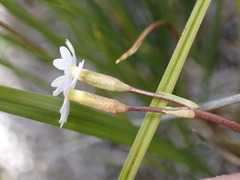 Primula egaliksensis
 Cucumis sativus