“Chitosan, (Biochikol 020 PC) a potential elicitor of plant defence and also an active inhibitor of fungal growth was used in experiments. The compound was used at concentrations 0.01 to 0.2% as a plant spray for rose protection against Sphaerotheca pannosa var. rosae, Peronospora sparsa and Diplocarpon rosae, Oidium chrysanthemi and Puccinia horiana on chrysanthemum, against Melampsora epitea on willow. Myrothecium r…” Show full quote
“Enrichment of CO2 to 46 mmol m-3 (1000 mm3 dm-3) at a moderate photosynthetic photon flux (PPF) of 450 micromoles m-2 s-1 stimulated fresh and dry weight gain of lettuce leaves 39% to 75% relative to plants at 16 mmol m-3 CO2 (350 mm3 dm-3).”
e1
“Enrichment of CO2 to 46 mmol m-3 (1000 mm3 dm-3) at a moderate photosynthetic photon flux (PPF) of 450 micromoles m-2 s-1 stimulated fresh and dry weight gain of lettuce leaves 39% to 75% relative to plants at 16 mmol m-3 CO2 (350 mm3 dm-3).”
t0
“Effects of CO2and Photosynthetic Photon Flux on Yield, Gas Exchange and Growth Rate ofLactuca SativaL. ‘Waldmann’s Green”
e2
“Enrichment of CO2 to 46 mmol m-3 (1000 mm3 dm-3) at a moderate photosynthetic photon flux (PPF) of 450 micromoles m-2 s-1 stimulated fresh and dry weight gain of lettuce leaves 39% to 75% relative to plants at 16 mmol m-3 CO2 (350 mm3 dm-3).”
e3
“high PPF of 880-900 micromoles m-2 s-1 gave further, substantial increases in growth, RGR, net assimilation rate (NAR) and photosynthetic rate (Pn), but a decreasein leaf area ratio (LAR), at 46 or 69 mmol m-3 (1000 or 1500 mm3 dm-3) CO2”
e4
“Enrichment of CO2 to a supraoptimal level of 92 mmol m-3 (2000 mm3 dm-3) at high PPF increased leaf area and LAR”
“Chitosan, (Biochikol 020 PC) a potential elicitor of plant defence and also an active inhibitor of fungal growth was used in experiments. The compound was used at concentrations 0.01 to 0.2% as a plant spray for rose protection against Sphaerotheca pannosa var. rosae, Peronospora sparsa and Diplocarpon rosae, Oidium chrysanthemi and Puccinia horiana on chrysanthemum, against Melampsora epitea on willow. Myrothecium r…” Show full quote
“In +M plants, SDW was increased with an increase in salt intensity especially in the first harvesting date”
e1
“In a greenhouse experiment, plant growth and rates of uptake and root to shoot transport of chloride and sodium were investigated in seedlings of pistachio (Pistacia vera cv. Badami-Riz-Zarand) inoculated with Glomus mosseae and exposed for 21 and 42 days with four salinity levels (0.5, 3.0, 6.0 and 9.0 dSm-1).”
e2
“Mycorrhizal (+M) plants maintained greater root and shoot biomass at all salinity levels compared to non-mycorrhizal (-M) plants”
e3
“In -M plants, salt intensity had no significant effect on shoot dry weight (SDW) and leaf dry weight (LDW) on each of harvesting dates but root dry weight (RDW) showed a significant decrease at the highest salinity level 42 days after the start of salt treatment (DAT) in comparison with control (EC of 0.5 dSm-1).”
e4
“In +M plants, SDW was increased with an increase in salt intensity especially in the first harvesting date.”
e5
“In conclusion, the study indicates that pistachio tolerance to salt stress is improved by mycorrhizal colonization, although the salinity levels used in this work could not induce biomass reduction in -M pistachio plants, higher levels of salinity should be investigated in order to optimize the effect of this symbiosis.”
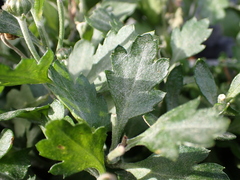
Chitosan treatment of rose against Sphaerotheca pannosa var. rosae gave about 32% rose powdery mildew symptoms response under 2-times at 7-day-intervals.
“Chitosan, (Biochikol 020 PC) a potential elicitor of plant defence and also an active inhibitor of fungal growth was used in experiments. The compound was used at concentrations 0.01 to 0.2% as a plant spray for rose protection against Sphaerotheca pannosa var. rosae, Peronospora sparsa and Diplocarpon rosae, Oidium chrysanthemi and Puccinia horiana on chrysanthemum, against Melampsora epitea on willow. Myrothecium r…” Show full quote
“In order to obtain an insight into the damage of thylakoid membranes of spruce (Picea abies) trees with damage of varying intensity, investigations were performed on the content of Q в -protein, cytochrome f, and P-700 in chloroplasts of spruce needles from apparently healthy and from damaged trees”
e1
“The investigations were carried out in 1986 on a 20 to 25-year-old spruce plantation in the Hunsriick mountains and on an 80-year-old spruce plantation in the Westerwald mountains”
e2
“In damaged trees an unequivocal decreasein the content of Q в -protein, cytochrome f, and P-700 was found, even in needle groups that appear visibly green and healthy”
e3
“The amount of cytochrome f decreased by 25% per dry weight (approximately to the same extent as chlorophyll); the content of Q в -protein and P-700, however, were more drastically reduced compared to the control trees (about 40% and 50%, respectively)”
“Enrichment of CO2 to 46 mmol m-3 (1000 mm3 dm-3) at a moderate photosynthetic photon flux (PPF) of 450 micromoles m-2 s-1 stimulated fresh and dry weight gain of lettuce leaves 39% to 75% relative to plants at 16 mmol m-3 CO2 (350 mm3 dm-3).”
e1
“Enrichment of CO2 to 46 mmol m-3 (1000 mm3 dm-3) at a moderate photosynthetic photon flux (PPF) of 450 micromoles m-2 s-1 stimulated fresh and dry weight gain of lettuce leaves 39% to 75% relative to plants at 16 mmol m-3 CO2 (350 mm3 dm-3).”
t0
“Effects of CO2and Photosynthetic Photon Flux on Yield, Gas Exchange and Growth Rate ofLactuca SativaL. ‘Waldmann’s Green”
e2
“Enrichment of CO2 to 46 mmol m-3 (1000 mm3 dm-3) at a moderate photosynthetic photon flux (PPF) of 450 micromoles m-2 s-1 stimulated fresh and dry weight gain of lettuce leaves 39% to 75% relative to plants at 16 mmol m-3 CO2 (350 mm3 dm-3).”
e3
“high PPF of 880-900 micromoles m-2 s-1 gave further, substantial increases in growth, RGR, net assimilation rate (NAR) and photosynthetic rate (Pn), but a decreasein leaf area ratio (LAR), at 46 or 69 mmol m-3 (1000 or 1500 mm3 dm-3) CO2”
e4
“Enrichment of CO2 to a supraoptimal level of 92 mmol m-3 (2000 mm3 dm-3) at high PPF increased leaf area and LAR”
“Rates of uptake and root to shoot transport of Cl- and Na+ were markedly lower in +M than in -M plants”
e1
“In a greenhouse experiment, plant growth and rates of uptake and root to shoot transport of chloride and sodium were investigated in seedlings of pistachio (Pistacia vera cv. Badami-Riz-Zarand) inoculated with Glomus mosseae and exposed for 21 and 42 days with four salinity levels (0.5, 3.0, 6.0 and 9.0 dSm-1).”
e2
“Mycorrhizal (+M) plants maintained greater root and shoot biomass at all salinity levels compared to non-mycorrhizal (-M) plants”
e3
“In -M plants, salt intensity had no significant effect on shoot dry weight (SDW) and leaf dry weight (LDW) on each of harvesting dates but root dry weight (RDW) showed a significant decrease at the highest salinity level 42 days after the start of salt treatment (DAT) in comparison with control (EC of 0.5 dSm-1).”
e4
“In +M plants, SDW was increased with an increase in salt intensity especially in the first harvesting date.”
e5
“In conclusion, the study indicates that pistachio tolerance to salt stress is improved by mycorrhizal colonization, although the salinity levels used in this work could not induce biomass reduction in -M pistachio plants, higher levels of salinity should be investigated in order to optimize the effect of this symbiosis.”
“Pre-harvest sprouting (PHS) reduces yields and grain quality, resulting in seriously economic losses in wheat. It has been showed that PHS is significantly correlated to seed dormancy levels. FUSCA3 (FUS3) gene is considered to be the key regulator of seed dormancy. However, little information is available about the function of FUS3 gene (TaFUS3) in wheat. In this study, three homologous genes were identified in whea…” Show full quote
“designated TaFUS3-3A, TaFUS3-3B and TaFUS3-3D, were first isolated from common wheat”
e1
“Pre-harvest sprouting (PHS) reduces yields and grain quality, resulting in seriously economic losses in wheat. It has been showed that PHS is significantly correlated to seed dormancy levels. FUSCA3 (FUS3) gene is considered to be the key regulator of seed dormancy. However, little information is available about the function of FUS3 gene (TaFUS3) in wheat. In this study, three homologous genes were identified in whea…” Show full quote
Lexical search (BM25). All words must match; if nothing does, any word. Organism names also match every spelling of the same organism. No semantic search yet.
 Chrysanthemume0
 Golovinomyces chrysanthemie0pathogen
 Lactuca sativa
 Podosphaera pannosa
 Pistacia vera
 Picea abies
 Triticum aestivum