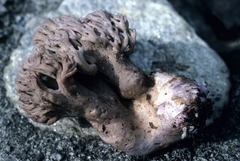
Gomphaceae 14 claims

family · order Gomphales · 5 taxa · NCBI Taxonomy ↗

5 entries

Intervention effectobservedoriginal resultpositivesignificant (as stated)measured

Claim · model-written summary

Gomphus matijun inoculation significantly increased pine seedling root dry weight and first-lateral root number.

Taxon
Pinus massonianaPinus massonianae0
Treatment
inoculated with G. matijune0
Interactor
G. matijunGomphus matijune0symbiont
Outcome
root dry weight and first-lateral root numbere0
Direction
enhancede0

Not reportedComparator

Verbatim

e0

“the root dry weight and first-lateral root number of inoculated seedlings were significantly enhanced by evaluating Pinus massoniana seedlings inoculated with G. matijun”

✓ located verbatim in the source · abstract, characters 685–854

Title

Preliminary exploration on the ectomycorrhizal status of a wild edible Gomphus species from Southwest China

Yangyang Geng; Shixin Zhang; Ningxian Yang; et al. Mycoscience 2023. doi:10.47371/mycosci.2022.12.002

Other claims from this paper (3)
Intervention effectobservedoriginal resultpositivemeasured

Claim · model-written summary

Nine root phytohormone levels were upregulated in inoculated seedlings.

Taxon
Pinus massonianaPinus massonianae1
Organ / stage
rootse0
Treatment
inoculated with G. matijune1
Interactor
G. matijunGomphus matijune1symbiont
Outcome
levels of nine phytohormonese0
Direction
upregulatede0

Not reportedComparator

Verbatim

e0

“the levels of nine phytohormones, including five new phytohormones, in the roots of inoculated seedlings were upregulated”

✓ located verbatim in the source · abstract, characters 867–988
e1

“Pinus massoniana seedlings inoculated with G. matijun”

✓ located verbatim in the source · abstract, characters 801–854

Title

Preliminary exploration on the ectomycorrhizal status of a wild edible Gomphus species from Southwest China

Yangyang Geng; Shixin Zhang; Ningxian Yang; et al. Mycoscience 2023. doi:10.47371/mycosci.2022.12.002

Other claims from this paper (3)
Observationauthor interpretationoriginal resultmeasured

Claim · model-written summary

The authors concluded that G. matijun might be ectomycorrhizal.

Taxon
P. massonianaPinus massonianae1
Interactor
G. matijunGomphus matijune0symbiont
Outcome
ECM funguse0
Qualifier
might bee0

Verbatim

e0

“We concluded that G. matijun might be an ECM fungus”

✓ located verbatim in the source · abstract, characters 1117–1168
e1

“with P. massoniana Lamb.”

✓ located verbatim in the source · abstract, characters 1092–1116

Title

Preliminary exploration on the ectomycorrhizal status of a wild edible Gomphus species from Southwest China

Yangyang Geng; Shixin Zhang; Ningxian Yang; et al. Mycoscience 2023. doi:10.47371/mycosci.2022.12.002

Other claims from this paper (3)
Observationobservedoriginal resultmeasured

Claim · model-written summary

Boletus, Ramaria and Scleroderma each had two associated species.

Taxon
Pinus gerardianaPinus gerardianat0
Interactor
BoletusBoletuse0symbiont
Second interactor
RamariaRamariae0symbiont
Outcome
2 species eache0
Value
2 species eache0
Qualifier
Sclerodermae0

Verbatim

e0

“Boletus, Ramaria and Scleroderma (2 species each)”

✓ located verbatim in the source · abstract, characters 323–372
t0

“Pinus gerardiana”

✓ located verbatim in the source · title, characters 38–54

Title

Ectomycorrhizal fungi associated with Pinus gerardiana in Kinnaur district of Himachal Pradesh, India

A Tapwal Studies in Fungi 2021. doi:10.5943/sif/6/1/32

Other claims from this paper (6)
Observationauthor interpretationoriginal resultmeasured

Claim · model-written summary

Several EMF species were considered likely Pacific Northwest endemics.

Taxon
Pseudotsuga menziesii var. menziesii and Tsuga heterophyllaTsuga heterophyllaPseudotsuga menziesii var. menziesiit0
Interactor
Ramaria , Inocybe and Russula speciesRussulaRamariaInocybee0symbiont
Outcome
likely to be endemic to the Pacific Northweste0

Verbatim

e0

“many of the Ramaria , Inocybe and Russula species are likely to be endemic to the Pacific Northwest”

✓ located verbatim in the source · abstract, characters 1603–1702
t0

“Pseudotsuga menziesii var. menziesii and Tsuga heterophylla forests”

✓ located verbatim in the source · abstract, characters 570–637

Title

Species–area curve and distance–decay relationships indicate habitat thresholds of ectomycorrhizal fungi in an old‐growth Pseudotsuga menziesii landscape

J. M. Kranabetter; S. M. Berch; J. A. MacKinnon; et al. Diversity and Distributions 2018. doi:10.1111/ddi.12720

Other claims from this paper (13)
Observationobservedoriginal resultmeasured

Claim · model-written summary

Ectomycorrhizal root tips of Abies religiosa seedlings inoculated with Turbinellus floccosus were yellow to brownish 3 months after inoculation.

Taxon
Abies religiosaAbies religiosae0
Organ / stage
EM root tipse1
Treatment
inoculatione1
Interactor
Turbinellus floccosusTurbinellus floccosuse0symbiont
Outcome
Yellow to brownishe1
Value
3 moe1
Setting
controlled conditionse0

Verbatim

e0

“The ectomycorrhizal (EM) synthesis between Turbinellus floccosus with Abies religiosa was accomplished under controlled conditions by using seedlings planted in a sterilized peat moss-vermiculite substrate and cultured mycelium”

✓ located verbatim in the source · abstract, characters 0–227
e1

“Yellow to brownish EM root tips were observed 3 mo after inoculation”

✓ located verbatim in the source · abstract, characters 229–297

Title

Mycorrhizal synthesis of the edible mushroom Turbinellus floccosus with Abies religiosa from central Mexico

Valentina Lamus; Sergio Franco; Leticia Montoya; et al. Mycoscience 2015. doi:10.1016/j.myc.2015.07.001

Other claims from this paper (2)
Observationobservedoriginal resultmeasured

Claim · model-written summary

The mycobiont of the synthesized ectomycorrhizas was identified by LSU sequence similarity across basidiomata, synthesized root tips and cultured mycelium.

Taxon
Abies religiosaAbies religiosae0
Material
basidiomata, synthesized EM root tips and inoculated cultured myceliume2
Interactor
Turbinellus floccosusTurbinellus floccosuse0symbiont
Outcome
mycobionte2
Qualifier
sequence similarity of the nuclear large subunit ribosomal RNA gene (LSU)e2

Verbatim

e0

“The ectomycorrhizal (EM) synthesis between Turbinellus floccosus with Abies religiosa was accomplished under controlled conditions by using seedlings planted in a sterilized peat moss-vermiculite substrate and cultured mycelium”

✓ located verbatim in the source · abstract, characters 0–227
e2

“We identified the mycobiont of the synthesized EM through sequence similarity of the nuclear large subunit ribosomal RNA gene (LSU) between three experimental sources: basidiomata, synthesized EM root tips and inoculated cultured mycelium”

✓ located verbatim in the source · abstract, characters 299–537

Title

Mycorrhizal synthesis of the edible mushroom Turbinellus floccosus with Abies religiosa from central Mexico

Valentina Lamus; Sergio Franco; Leticia Montoya; et al. Mycoscience 2015. doi:10.1016/j.myc.2015.07.001

Other claims from this paper (2)
Observationobservedoriginal resultmeasured

Claim · model-written summary

Ramaria fumigata was found in association with Eucalyptus globulus in West Bengal, an association not reported earlier from the region.

Taxon
Eucalyptus globulusEucalyptus globuluse1
Interactor
Ramaria fumigataRamaria fumigatae2other
Outcome
occurrence and associatione1
Setting
West Bengal, Indiae2

Verbatim

e1

“its occurrence and association with Eucalyptus globulus and Acacia auriculiformis was not reported earlier from this region”

✓ located verbatim in the source · abstract, characters 317–440
e2

“Ramaria fumigata, a member of the family Gomphaceae was collected from different places of West Bengal, India”

✓ located verbatim in the source · abstract, characters 174–283

Title

Notes on Ramaria fumigata regarding its occurrence and plant association in West Bengal, India.

Prakash Pradhan; Arun Kumar Dutta; Anirban Roy; et al. Environment and Ecology 2013

Other claims from this paper (1)
Observationobservedoriginal resultmeasured

Claim · model-written summary

Ramaria fumigata was found in association with Acacia auriculiformis in West Bengal, an association not reported earlier from the region.

Taxon
Acacia auriculiformisAcacia auriculiformise1
Interactor
Ramaria fumigataRamaria fumigatae2other
Outcome
occurrence and associatione1
Setting
West Bengal, Indiae2

Verbatim

e1

“its occurrence and association with Eucalyptus globulus and Acacia auriculiformis was not reported earlier from this region”

✓ located verbatim in the source · abstract, characters 317–440
e2

“Ramaria fumigata, a member of the family Gomphaceae was collected from different places of West Bengal, India”

✓ located verbatim in the source · abstract, characters 174–283

Title

Notes on Ramaria fumigata regarding its occurrence and plant association in West Bengal, India.

Prakash Pradhan; Arun Kumar Dutta; Anirban Roy; et al. Environment and Ecology 2013

Other claims from this paper (1)
Observationobservedoriginal resultmeasured

Claim · model-written summary

Ectomycorrhizal types formed by Ramaria botrytis on Pinus densiflora seedlings were simple and dichotomous.

Taxon
Pinus densifloraPinus densiflorat0
Interactor
Ramaria botrytisRamaria botrytist0symbiont
Outcome
Ectomycorrhizal typese1
Qualifier
simple and dichotomouse1

Verbatim

t0

“Ramaria botrytis Using Pinus densiflora”

✓ located verbatim in the source · title, characters 29–68
e1

“Ectomycorrhizal types of the fungus were simple and dichotomous”

✓ located verbatim in the source · abstract, characters 505–568

Title

Ectomycorrhizal Formation of Ramaria botrytis Using Pinus densiflora Seedling

Kang-Hyeon Ka; Suk-Ju Jeong; Hyun Park The Korean Journal of Mycology 2009. doi:10.4489/kjm.2009.37.1.111

Other claims from this paper (4)