Claim · model-written summary
The Nahuelbuta D. fascicularis population was genetically distinct.
- Taxon
- D. fascicularis
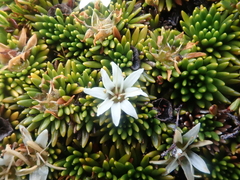 Donatia fascicularise0
- Outcome
- genetically distincte0
- Setting
- Nahuelbuta (Chile)e0
Verbatim
e0“In the case of D. fascicularis , only the northernmost sampled population from Nahuelbuta (Chile) is genetically distinct”
Title
Simon Pfanzelt; Petra Šarhanová; Dirk C. Albach; et al. Journal of Biogeography 2019. doi:10.1111/jbi.13562
Other claims from this paper (7)
- Observation A. pumila populations formed one genetic cluster.
- Observation Other D. fascicularis populations formed a cluster with little substructure.
- Observation Models indicated suitable glacial habitat in south-central Chile.
- Observation Genetic and modelling evidence supports a tabula rasa scenario for the Patagonian Channels.
- Observation The populations survived the last glacial northwest of the ice sheet in south-central Chile.
- Observation Southern regions were recolonized from highly bottlenecked source populations.
- Mechanism Wind-mediated gene flow may also have shaped population genetic patterns.
 Stylidium
 Stylidium piliferum
 Stylidium diversifolium