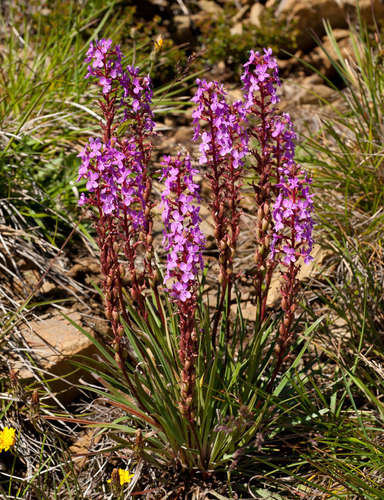
Stylidium armeria 24 claims

species · family Stylidiaceae · green plant · NCBI Taxonomy ↗

Common name: thrift-leaved triggerplant

2 spellings

Stylidium armeria
Stylidium armeriaChris Clarke · CC BY 4.0 · iNaturalist ↗
Associationobservedoriginal resultmeasured

Claim · model-written summary

Allocation to male function increased across the flowering season in Stylidium armeria.

Taxon
Stylidium armeriaStylidium armeriae0
Outcome
allocation to male functione1
Direction
increasede1
Setting
across the seasone1

Verbatim

e0

“We examined the flowering phenology of protandrous Stylidium armeria”

✓ located verbatim in the source · abstract, characters 428–496
e1

“there was a general pattern of increased allocation to male function across the season”

✓ located verbatim in the source · abstract, characters 633–719

Title

Do Pollen and Ovule Number Match the Mating Environment? An Examination of Temporal Change in a Population of Stylidium armeria

Rowan H. Brookes; Linley K. Jesson International Journal of Plant Sciences 2010. doi:10.1086/655770

Other claims from this paper (5)
Associationobservedoriginal resultmeasured

Claim · model-written summary

Early flowers on the earliest plants had the highest pollen/ovule ratio.

Taxon
Stylidium armeriaStylidium armeriae0
Material
earliest plantse2
Organ / stage
early flowerse2
Outcome
pollen/ovule ratioe2
Direction
higheste2

Verbatim

e0

“We examined the flowering phenology of protandrous Stylidium armeria”

✓ located verbatim in the source · abstract, characters 428–496
e2

“early flowers on the earliest plants had the highest pollen/ovule ratio”

✓ located verbatim in the source · abstract, characters 721–792

Title

Do Pollen and Ovule Number Match the Mating Environment? An Examination of Temporal Change in a Population of Stylidium armeria

Rowan H. Brookes; Linley K. Jesson International Journal of Plant Sciences 2010. doi:10.1086/655770

Other claims from this paper (5)
Associationobservedoriginal resultpositivemeasured

Claim · model-written summary

A small number of early flowering female plants increased the probability of pollen transfer from early staminate-phase flowers.

Taxon
Stylidium armeriaStylidium armeriae0
Material
early flowering female plantse3
Outcome
probability of pollen transfere3
Direction
increasinge3

Verbatim

e0

“We examined the flowering phenology of protandrous Stylidium armeria”

✓ located verbatim in the source · abstract, characters 428–496
e3

“had a small number of early flowering female plants, increasing the probability of pollen transfer”

✓ located verbatim in the source · abstract, characters 812–910

Title

Do Pollen and Ovule Number Match the Mating Environment? An Examination of Temporal Change in a Population of Stylidium armeria

Rowan H. Brookes; Linley K. Jesson International Journal of Plant Sciences 2010. doi:10.1086/655770

Other claims from this paper (5)
Associationobservedoriginal resultsignificant (as stated)measured

Claim · model-written summary

Fruit set was significantly influenced by the ratio of staminate to pistillate flowers in the population.

Taxon
Stylidium armeriaStylidium armeriae0
Treatment
ratio of staminate/pistillate flowerse4
Outcome
Fruit sete4

Not reportedDirection

Verbatim

e0

“We examined the flowering phenology of protandrous Stylidium armeria”

✓ located verbatim in the source · abstract, characters 428–496
e4

“Fruit set was significantly influenced by the ratio of staminate/pistillate flowers in the population”

✓ located verbatim in the source · abstract, characters 947–1048

Title

Do Pollen and Ovule Number Match the Mating Environment? An Examination of Temporal Change in a Population of Stylidium armeria

Rowan H. Brookes; Linley K. Jesson International Journal of Plant Sciences 2010. doi:10.1086/655770

Other claims from this paper (5)
Associationobservedoriginal resultpositivemeasured

Claim · model-written summary

Plants flowering earlier than the main population tended to have higher female fitness.

Taxon
Stylidium armeriaStylidium armeriae0
Outcome
female fitnesse5
Direction
higherinferrede5
Comparator
main populatione5

Verbatim

e0

“We examined the flowering phenology of protandrous Stylidium armeria”

✓ located verbatim in the source · abstract, characters 428–496
e5

“plants flowering earlier than the main population tended to have high female fitness”

✓ located verbatim in the source · abstract, characters 1054–1138

Title

Do Pollen and Ovule Number Match the Mating Environment? An Examination of Temporal Change in a Population of Stylidium armeria

Rowan H. Brookes; Linley K. Jesson International Journal of Plant Sciences 2010. doi:10.1086/655770

Other claims from this paper (5)
Mechanismhypothesisoriginal resultbasis n/a

Claim · model-written summary

Low probability of pollen transfer may select for, or maintain, early flowering females in protandrous populations (authors suggest).

Taxon
Stylidium armeriaStylidium armeriae0
Outcome
early flowering femalese6
Qualifier
the low probability of pollen transfere7

Verbatim

e0

“We examined the flowering phenology of protandrous Stylidium armeria”

✓ located verbatim in the source · abstract, characters 428–496
e6

“may select for, or maintain, early flowering females”

✓ located verbatim in the source · abstract, characters 1256–1308
e7

“the low probability of pollen transfer”

✓ located verbatim in the source · abstract, characters 1184–1222

Title

Do Pollen and Ovule Number Match the Mating Environment? An Examination of Temporal Change in a Population of Stylidium armeria

Rowan H. Brookes; Linley K. Jesson International Journal of Plant Sciences 2010. doi:10.1086/655770

Other claims from this paper (5)
Associationobservedoriginal resultmeasured

Claim · model-written summary

Most plants showed a decline in ovule and seed number toward the distal positions on the raceme.

Taxon
Stylidium armeriaStylidium armeriat0
Organ / stage
racemee1
Outcome
ovule and seed numbere1
Direction
declinee1

Verbatim

e1

“Most plants showed a decline in ovule and seed number toward the distal positions on the raceme”

✓ located verbatim in the source · abstract, characters 746–841
t0

“inflorescences of Stylidium armeria”

✓ located verbatim in the source · title, characters 31–66

Title

Reproductive investment within inflorescences of Stylidium armeria varies with the strength of early resource commitment

Rowan H. Brookes; Linley K. Jesson; Martin Burd Annals of Botany 2010. doi:10.1093/aob/mcq026

Other claims from this paper (6)
Associationobservedoriginal resultmeasured

Claim · model-written summary

Racemes with greater basal fruit investment showed a stronger trade-off with distal investment than racemes with smaller initial investment.

Taxon
Stylidium armeriaStylidium armeriat0
Material
racemes with greater investment in basal fruitse2
Outcome
trade-off with distal investmente2
Direction
strongere2
Comparator
racemes that made smaller initial investmentse2

Verbatim

e2

“racemes with greater investment in basal fruits displayed a stronger trade-off with distal investment than did racemes that made smaller initial investments”

✓ located verbatim in the source · abstract, characters 915–1071
t0

“inflorescences of Stylidium armeria”

✓ located verbatim in the source · title, characters 31–66

Title

Reproductive investment within inflorescences of Stylidium armeria varies with the strength of early resource commitment

Rowan H. Brookes; Linley K. Jesson; Martin Burd Annals of Botany 2010. doi:10.1093/aob/mcq026

Other claims from this paper (6)
Associationobservedoriginal resultmeasured

Claim · model-written summary

The trade-off was much stronger for ovule number than for seed number.

Taxon
Stylidium armeriaStylidium armeriat0
Outcome
trade-offe3
Direction
much strongere3
Qualifier
for ovule numbere3
Comparator
seed numbere3

Verbatim

e3

“This trade-off was (a) much stronger for ovule number than for seed number, (b) ameliorated but not erased by resource addition, and (c) exacerbated by resource reduction”

✓ located verbatim in the source · abstract, characters 1073–1243
t0

“inflorescences of Stylidium armeria”

✓ located verbatim in the source · title, characters 31–66

Title

Reproductive investment within inflorescences of Stylidium armeria varies with the strength of early resource commitment

Rowan H. Brookes; Linley K. Jesson; Martin Burd Annals of Botany 2010. doi:10.1093/aob/mcq026

Other claims from this paper (6)
Intervention effectobservedoriginal resultmeasured

Claim · model-written summary

Resource addition ameliorated but did not erase the trade-off between distal and basal fruit investment.

Taxon
Stylidium armeriaStylidium armeriat0
Treatment
resource additione3
Outcome
trade-offe3
Direction
amelioratede3
Qualifier
but not erasede3

Not reportedComparator

Verbatim

e3

“This trade-off was (a) much stronger for ovule number than for seed number, (b) ameliorated but not erased by resource addition, and (c) exacerbated by resource reduction”

✓ located verbatim in the source · abstract, characters 1073–1243
t0

“inflorescences of Stylidium armeria”

✓ located verbatim in the source · title, characters 31–66

Title

Reproductive investment within inflorescences of Stylidium armeria varies with the strength of early resource commitment

Rowan H. Brookes; Linley K. Jesson; Martin Burd Annals of Botany 2010. doi:10.1093/aob/mcq026

Other claims from this paper (6)