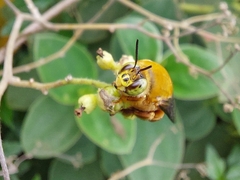
Janusia anisandra 7 claims

species · family Malpighiaceae · green plant · NCBI Taxonomy ↗

2 spellings

Janusia anisandra
Janusia anisandraAlex Popovkin, Bahia, Brazil from Brazil · CC BY 2.0 · Wikimedia Commons ↗
Observationobservedoriginal resultmeasured

Claim · model-written summary

Janusia anisandra individuals bear both right- and left-styled flowers.

Taxon
Janusia anisandraJanusia anisandrae0
Outcome
right and left‐styled flowerse0
Setting
Northeastern Brazile0

Verbatim

e0

“Janusia anisandra (A. Juss.) Griseb (Malpighiaceae) shows right and left‐styled flowers in individuals occurring in an area of tropical dry forest in Northeastern Brazil”

✓ located verbatim in the source · abstract, characters 316–485

Title

Janusia anisandra (A. Juss.) Griseb (Malpighiaceae): The first case of enantiostyly in oil‐flower species

Elisangela Lucia de Santana de Bezerra; Ana Carolina Sabino‐Oliveira; Isabel Cristina Machado Austral Ecology 2023. doi:10.1111/aec.13402

Other claims from this paper (6)
Mechanismauthor interpretationoriginal resultmeasured

Claim · model-written summary

Janusia anisandra has floral traits characteristic of neotropical Malpighiaceae that support a specialized oil-bee pollination system.

Taxon
J. anisandraJanusia anisandrae0
Interactor
oil‐collecting bees of the Centridini tribee0pollinator
Outcome
highly specialized pollination systeme0
Qualifier
morphological traitse0

Verbatim

e0

“J. anisandra has morphological traits that are part of the floral conservatism found in the neotropical species of Malpighiaceae, which preserves features that are decisive for the interaction with oil‐collecting bees of the Centridini tribe, performing a highly specialized pollination system”

✓ located verbatim in the source · abstract, characters 618–911

Title

Janusia anisandra (A. Juss.) Griseb (Malpighiaceae): The first case of enantiostyly in oil‐flower species

Elisangela Lucia de Santana de Bezerra; Ana Carolina Sabino‐Oliveira; Isabel Cristina Machado Austral Ecology 2023. doi:10.1111/aec.13402

Other claims from this paper (6)
Observationobservedoriginal resultmeasured

Claim · model-written summary

The six stamens comprise two major and four smaller stamens, expressing heteranthery.

Taxon
Janusia anisandraJanusia anisandrat0
Organ / stage
stamense0
Outcome
heterantherye0
Value
six stamense0

Verbatim

e0

“The six stamens (two major and four smaller), located in the center of the flower, characterizes heteranthery”

✓ located verbatim in the source · abstract, characters 913–1022
t0

“Janusia anisandra”

✓ located verbatim in the source · title, characters 0–17

Title

Janusia anisandra (A. Juss.) Griseb (Malpighiaceae): The first case of enantiostyly in oil‐flower species

Elisangela Lucia de Santana de Bezerra; Ana Carolina Sabino‐Oliveira; Isabel Cristina Machado Austral Ecology 2023. doi:10.1111/aec.13402

Other claims from this paper (6)
Observationobservedoriginal resultmeasured

Claim · model-written summary

Both floral morphs occur on the same individual, with style displacement to the right or left and one larger stamen.

Taxon
Janusia anisandraJanusia anisandrat0
Organ / stage
stylee0
Outcome
monomorphic enantiostylye0

Verbatim

e0

“We identified the two floral morphs in the same individual, characterizing a monomorphic enantiostyly; each of the morphs differs by lateral displacement of the style to the right or to the left, always accompanied by one larger stamen”

✓ located verbatim in the source · abstract, characters 1156–1391
t0

“Janusia anisandra”

✓ located verbatim in the source · title, characters 0–17

Title

Janusia anisandra (A. Juss.) Griseb (Malpighiaceae): The first case of enantiostyly in oil‐flower species

Elisangela Lucia de Santana de Bezerra; Ana Carolina Sabino‐Oliveira; Isabel Cristina Machado Austral Ecology 2023. doi:10.1111/aec.13402

Other claims from this paper (6)
Observationobservedoriginal resultpositivemeasured

Claim · model-written summary

The species is moderately self-compatible.

Taxon
Janusia anisandraJanusia anisandrat0
Outcome
moderately self‐compatiblee0

Verbatim

e0

“The species is moderately self‐compatible”

✓ located verbatim in the source · abstract, characters 1393–1434
t0

“Janusia anisandra”

✓ located verbatim in the source · title, characters 0–17

Title

Janusia anisandra (A. Juss.) Griseb (Malpighiaceae): The first case of enantiostyly in oil‐flower species

Elisangela Lucia de Santana de Bezerra; Ana Carolina Sabino‐Oliveira; Isabel Cristina Machado Austral Ecology 2023. doi:10.1111/aec.13402

Other claims from this paper (6)
Observationobservedoriginal resultmeasured

Claim · model-written summary

Four Centris bee species visited both floral morphs.

Taxon
J. anisandraJanusia anisandrae0
Interactor
CentrisCentrise0pollinator
Outcome
visiting the two morphse0
Value
Four speciese0

Verbatim

e0

“Four species of solitary bees of the genus Centris were registered visiting the two morphs of J. anisandra flowers”

✓ located verbatim in the source · abstract, characters 1436–1550

Title

Janusia anisandra (A. Juss.) Griseb (Malpighiaceae): The first case of enantiostyly in oil‐flower species

Elisangela Lucia de Santana de Bezerra; Ana Carolina Sabino‐Oliveira; Isabel Cristina Machado Austral Ecology 2023. doi:10.1111/aec.13402

Other claims from this paper (6)
Observationobservedoriginal resultmeasured

Claim · model-written summary

Centris aenea and C. fuscata were the main pollinators and made 65% of visits.

Taxon
Janusia anisandraJanusia anisandrat0
Interactor
Centris aenea and C. fuscataCentris aeneaCentris fuscatae0pollinator
Outcome
visitse0
Value
65%e0

Verbatim

e0

“Centris aenea and C. fuscata were the main pollinators, performing 65% of the visits”

✓ located verbatim in the source · abstract, characters 1552–1636
t0

“Janusia anisandra”

✓ located verbatim in the source · title, characters 0–17

Title

Janusia anisandra (A. Juss.) Griseb (Malpighiaceae): The first case of enantiostyly in oil‐flower species

Elisangela Lucia de Santana de Bezerra; Ana Carolina Sabino‐Oliveira; Isabel Cristina Machado Austral Ecology 2023. doi:10.1111/aec.13402

Other claims from this paper (6)