Stemonaceae 29 claims

family · order Pandanales · 7 taxa · NCBI Taxonomy ↗

7 entries

Observationobservedoriginal resultmeasured

Claim · model-written summary

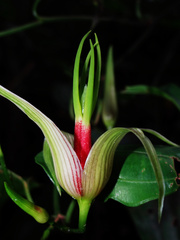
One Stemona species was collected.
Taxon
StemonaStemonae3
Outcome
collectede3
Value
one speciese3

Verbatim

e3

“a total of eighty nine (89) tuber crop species comprising of thirty five (35) yam, twenty eight (28) taro, eight (8) sweet potato, six (6) xanthosoma, five (5) tapioca, four (4) arrow root, two (2) elephant yam and one species of Stemona were collected”

✓ located verbatim in the source · abstract, characters 1054–1306

Title

Exploration and Collection of Root and Tuber Crop Germplasm in Southern Districts of Assam, India

P. Arun Kumar; G.D. Harish; M.N. Sheela; et al. Ecology Environment and Conservation 2024. doi:10.53550/eec.2024.v30i05s.034

Other claims from this paper (12)
Observationobservedoriginal resultbasis n/a

Claim · model-written summary

Preliminary taxonomic studies of Stemonaceae in Assam are presented.

Taxon
StemonaceaeStemonaceaee0
Outcome
preliminary taxonomic studiese0
Setting
Assam regione0

Verbatim

e0

“preliminary taxonomic studies on three more families of the Monocotyledons of Assam region (Taccaceae, Dioscoreaceae and Stemonaceae) are presented here”

✓ located verbatim in the source · abstract, characters 64–216

Title

Materials towards a Monocot Flora of Assam-III. (Taccaceae, Dioscoreaceae & Stemonaceae)

A. S. Rao; D. M. Verma Nelumbo 2024. doi:10.20324/nelumbo/v15/1973/75162

Other claims from this paper (2)
Observationobservedoriginal resultsimulated

Claim · model-written summary

Stemonaceae originated on the Asian mainland in the late Cretaceous and subsequently dispersed to other regions.

Taxon
StemonaceaeStemonaceaee0
Outcome
originated on the Asian mainlande0
Setting
late Cretaceouse0

Verbatim

e0

“Stemonaceae originated on the Asian mainland during the late Cretaceous and then dispersed to North America, the western Malay Archipelago and eastern Malay Archipelago and Australia between the late Cretaceous and Pliocene.”

✓ located verbatim in the source · abstract, characters 858–1082

Title

Invertebrate‐mediated dispersal plays an important role in shaping the current distribution of a herbaceous monocot

Yong‐Sheng Chen; Chun‐Xia Zeng; Alexandra N. Muellner‐Riehl; et al. Journal of Biogeography 2021. doi:10.1111/jbi.14062

Other claims from this paper (2)
Associationobservedoriginal resultpositivesignificant (as stated)measured

Claim · model-written summary

Hornet-dispersed Stemonaceae have broader ranges than ant-dispersed species.

Taxon
StemonaceaeStemonaceaee0
Interactor
hornete0
Outcome
distribution rangese0
Direction
broadere0
Comparator
myrmecochorous speciese0

Verbatim

e0

“Geographical ranges of ant‐ versus hornet‐dispersed Stemonaceae species are significantly different, with vespicochorous species having broader distribution ranges than myrmecochorous species.”

✓ located verbatim in the source · abstract, characters 1083–1275

Title

Invertebrate‐mediated dispersal plays an important role in shaping the current distribution of a herbaceous monocot

Yong‐Sheng Chen; Chun‐Xia Zeng; Alexandra N. Muellner‐Riehl; et al. Journal of Biogeography 2021. doi:10.1111/jbi.14062

Other claims from this paper (2)
Observationobservedoriginal resultpositivemeasured

Claim · model-written summary

Stemona tuberosa elaiosomes emit hydrocarbons attractive to hornets.

Taxon
S. tuberosaStemona tuberosae0
Organ / stage
elaiosomee0
Interactor
hornetse0pollinator
Outcome
emits hydrocarbonse0

Verbatim

e0

“This study demonstrated that the elaiosome of S. tuberosa emits hydrocarbons, which are attractive to hornets.”

✓ located verbatim in the source · abstract, characters 645–755

Title

Hydrocarbons mediate seed dispersal: a new mechanism of vespicochory

Gao Chen; Zheng‐Wei Wang; Ping Wen; et al. New Phytologist 2018. doi:10.1111/nph.15166

Other claims from this paper (3)
Observationobservedoriginal resultmeasured

Claim · model-written summary

The elaiosome hydrocarbons induced antennal responses in naive hornets.

Taxon
Stemona tuberosaStemona tuberosat0
Interactor
hornetse0pollinator
Outcome
responses in the antennae of naive hornetse0

Verbatim

e0

“these compounds, which induce responses in the antennae of naive hornets, are ubiquitous substances on insect cuticle surfaces”

✓ located verbatim in the source · abstract, characters 765–891
t0

“Stemona tuberosa”

✓ located verbatim in the source · abstract, characters 555–571

Title

Hydrocarbons mediate seed dispersal: a new mechanism of vespicochory

Gao Chen; Zheng‐Wei Wang; Ping Wen; et al. New Phytologist 2018. doi:10.1111/nph.15166

Other claims from this paper (3)
Mechanismauthor interpretationoriginal resultpositivemeasured

Claim · model-written summary

Innate preference and experienced foraging behavior of hornets can increase seed dispersal efficiency.

Taxon
Stemona tuberosaStemona tuberosat0
Interactor
hornetse0pollinator
Outcome
seed dispersal efficiencye0
Direction
increasee0
Qualifier
Innate preference and experienced foraging behaviore0

Verbatim

e0

“Innate preference and experienced foraging behavior of hornets can increase their seed dispersal efficiency.”

✓ located verbatim in the source · abstract, characters 893–1001
t0

“Stemona tuberosa”

✓ located verbatim in the source · abstract, characters 555–571

Title

Hydrocarbons mediate seed dispersal: a new mechanism of vespicochory

Gao Chen; Zheng‐Wei Wang; Ping Wen; et al. New Phytologist 2018. doi:10.1111/nph.15166

Other claims from this paper (3)
Observationauthor interpretationoriginal resultpositivemeasured

Claim · model-written summary

Hydrocarbons were identified as a diaspore odor that attracts hornets.

Taxon
Stemona tuberosaStemona tuberosat0
Interactor
hornetse0pollinator
Outcome
diaspore odour involved in the attraction of hornetse0

Verbatim

e0

“This is the first example in which hydrocarbons have been identified as a diaspore odour involved in the attraction of hornets.”

✓ located verbatim in the source · abstract, characters 1002–1129
t0

“Stemona tuberosa”

✓ located verbatim in the source · abstract, characters 555–571

Title

Hydrocarbons mediate seed dispersal: a new mechanism of vespicochory

Gao Chen; Zheng‐Wei Wang; Ping Wen; et al. New Phytologist 2018. doi:10.1111/nph.15166

Other claims from this paper (3)
Observationobservedcited backgroundmeasured

Claim · model-written summary

Hornets are reported as primary long-distance seed dispersers of Stemona tuberosa.

Taxon
Stemona tuberosaStemona tuberosae0
Interactor
hornetse0other
Outcome
primary and long‐distance seed disperserse0

Verbatim

e0

“hornets are the primary and long‐distance seed dispersers in Stemona tuberosa”

✓ located verbatim in the source · abstract, characters 130–207

Title

Cover Caption: Seed dispersal by hornets

Journal of Integrative Plant Biology 2017. doi:10.1111/jipb.12608

Other claims from this paper (1)
Observationobservedcited backgroundmeasured

Claim · model-written summary

Ants are reported as secondary dispersers that take Stemona seeds to safe sites.

Taxon
Stemona tuberosaStemona tuberosae1
Interactor
antsFormicidaee0other
Outcome
secondary dispersers and transport seeds to safe sitese0

Verbatim

e0

“ants act as the secondary dispersers and transport seeds to safe sites”

✓ located verbatim in the source · abstract, characters 214–284
e1

“seed dispersers in Stemona tuberosa”

✓ located verbatim in the source · abstract, characters 172–207

Title

Cover Caption: Seed dispersal by hornets

Journal of Integrative Plant Biology 2017. doi:10.1111/jipb.12608

Other claims from this paper (1)