Claim · model-written summary
The model correctly predicted that Toona, Cañafístola and Petiribi support higher yerba mate harvest yields than the no-tree control.
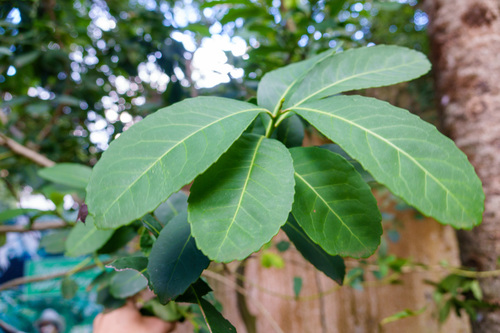
 Ilex paraguariensis
Verbatim
e0“the model reproduces observed relative Ilex paraguariensis yield differences, correctly predicting that Toona , Cañafístola , Petiribi , Anchico , and Kiri support higher harvest yields than the control (no trees)”
Title
Luis R. Comolli; Hugo Fassola Frontiers in Agronomy 2026. doi:10.3389/fagro.2026.1657465
Other claims from this paper (7)
- Method / resource In the simulations, adaptive management gave about 56% higher net productivity than fixed management.
- Method / resource In the simulations, adaptive management shortened the recovery time of soil fertility from about 260 weeks to about 88 weeks.
- Method / resource In the simulations, adaptive management produced nearly threefold higher total biomass than fixed management.
- Observation Starting from degraded soil, both management strategies showed an initial fertility decline followed by recovery driven by endogenous soil organic matter accumulation.
- Method / resource The model reproduced key field-observed patterns with quantitative agreement.
- Method / resource The model correctly predicted that Anchico and Kiri support higher yerba mate harvest yields than the no-tree control.
- Mechanism The simulations indicate the focal crop responds to tree-mediated shade and nutrient inputs while reorganizing soil fertility gradients through biomass extraction and residue return.