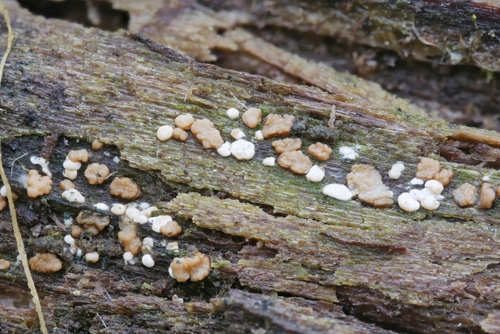
Trichoderma hamatum 19 claims

species · family Hypocreaceae · fungus · NCBI Taxonomy ↗

NCBI synonyms: Verticillium hamatum

Listed here with its subspecies, varieties and cultivar groups: Trichoderma hamatum GD12 (5 claims)

4 spellings

Trichoderma hamatum
Trichoderma hamatumGarrett Taylor · CC0 · iNaturalist ↗
Observationobservedoriginal resultpositivemeasured

Claim · model-written summary

Ham34 showed the strongest antagonism among four Trichoderma isolates.

Taxon
Trichoderma hamatumTrichoderma hamatume0
Material
Ham34e0
Outcome
antagonistic activitye0
Direction
most significante0

Verbatim

e0

“Among them, Ham34 ( Trichoderma hamatum ) showed the most significant antagonistic activity in dual-culture assays.”

✓ located verbatim in the source · abstract, characters 540–655

Title

Synergistic curative effects of Trichoderma hamatum and Rumex dentatus against Alternaria alternata, the causal agent of tomato leaf spot disease

Bassant Philip; Asia R. Eid; Shokry R. Bayoumi; et al. Frontiers in Plant Science 2025. doi:10.3389/fpls.2025.1700051

Other claims from this paper (14)
Observationobservedoriginal resultpositivemeasured

Claim · model-written summary

Ham34 ethyl acetate extract inhibited fungal growth by 57.8% at 2000 µg/mL.

Taxon
Trichoderma hamatumTrichoderma hamatumt0
Material
Ham34e0
Outcome
inhibitione0
Direction
most potente0
Value
57.8%e0
Qualifier
2000 µg/mLe0

Verbatim

e0

“Ham34 showing the most potent inhibition (57.8% at 2000 µg/mL)”

✓ located verbatim in the source · abstract, characters 754–816
t0

“Trichoderma hamatum and Rumex dentatus against Alternaria alternata, the causal agent of tomato leaf spot disease”

✓ located verbatim in the source · title, characters 32–145

Title

Synergistic curative effects of Trichoderma hamatum and Rumex dentatus against Alternaria alternata, the causal agent of tomato leaf spot disease

Bassant Philip; Asia R. Eid; Shokry R. Bayoumi; et al. Frontiers in Plant Science 2025. doi:10.3389/fpls.2025.1700051

Other claims from this paper (14)
Intervention effectobservedoriginal resultmeasured

Claim · model-written summary

The Plumeria alba flower extract reduced growth of T. hamatum by 7–77%.

Taxon
T. hamatumTrichoderma hamatume0
Treatment
The extracte0
Outcome
growthe0
Direction
reductione0
Value
7–77%e0

Not reportedComparator

Verbatim

e0

“The extract was the most effective against T. reesii followed by T. viride, T. harzianum, T. hamatum and T. koningii causing 11–97%, 36–90%, 24–86%, 7–77% and 9–76% reduction in their growth”

✓ located verbatim in the source · abstract, characters 776–966

Title

Potential antimicrobial compounds in flower extract of Plumeria alba

Malik F. H. Ferdosi; Muhammad Kaleem Naseem; Aroosa Afzal; et al. Arabian Journal of Chemistry 2023. doi:10.1016/j.arabjc.2023.104719

Other claims from this paper (19)
Observationobservedoriginal resultmeasured

Claim · model-written summary

Differentially expressed GD12 genes were enriched in transcripts encoding proteins involved in transportation and oxidation-reduction reactions during both biocontrol and plant growth promotion.

Taxon
Trichoderma hamatum GD12Trichoderma hamatum GD12t0
Interactor
Sclerotinia sclerotiorumSclerotinia sclerotiorumt1pathogen
Outcome
transcripts encoding proteins involved in transportation and oxidation-reduction reactionse0
Direction
enrichmente0

Verbatim

e0

“enrichment of transcripts encoding proteins involved in transportation and oxidation-reduction reactions during both processes”

✓ located verbatim in the source · abstract, characters 1117–1243
t0

“Trichoderma hamatum GD12”

✓ located verbatim in the source · title, characters 97–121
t1

“Sclerotinia sclerotiorum”

✓ located verbatim in the source · title, characters 160–184

Title

Transcriptional reprogramming underpins enhanced plant growth promotion by the biocontrol fungus Trichoderma hamatum GD12 during antagonistic interactions with Sclerotinia sclerotiorum in soil

Sophie Shaw; Kate Le Cocq; Konrad Paszkiewicz; et al. Molecular Plant Pathology 2016. doi:10.1111/mpp.12429

Other claims from this paper (5)
Observationobservedoriginal resultmeasured

Claim · model-written summary

Siderophores were over-represented among differentially expressed GD12 genes.

Taxon
Trichoderma hamatum GD12Trichoderma hamatum GD12t0
Outcome
siderophorese0
Direction
over-representatione0

Verbatim

e0

“an over-representation of siderophores”

✓ located verbatim in the source · abstract, characters 1248–1286
t0

“Trichoderma hamatum GD12”

✓ located verbatim in the source · title, characters 97–121

Title

Transcriptional reprogramming underpins enhanced plant growth promotion by the biocontrol fungus Trichoderma hamatum GD12 during antagonistic interactions with Sclerotinia sclerotiorum in soil

Sophie Shaw; Kate Le Cocq; Konrad Paszkiewicz; et al. Molecular Plant Pathology 2016. doi:10.1111/mpp.12429

Other claims from this paper (5)
Observationobservedoriginal resultpositivesignificant (as stated)measured

Claim · model-written summary

A biphasic response during biocontrol showed significant induction of transcripts encoding small-secreted cysteine-rich proteins, secondary metabolite-producing gene clusters and genes unique to GD12.

Taxon
Trichoderma hamatum GD12Trichoderma hamatum GD12t0
Interactor
Sclerotinia sclerotiorumSclerotinia sclerotiorumt1pathogen
Outcome
transcripts encoding small-secreted cysteine-rich proteins, secondary metabolite-producing gene clusters and genes unique to GD12e0
Direction
inductione0

Verbatim

e0

“a significant induction of transcripts encoding small-secreted cysteine-rich proteins, secondary metabolite-producing gene clusters and genes unique to GD12”

✓ located verbatim in the source · abstract, characters 1355–1511
t0

“Trichoderma hamatum GD12”

✓ located verbatim in the source · title, characters 97–121
t1

“Sclerotinia sclerotiorum”

✓ located verbatim in the source · title, characters 160–184

Title

Transcriptional reprogramming underpins enhanced plant growth promotion by the biocontrol fungus Trichoderma hamatum GD12 during antagonistic interactions with Sclerotinia sclerotiorum in soil

Sophie Shaw; Kate Le Cocq; Konrad Paszkiewicz; et al. Molecular Plant Pathology 2016. doi:10.1111/mpp.12429

Other claims from this paper (5)
Mechanismhypothesisoriginal resultbasis n/a

Claim · model-written summary

The data support the hypothesis that Sclerotinia biocontrol by GD12 is mediated by synthesis and secretion of antifungal compounds.

Taxon
Trichoderma hamatum GD12Trichoderma hamatum GD12t0
Compound
antifungal compoundse0
Outcome
Sclerotinia biocontrole0

Verbatim

e0

“Sclerotinia biocontrol is mediated by the synthesis and secretion of antifungal compounds”

✓ located verbatim in the source · abstract, characters 1552–1641
t0

“Trichoderma hamatum GD12”

✓ located verbatim in the source · title, characters 97–121

Title

Transcriptional reprogramming underpins enhanced plant growth promotion by the biocontrol fungus Trichoderma hamatum GD12 during antagonistic interactions with Sclerotinia sclerotiorum in soil

Sophie Shaw; Kate Le Cocq; Konrad Paszkiewicz; et al. Molecular Plant Pathology 2016. doi:10.1111/mpp.12429

Other claims from this paper (5)
Mechanismhypothesisoriginal resultbasis n/a

Claim · model-written summary

The data support the hypothesis that the unique reservoir of uncharacterized genes of GD12 is actively recruited during effective biological control of a plant pathogen.

Taxon
Trichoderma hamatum GD12Trichoderma hamatum GD12t0
Gene
GD12's unique reservoir of uncharacterized genese0
Outcome
effective biological controle0

Verbatim

e0

“GD12's unique reservoir of uncharacterized genes is actively recruited during the effective biological control of a plurivorous plant pathogen”

✓ located verbatim in the source · abstract, characters 1651–1793
t0

“Trichoderma hamatum GD12”

✓ located verbatim in the source · title, characters 97–121

Title

Transcriptional reprogramming underpins enhanced plant growth promotion by the biocontrol fungus Trichoderma hamatum GD12 during antagonistic interactions with Sclerotinia sclerotiorum in soil

Sophie Shaw; Kate Le Cocq; Konrad Paszkiewicz; et al. Molecular Plant Pathology 2016. doi:10.1111/mpp.12429

Other claims from this paper (5)
Intervention effectobservedoriginal resultmeasured

Claim · model-written summary

Trichoderma harzianum, T. hamatum and Alternaria alternata showed maximum colony growth at 0.025% humic acid.

Taxon
Trichoderma harzianum, T. hamatum and Alternaria alternataTrichoderma harzianumAlternaria alternataTrichoderma hamatume1
Treatment
0.025% HAe1
Outcome
growthe1
Direction
maximume1

Not reportedComparator

Verbatim

e1

“Three fungi, Trichoderma harzianum, T. hamatum and Alternaria alternata showed maximum growth at 0.025% HA in the growth medium on the basis of colony diameter”

✓ located verbatim in the source · abstract, characters 1496–1655

Title

Characterization of commercial humic acid samples and their impact on growth of fungi and plants

Asma Lodhi, Shermeen Tahir, Zafar Iqbal, Ansar Mahmood, Muhammad Akhtar, Tariq Mahmood Qureshi, Muhammad Yaqub; Asif Naeem DOAJ (DOAJ: Directory of Open Access Journals) 2013

Other claims from this paper (17)
Associationobservedoriginal resultmeasured

Claim · model-written summary

Growth promotion differences correlated with differences in the small molecule secretome.

Taxon
Trichoderma hamatumTrichoderma hamatumt0
Compound
small molecule secretomee0
Outcome
these differencese0

Not reportedDirection

Verbatim

e0

“these differences correlate with differences in the small molecule secretome.”

✓ located verbatim in the source · abstract, characters 711–788
t0

“Trichoderma hamatum”

✓ located verbatim in the source · title, characters 39–58

Title

Investigating the beneficial traits of Trichoderma hamatum GD12 for sustainable agriculture—insights from genomics

David J. Studholme; Beverley Harris; Kate Le Cocq; et al. Frontiers in Plant Science 2013. doi:10.3389/fpls.2013.00258

Other claims from this paper (8)