Abstract
This study investigated the distribution and characteristics of the Barley yellow dwarf virus (BYDV) species BYDV‐PAS, which was recently separated from BYDV‐PAV, the most commonly studied BYDV species. Throughout 3 years of experimental monitoring of BYDV incidence, PAS was the most frequently occurring species infecting cereals and grasses in the Czech Republic. Furthermore, Rhopalosiphum maidis and Metopolophium dirhodum were recorded as BYDV‐PAS vectors, even though M. dirhodum does not usually transmit BYDV‐PAV. In field experiments with barley and wheat, where virus accumulation, symptoms and effect on the yield were tested, BYDV‐PAV was more severe than PAS. Infection with the BYDV‐PAV isolate resulted in greater expression of symptoms and also in a greater reduction in plant height and grain weight per spike than BYDV‐PAS. In a sensitive cultivar of barley (Graciosa), the amount of viral RNA of BYDV‐PAV was also significantly higher than that of BYDV‐PAS. In a tolerant line (Wbon‐123), however, no such differences were found. In conclusion, although BYDV‐PAS seems to be dominant in the Czech Republic, BYDV‐PAV has the potential to cause more significant crop losses in barley and wheat.
Abstract from the paper’s OpenAlex record, shown for indexing and research. Copyright remains with the authors or the publisher. Read at the source ↗
The text the model read, with the source record’s inline markup (italics, sub- and superscripts) rendered and its character entities decoded; quote offsets refer to the raw text.
Claims 8
Claim · model-written summary
BYDV-PAS was the most frequently occurring BYDV species in cereals and grasses in the Czech Republic.
Verbatim
e0“the Barley yellow dwarf virus (BYDV) species BYDV‐PAS, which was recently separated from BYDV‐PAV”
e1“PAS was the most frequently occurring species infecting cereals and grasses in the Czech Republic”
Claim · model-written summary
Rhopalosiphum maidis was recorded as a vector of BYDV-PAS.
- Taxon
- cereals and grassese1
- Interactor
- Rhopalosiphum maidis
 Rhopalosiphum maidise2pest
- Second interactor
- BYDV‐PASe2pathogen
- Outcome
- recorded as BYDV‐PAS vectorse2
- Qualifier
- Metopolophium dirhodume2
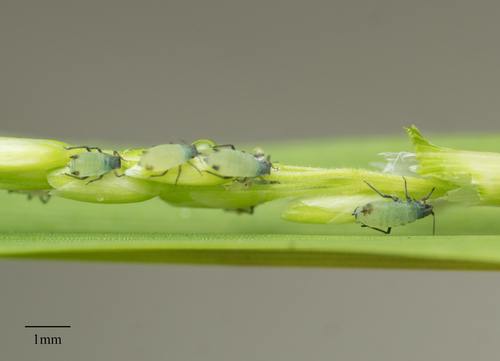
Organisms pictured · Representative pictures of the matched species, not figures from the paper.
Verbatim
e1“PAS was the most frequently occurring species infecting cereals and grasses in the Czech Republic”
e2“Rhopalosiphum maidis and Metopolophium dirhodum were recorded as BYDV‐PAS vectors”
Claim · model-written summary
BYDV-PAV was more severe than BYDV-PAS in barley and wheat field experiments.
- Taxon
- barley and wheat
 Hordeum vulgare
 Triticum aestivume3
- Treatment
- BYDV‐PAVe3
- Interactor
- BYDV‐PAVe3pathogen
- Outcome
- symptomse3
- Direction
- more severee3
- Comparator
- PASe3
Organisms pictured · Representative pictures of the matched species, not figures from the paper.


Verbatim
e3“In field experiments with barley and wheat, where virus accumulation, symptoms and effect on the yield were tested, BYDV‐PAV was more severe than PAS”
Claim · model-written summary
Infection with BYDV-PAV resulted in greater expression of symptoms than BYDV-PAS.
- Taxon
- barley and wheatHordeum vulgareTriticum aestivume3
- Treatment
- Infection with the BYDV‐PAV isolatee4
- Interactor
- BYDV‐PAVe4pathogen
- Outcome
- expression of symptomse4
- Direction
- greatere4
- Comparator
- BYDV‐PASe4
Organisms pictured · Representative pictures of the matched species, not figures from the paper.
Verbatim
e3“In field experiments with barley and wheat, where virus accumulation, symptoms and effect on the yield were tested, BYDV‐PAV was more severe than PAS”
e4“Infection with the BYDV‐PAV isolate resulted in greater expression of symptoms and also in a greater reduction in plant height and grain weight per spike than BYDV‐PAS”
Claim · model-written summary
Infection with BYDV-PAV caused a greater reduction in plant height and grain weight per spike than BYDV-PAS.
- Taxon
- barley and wheatHordeum vulgareTriticum aestivume3
- Treatment
- Infection with the BYDV‐PAV isolatee4
- Interactor
- BYDV‐PAVe4pathogen
- Outcome
- plant height and grain weight per spikee4
- Direction
- greater reductione4
- Comparator
- BYDV‐PASe4
Organisms pictured · Representative pictures of the matched species, not figures from the paper.
Verbatim
e3“In field experiments with barley and wheat, where virus accumulation, symptoms and effect on the yield were tested, BYDV‐PAV was more severe than PAS”
e4“Infection with the BYDV‐PAV isolate resulted in greater expression of symptoms and also in a greater reduction in plant height and grain weight per spike than BYDV‐PAS”
Claim · model-written summary
In sensitive barley cultivar Graciosa, viral RNA of BYDV-PAV was significantly higher than of BYDV-PAS.
- Taxon
- barleyHordeum vulgaree6
- Material
- Graciosae6
- Treatment
- BYDV‐PAVe6
- Interactor
- BYDV‐PAVe6pathogen
- Outcome
- amount of viral RNAe6
- Direction
- highere6
- Comparator
- BYDV‐PASe6
Organisms pictured · Representative pictures of the matched species, not figures from the paper.
Verbatim
e6“In a sensitive cultivar of barley (Graciosa), the amount of viral RNA of BYDV‐PAV was also significantly higher than that of BYDV‐PAS”
Claim · model-written summary
In tolerant barley line Wbon-123, no such differences in viral RNA between BYDV-PAV and BYDV-PAS were found.
- Taxon
- barleyHordeum vulgaree6
- Material
- Wbon‐123e7
- Treatment
- BYDV‐PAVe6
- Interactor
- BYDV‐PAVe6pathogen
- Outcome
- amount of viral RNAe6
- Direction
- no such differencese7
- Comparator
- BYDV‐PASe6
Organisms pictured · Representative pictures of the matched species, not figures from the paper.
Verbatim
e6“In a sensitive cultivar of barley (Graciosa), the amount of viral RNA of BYDV‐PAV was also significantly higher than that of BYDV‐PAS”
e7“In a tolerant line (Wbon‐123), however, no such differences were found”
Claim · model-written summary
BYDV-PAV has the potential to cause more significant crop losses in barley and wheat than BYDV-PAS.
- Taxon
- barley and wheatHordeum vulgareTriticum aestivume2
- Interactor
- BYDV‐PAVe2pathogen
- Outcome
- crop lossese2
- Direction
- more significante2
Organisms pictured · Representative pictures of the matched species, not figures from the paper.
Verbatim
e2“BYDV‐PAV has the potential to cause more significant crop losses in barley and wheat”
The same questions in other papers
infection · molecular: expression · Hordeum vulgare (barley)Positive and negative results
4 papers in the same direction as this paper · 5 in the opposite direction
- positive
- positive
- positive
6 papers more in this group
See all 10 papers →infection · yield · Hordeum vulgare (barley)Positive and negative results
14 papers in the same direction as this paper · 7 in the opposite direction
- positive
- positive
- positive
18 papers more in this group
See all 22 papers →infection · molecular: expression · Triticum aestivum (wheat)Positive and negative results
7 papers in the same direction as this paper · 30 in the opposite direction
- positive
- positive
- positive
34 papers more in this group
See all 38 papers →infection · yield · Triticum aestivum (wheat)Positive and negative results
50 papers in the same direction as this paper · 32 in the opposite direction
- positive
- positive
- positive
79 papers more in this group
See all 83 papers →Claims are grouped by organism, treatment and what was measured or targeted. A paper counts as positive when any of its claims in the group is positive.