Abstract
The plant hormone abscisic acid (ABA) is involved in an array of plant processes, including the regulation of gene expression during adaptive responses to various environmental cues. Apart from its well-established role in abiotic stress adaptation, emerging evidence indicates that ABA is also prominently involved in the regulation and integration of pathogen defense responses. Here, we demonstrate that exogenously administered ABA enhances basal resistance of rice (Oryza sativa) against the brown spot-causing ascomycete Cochliobolus miyabeanus. Microscopic analysis of early infection events in control and ABA-treated plants revealed that this ABA-inducible resistance (ABA-IR) is based on restriction of fungal progression in the mesophyll. We also show that ABA-IR does not rely on boosted expression of salicylic acid-, jasmonic acid -, or callose-dependent resistance mechanisms but, instead, requires a functional Galpha-protein. In addition, several lines of evidence are presented suggesting that ABA steers its positive effect on brown spot resistance through antagonistic cross talk with the ethylene (ET) response pathway. Exogenous ethephon application enhances susceptibility, whereas genetic disruption of ET signaling renders plants less vulnerable to C. miyabeanus attack, thereby inducing a level of resistance similar to that observed on ABA-treated wild-type plants. Moreover, ABA treatment alleviates C. miyabeanus-induced activation of the ET reporter gene EBP89, while derepression of pathogen-triggered EBP89 transcription via RNA interference-mediated knockdown of OsMPK5, an ABA-primed mitogen-activated protein kinase gene, compromises ABA-IR. Collectively, these data favor a model whereby exogenous ABA enhances resistance against C. miyabeanus at least in part by suppressing pathogen-induced ET action in an OsMPK5-dependent manner.
Abstract from the paper’s OpenAlex record; open copy licensed cc-by. Read at the source ↗
The text the model read, with the source record’s inline markup (italics, sub- and superscripts) rendered and its character entities decoded; quote offsets refer to the raw text.
Claims 12
Claim · model-written summary
Exogenous ABA enhanced basal resistance of rice against Cochliobolus miyabeanus relative to control plants.
- Taxon
- rice
 Oryza sativae0
- Treatment
- exogenously administered ABAe0
- Interactor
- Cochliobolus miyabeanus
 Bipolaris oryzaee0pathogen
- Outcome
- basal resistancee0
- Direction
- enhancese0
- Comparator
- controle1
Organisms pictured · Representative pictures of the matched species, not figures from the paper.

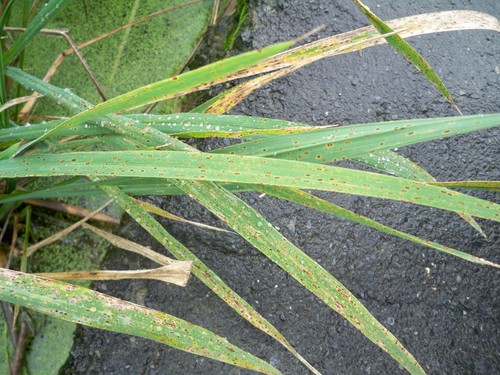
Verbatim
e0“Here, we demonstrate that exogenously administered ABA enhances basal resistance of rice (Oryza sativa) against the brown spot-causing ascomycete Cochliobolus miyabeanus”
e1“Microscopic analysis of early infection events in control and ABA-treated plants”
Claim · model-written summary
ABA-induced resistance restricts fungal progression in the rice mesophyll.
- Taxon
- riceOryza sativae0
- Organ / stage
- mesophylle1
- Interactor
- Cochliobolus miyabeanusBipolaris oryzaee0pathogen
- Outcome
- restriction of fungal progressione1
Organisms pictured · Representative pictures of the matched species, not figures from the paper.
Verbatim
e0“Here, we demonstrate that exogenously administered ABA enhances basal resistance of rice (Oryza sativa) against the brown spot-causing ascomycete Cochliobolus miyabeanus”
e1“this ABA-inducible resistance (ABA-IR) is based on restriction of fungal progression in the mesophyll”
Claim · model-written summary
ABA-induced resistance does not rely on boosted expression of salicylic acid-, jasmonic acid- or callose-dependent resistance mechanisms.
- Taxon
- riceOryza sativae0
- Compound
- salicylic acide1
- Outcome
- boosted expression of salicylic acid-, jasmonic acid -, or callose-dependent resistance mechanismse1
- Qualifier
- does not rely one1
Organisms pictured · Representative pictures of the matched species, not figures from the paper.
Verbatim
e0“Here, we demonstrate that exogenously administered ABA enhances basal resistance of rice (Oryza sativa) against the brown spot-causing ascomycete Cochliobolus miyabeanus”
e1“ABA-IR does not rely on boosted expression of salicylic acid-, jasmonic acid -, or callose-dependent resistance mechanisms”
Claim · model-written summary
ABA-induced resistance requires a functional Galpha-protein in rice.
- Taxon
- riceOryza sativae0
- Gene
- Galpha-proteine1
- Outcome
- ABA-IRe1
Organisms pictured · Representative pictures of the matched species, not figures from the paper.
Verbatim
e0“Here, we demonstrate that exogenously administered ABA enhances basal resistance of rice (Oryza sativa) against the brown spot-causing ascomycete Cochliobolus miyabeanus”
e1“ABA-IR does not rely on boosted expression of salicylic acid-, jasmonic acid -, or callose-dependent resistance mechanisms but, instead, requires a functional Galpha-protein”
Claim · model-written summary
ABA steers its positive effect on rice brown spot resistance through antagonistic cross talk with ethylene signalling.
- Taxon
- riceOryza sativae0
- Compound
- ethylenee1
- Outcome
- brown spot resistancee1
- Qualifier
- antagonistic cross talke1
Organisms pictured · Representative pictures of the matched species, not figures from the paper.
Verbatim
e0“Here, we demonstrate that exogenously administered ABA enhances basal resistance of rice (Oryza sativa) against the brown spot-causing ascomycete Cochliobolus miyabeanus”
e1“ABA steers its positive effect on brown spot resistance through antagonistic cross talk with the ethylene (ET) response pathway”
Claim · model-written summary
Exogenous ethephon application enhances susceptibility of rice to brown spot.
- Taxon
- riceOryza sativae0
- Treatment
- Exogenous ethephon applicatione1
- Outcome
- susceptibilitye1
- Direction
- enhancese1
Not reportedComparator
Organisms pictured · Representative pictures of the matched species, not figures from the paper.
Verbatim
e0“Here, we demonstrate that exogenously administered ABA enhances basal resistance of rice (Oryza sativa) against the brown spot-causing ascomycete Cochliobolus miyabeanus”
e1“Exogenous ethephon application enhances susceptibility”
Claim · model-written summary
Genetic disruption of ET signalling makes rice less vulnerable to Cochliobolus miyabeanus attack.
- Taxon
- riceOryza sativae0
- Treatment
- genetic disruption of ET signalinge1
- Interactor
- C. miyabeanusBipolaris oryzaee1pathogen
- Outcome
- vulnerable to C. miyabeanus attacke1
- Direction
- lesse1
Not reportedComparator
Organisms pictured · Representative pictures of the matched species, not figures from the paper.
Verbatim
e0“Here, we demonstrate that exogenously administered ABA enhances basal resistance of rice (Oryza sativa) against the brown spot-causing ascomycete Cochliobolus miyabeanus”
e1“genetic disruption of ET signaling renders plants less vulnerable to C. miyabeanus attack”
Claim · model-written summary
Genetic disruption of ET signalling gives rice a level of resistance similar to ABA-treated wild-type plants.
- Taxon
- riceOryza sativae0
- Treatment
- genetic disruption of ET signalinge1
- Outcome
- level of resistancee2
- Direction
- similare2
- Comparator
- ABA-treated wild-type plantse2
Organisms pictured · Representative pictures of the matched species, not figures from the paper.
Verbatim
e0“Here, we demonstrate that exogenously administered ABA enhances basal resistance of rice (Oryza sativa) against the brown spot-causing ascomycete Cochliobolus miyabeanus”
e1“genetic disruption of ET signaling renders plants less vulnerable to C. miyabeanus attack”
e2“a level of resistance similar to that observed on ABA-treated wild-type plants”
Claim · model-written summary
ABA treatment alleviates pathogen-induced activation of the ET reporter gene EBP89 in rice.
- Taxon
- riceOryza sativae0
- Treatment
- ABA treatmente1
- Interactor
- C. miyabeanusBipolaris oryzaee1pathogen
- Gene
- EBP89e1
- Outcome
- activation of the ET reporter gene EBP89e1
- Direction
- alleviatese1
Not reportedComparator
Organisms pictured · Representative pictures of the matched species, not figures from the paper.
Verbatim
e0“Here, we demonstrate that exogenously administered ABA enhances basal resistance of rice (Oryza sativa) against the brown spot-causing ascomycete Cochliobolus miyabeanus”
e1“ABA treatment alleviates C. miyabeanus-induced activation of the ET reporter gene EBP89”
Claim · model-written summary
Knockdown of OsMPK5 derepresses pathogen-triggered EBP89 transcription in rice.
- Taxon
- riceOryza sativae0
- Treatment
- RNA interference-mediated knockdown of OsMPK5e1
- Gene
- OsMPK5e1
- Outcome
- pathogen-triggered EBP89 transcriptione1
- Direction
- derepressione1
Not reportedComparator
Organisms pictured · Representative pictures of the matched species, not figures from the paper.
Verbatim
e0“Here, we demonstrate that exogenously administered ABA enhances basal resistance of rice (Oryza sativa) against the brown spot-causing ascomycete Cochliobolus miyabeanus”
e1“derepression of pathogen-triggered EBP89 transcription via RNA interference-mediated knockdown of OsMPK5”
Claim · model-written summary
Knockdown of OsMPK5 compromises ABA-induced resistance in rice.
- Taxon
- riceOryza sativae0
- Treatment
- RNA interference-mediated knockdown of OsMPK5e1
- Gene
- OsMPK5e1
- Outcome
- ABA-IRe2
- Direction
- compromisese2
Not reportedComparator
Organisms pictured · Representative pictures of the matched species, not figures from the paper.
Verbatim
e0“Here, we demonstrate that exogenously administered ABA enhances basal resistance of rice (Oryza sativa) against the brown spot-causing ascomycete Cochliobolus miyabeanus”
e1“derepression of pathogen-triggered EBP89 transcription via RNA interference-mediated knockdown of OsMPK5”
e2“compromises ABA-IR”
Claim · model-written summary
ABA enhances rice resistance to Cochliobolus miyabeanus at least in part by suppressing pathogen-induced ET action in an OsMPK5-dependent manner (model).
- Taxon
- riceOryza sativae0
- Interactor
- C. miyabeanusBipolaris oryzaee1pathogen
- Gene
- OsMPK5e1
- Outcome
- resistance against C. miyabeanuse1
- Qualifier
- at least in part by suppressing pathogen-induced ET actione1
Organisms pictured · Representative pictures of the matched species, not figures from the paper.
Verbatim
e0“Here, we demonstrate that exogenously administered ABA enhances basal resistance of rice (Oryza sativa) against the brown spot-causing ascomycete Cochliobolus miyabeanus”
e1“Collectively, these data favor a model whereby exogenous ABA enhances resistance against C. miyabeanus at least in part by suppressing pathogen-induced ET action in an OsMPK5-dependent manner”
The same questions in other papers
(2-chloroethyl)phosphonic acid · disease · Oryza sativa (rice)Positive and negative results
2 papers in the same direction as this paper · 4 in the opposite direction
- positive
- positive
- positive
3 papers more in this group
See all 7 papers →loss of function · Bipolaris oryzae · Oryza sativa (rice)Positive and negative results
1 paper in the same direction as this paper · 2 in the opposite direction
- negative
- negative
- positive
Claims are grouped by organism, treatment and what was measured or targeted. A paper counts as positive when any of its claims in the group is positive.