Abstract
ABSTRACT: Among various weed management strategies, chemical weed control is considered the most effective method. However, optimum dose and suitable combination of herbicide with adjuvants play a vital role in controlling weeds at an acceptable level and produce maximum crop yield. A field study was conducted to investigate the effect of post-emergence herbicide isoproturon alone or with combination of adjuvants on winter wheat and its associated weeds. The treatments were isoproturon at 175 g a.i. ha-1, 140 g a.i. ha-1 and 105 g a.i. ha-1 applied alone or with adjuvants Ad-500 or Bio-enhancer at 400 mL ha-1 each and weedy check as a control treatment. Isoproturon at 175 g a.i. ha-1 + Bio-enhancer at 400 mL ha-1 was most effective treatment for control of Melilotus indica, Anagallis arvensis, Phalaris minor and Fumaria indica as it decreased the photosynthetic activity, fresh and dry biomass of these weeds. In case of wheat, highest productive tillers, plant height, 1000-grain weight, biological and grain yield were achieved with isoproturon at 175 g a.i. ha-1 + Bio-enhancer at 400 mL ha-1. However, highest values of gas exchange parameters of wheat were observed where no herbicide was sprayed. It can be concluded that isoproturon at 175 g a.i. ha-1 + Bio-enhancer at 400 mL ha-1 might be a profitable approach to achieve optimal yield of wheat by causing the maximum suppression of these tested weeds. Moreover, the herbicide at reduced dose with adjuvants was not much effective in terms of weed control or increased yield.
Abstract from the paper’s OpenAlex record; open copy licensed cc-by-nc. Read at the source ↗
The text the model read, with the source record’s inline markup (italics, sub- and superscripts) rendered and its character entities decoded; quote offsets refer to the raw text.
Claims 6
Claim · model-written summary
Isoproturon at 175 g a.i. ha-1 with Bio-enhancer at 400 mL ha-1 decreased photosynthetic activity, fresh and dry biomass of the tested weeds compared with the weedy check.
- Taxon
- wheat
 Triticum aestivume3
- Treatment
- Isoproturon at 175 g a.i. ha-1 + Bio-enhancer at 400 mL ha-1e1
- Interactor
- Melilotus indica, Anagallis arvensis, Phalaris minor and Fumaria indica
 Lysimachia arvensis
 Melilotus indicus
 Phalaris minor
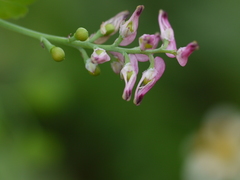 Fumaria indicae1weed
- Outcome
- photosynthetic activity, fresh and dry biomasse1
- Direction
- decreasede1
- Comparator
- weedy checke2
- Setting
- fielde4
Organisms pictured · Representative pictures of the matched species, not figures from the paper.


Verbatim
e1“Isoproturon at 175 g a.i. ha-1 + Bio-enhancer at 400 mL ha-1 was most effective treatment for control of Melilotus indica, Anagallis arvensis, Phalaris minor and Fumaria indica as it decreased the photosynthetic activity, fresh and dry biomass of these weeds”
e2“and weedy check as a control treatment”
e3“on winter wheat and its associated weeds”
e4“A field study was conducted”
Claim · model-written summary
Isoproturon at 175 g a.i. ha-1 with Bio-enhancer at 400 mL ha-1 gave the highest productive tillers, plant height and 1000-grain weight of wheat.
- Taxon
- wheatTriticum aestivume3
- Treatment
- isoproturon at 175 g a.i. ha-1 + Bio-enhancer at 400 mL ha-1e2
- Outcome
- productive tillers, plant height, 1000-grain weighte1
- Direction
- higheste1
- Setting
- fielde4
Not reportedComparator
Organisms pictured · Representative pictures of the matched species, not figures from the paper.
Verbatim
e1“highest productive tillers, plant height, 1000-grain weight”
e2“biological and grain yield were achieved with isoproturon at 175 g a.i. ha-1 + Bio-enhancer at 400 mL ha-1”
e3“on winter wheat and its associated weeds”
e4“A field study was conducted”
Claim · model-written summary
Isoproturon at 175 g a.i. ha-1 with Bio-enhancer at 400 mL ha-1 gave the highest biological and grain yield of wheat.
- Taxon
- wheatTriticum aestivume3
- Treatment
- isoproturon at 175 g a.i. ha-1 + Bio-enhancer at 400 mL ha-1e2
- Outcome
- biological and grain yielde2
- Direction
- higheste1
- Setting
- fielde4
Not reportedComparator
Organisms pictured · Representative pictures of the matched species, not figures from the paper.
Verbatim
e1“highest productive tillers, plant height, 1000-grain weight”
e2“biological and grain yield were achieved with isoproturon at 175 g a.i. ha-1 + Bio-enhancer at 400 mL ha-1”
e3“on winter wheat and its associated weeds”
e4“A field study was conducted”
Claim · model-written summary
Wheat gas exchange parameters were highest where no herbicide was sprayed.
- Taxon
- wheatTriticum aestivume2
- Treatment
- no herbicide was sprayede1
- Outcome
- gas exchange parameterse1
- Direction
- higheste1
Not reportedComparator
Organisms pictured · Representative pictures of the matched species, not figures from the paper.
Verbatim
e1“highest values of gas exchange parameters of wheat were observed where no herbicide was sprayed”
e2“on winter wheat and its associated weeds”
Claim · model-written summary
Isoproturon at 175 g a.i. ha-1 with Bio-enhancer at 400 mL ha-1 might be a profitable approach to achieve optimal wheat yield.
- Taxon
- wheatTriticum aestivume2
- Treatment
- isoproturon at 175 g a.i. ha-1 + Bio-enhancer at 400 mL ha-1e1
- Outcome
- profitable approach to achieve optimal yield of wheate1
Organisms pictured · Representative pictures of the matched species, not figures from the paper.
Verbatim
e1“It can be concluded that isoproturon at 175 g a.i. ha-1 + Bio-enhancer at 400 mL ha-1 might be a profitable approach to achieve optimal yield of wheat”
e2“on winter wheat and its associated weeds”
Claim · model-written summary
The herbicide at reduced dose with adjuvants was not much effective for weed control or increased yield.
- Taxon
- wheatTriticum aestivume2
- Treatment
- the herbicide at reduced dose with adjuvantse1
- Outcome
- weed control or increased yielde1
- Direction
- not much effectivee1
Not reportedComparator
Organisms pictured · Representative pictures of the matched species, not figures from the paper.
Verbatim
e1“the herbicide at reduced dose with adjuvants was not much effective in terms of weed control or increased yield”
e2“on winter wheat and its associated weeds”
The same questions in other papers
isoproturon · yield · Triticum aestivum (wheat)Results differ
74 papers in the same direction as this paper · 7 in the opposite direction · 7 reporting no difference from an alternative
- negative
- negative
- positive
85 papers more in this group
See all 89 papers →adjuvant · weed · Triticum aestivum (wheat)Positive and negative results
1 paper in the same direction as this paper · 5 in the opposite direction
- positive
- positive
- positive
3 papers more in this group
See all 7 papers →isoproturon · Phalaris minor · Triticum aestivum (wheat)Positive and negative results
17 papers in the same direction as this paper · 6 in the opposite direction
- negative
- negative
- negative
20 papers more in this group
See all 24 papers →application · physiology: gas exchange · Triticum aestivum (wheat)Positive and negative results
20 papers in the same direction as this paper · 2 in the opposite direction
- negative
- negative
- positive
19 papers more in this group
See all 23 papers →herbicide · weed · Triticum aestivum (wheat)Positive and negative results
38 papers in the same direction as this paper · 362 in the opposite direction
- positive
- positive
- positive
397 papers more in this group
See all 401 papers →Claims are grouped by organism, treatment and what was measured or targeted. A paper counts as positive when any of its claims in the group is positive.