Abstract
Aphids are serious pests of a wide range of agricultural crops, including pomegranates and grapevines. In addition, due to the negative environmental impacts of chemical insecticides, these pests are developing important resistance against aphicides. Therefore, one alternative method to control aphids is the use of essential oils (EO). The present study aimed to evaluate the insecticidal activity of Citrus aurantium and C. reticulata peel EO at different concentrations and with different exposure periods to pomegranate and grapevine aphids, Aphis punicae and A. illinoisensis via the topical application method under laboratory conditions. The results reveal that C. aurantium L. EO had greater toxicity against pomegranate and grapevine aphids, with LC50 of 0.37 and 0.82 μL/mL, respectively, at 48 h after application. The highest repellence effect was estimated for C. aurantium EO, at 2.5 μL/cm2, on A. punicae, with a value of 100% after an exposure time of 3 h, in contrast to the 88% repellence estimated for A. illinoisensis. The GC-MS investigation of both essential oils identified limonene, 3-carene, pinene, and p-cymene as active substances that could be attributed to the effects observed. Overall, our results offer a potential tool to control the two aphid species and could help in the development of integrated insect management in pomegranate and grapevine fields.
Abstract from the paper’s OpenAlex record; open copy licensed cc-by. Read at the source ↗
The text the model read, with the source record’s inline markup (italics, sub- and superscripts) rendered and its character entities decoded; quote offsets refer to the raw text.
Claims 6
Claim · model-written summary
Citrus aurantium essential oil was more toxic to pomegranate aphids (Aphis punicae), LC50 0.37 μL/mL at 48 h.
- Taxon
- pomegranate
 Punica granatume0
- Treatment
- C. aurantium L. EOe1
- Interactor
- Aphis punicae
 Aphis punicaee2pest
- Outcome
- toxicitye1
- Direction
- greatere1
- Value
- 0.37e1
- Qualifier
- at 48 h after applicatione1
Not reportedComparator
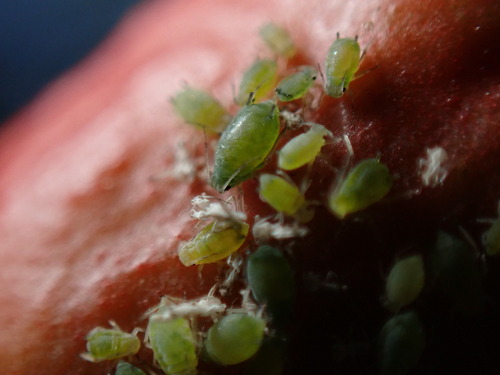
Organisms pictured · Representative pictures of the matched species, not figures from the paper.

Verbatim
e0“Aphids are serious pests of a wide range of agricultural crops, including pomegranates and grapevines”
e1“C. aurantium L. EO had greater toxicity against pomegranate and grapevine aphids, with LC50 of 0.37 and 0.82 μL/mL, respectively, at 48 h after application”
e2“pomegranate and grapevine aphids, Aphis punicae and A. illinoisensis”
Claim · model-written summary
Citrus aurantium essential oil was more toxic to grapevine aphids (A. illinoisensis), LC50 0.82 μL/mL at 48 h.
- Treatment
- C. aurantium L. EOe1
- Interactor
- A. illinoisensis
 Aphis illinoisensise2pest
- Outcome
- toxicitye1
- Direction
- greatere1
- Value
- 0.82e1
- Qualifier
- at 48 h after applicatione1
 Vitis
Not reportedComparator
Organisms pictured · Representative pictures of the matched species, not figures from the paper.


Verbatim
e0“Aphids are serious pests of a wide range of agricultural crops, including pomegranates and grapevines”
e1“C. aurantium L. EO had greater toxicity against pomegranate and grapevine aphids, with LC50 of 0.37 and 0.82 μL/mL, respectively, at 48 h after application”
e2“pomegranate and grapevine aphids, Aphis punicae and A. illinoisensis”
Claim · model-written summary
C. aurantium EO at 2.5 μL/cm2 gave the highest repellence of A. punicae, 100% after 3 h.
- Taxon
- pomegranatePunica granatume0
- Treatment
- C. aurantium EO, at 2.5 μL/cm2e3
- Interactor
- A. punicaeAphis punicaee3pest
- Outcome
- repellencee3
- Direction
- higheste3
- Value
- 100%e3
- Qualifier
- after an exposure time of 3 he3
Not reportedComparator
Organisms pictured · Representative pictures of the matched species, not figures from the paper.
Verbatim
e0“Aphids are serious pests of a wide range of agricultural crops, including pomegranates and grapevines”
e3“The highest repellence effect was estimated for C. aurantium EO, at 2.5 μL/cm2, on A. punicae, with a value of 100% after an exposure time of 3 h”
Claim · model-written summary
Repellence of A. illinoisensis on grapevine was 88%, in contrast to A. punicae.
- Interactor
- A. illinoisensisAphis illinoisensise4pest
- Outcome
- repellencee4
- Value
- 88%e4
Organisms pictured · Representative pictures of the matched species, not figures from the paper.
Verbatim
e0“Aphids are serious pests of a wide range of agricultural crops, including pomegranates and grapevines”
e4“in contrast to the 88% repellence estimated for A. illinoisensis”
Claim · model-written summary
GC-MS identified limonene, 3-carene, pinene and p-cymene as the active substances of the Citrus essential oils.
- Taxon
- Citrus aurantium
 Citrus ×aurantiume6
- Compound
- limonene, 3-carene, pinene, and p-cymenee5
- Outcome
- GC-MS investigatione5
- Qualifier
- active substancese5
Organisms pictured · Representative pictures of the matched species, not figures from the paper.

Verbatim
e5“The GC-MS investigation of both essential oils identified limonene, 3-carene, pinene, and p-cymene as active substances”
e6“Citrus aurantium and C. reticulata peel EO”
Claim · model-written summary
The results offer a potential tool to control the two aphid species in pomegranate and grapevine fields.
- Taxon
- pomegranatePunica granatume1
- Outcome
- control the two aphid speciese7
Organisms pictured · Representative pictures of the matched species, not figures from the paper.
Verbatim
e7“our results offer a potential tool to control the two aphid species”
e1“in pomegranate and grapevine fields”
The same questions in other papers
botanical · Aphis punicae · Punica granatum (pomegranate)Results agree
2 papers in the same direction as this paper
- positive
- positive
Claims are grouped by organism, treatment and what was measured or targeted. A paper counts as positive when any of its claims in the group is positive.