Abstract
The basidiomycete fungus Tilletia horrida causes rice kernel smut (RKS), a crucial disease afflicting hybrid-rice-growing areas worldwide, which results in significant economic losses. However, few studies have investigated the pathogenic mechanisms and functions of effectors in T. horrida. In this study, we found that the candidate effector ThSCSP_12 caused cell necrosis in the leaves of Nicotiana benthamiana. The predicted signal peptide (SP) of this protein has a secreting function, which is required for ThSCSP_12 to induce cell death. The 1- 189 amino acid (aa) sequences of ThSCSP_12 are sufficient to confer it the ability to trigger cell death in N. benthamiana. The expression of ThSCSP_12 was induced and up-regulated during T. horrida infection. In addition, we also found that ThSCSP_12 localized in both the cytoplasm and nucleus of plant cells and that nuclear localization of this protein is required to induce cell death. Furthermore, the ability of ThSCSP_12 to trigger cell death in N. benthamiana depends on the (RAR1) protein required for Mla12 resistance but not on the suppressor of the G2 allele of Skp1 (SGT1), heat shock protein 90 (HSP90), or somatic embryogenesis receptor-like kinase (SERK3). Crucially, however, ThSCSP_12 induced a defense response in N. benthamiana leaves; yet, the expression of multiple defense-related genes was suppressed in response to heterologous expression in host plants. To sum up, these results strongly suggest that ThSCSP_12 operates as an effector in T. horrida–host interactions.
Abstract from the paper’s OpenAlex record; open copy licensed cc-by. Read at the source ↗
The text the model read, with the source record’s inline markup (italics, sub- and superscripts) rendered and its character entities decoded; quote offsets refer to the raw text.
Claims 10
Claim · model-written summary
ThSCSP_12 caused necrosis in Nicotiana leaves.
- Taxon
- Nicotiana benthamiana
 Nicotiana benthamianae0
- Treatment
- candidate effector ThSCSP_12e0
- Interactor
- ThSCSP_12e0
- Gene
- ThSCSP_12e0
- Outcome
- cell necrosise0
Not reportedComparatorDirection
Organisms pictured · Representative pictures of the matched species, not figures from the paper.

Verbatim
e0“the candidate effector ThSCSP_12 caused cell necrosis in the leaves of Nicotiana benthamiana.”
Claim · model-written summary
The signal peptide had a secreting function needed for effector-induced cell death.
Not reportedTaxon
Verbatim
e0“The predicted signal peptide (SP) of this protein has a secreting function, which is required for ThSCSP_12 to induce cell death.”
t0“Non-Host Plants”
Claim · model-written summary
The 1- 189 amino acid segment of ThSCSP_12 was sufficient for cell death in Nicotiana.
- Taxon
- Nicotiana benthamianaNicotiana benthamianae1
- Gene
- ThSCSP_12e0
- Outcome
- ability to trigger cell deathe0
- Qualifier
- 1- 189 amino acid (aa) sequencese0
Organisms pictured · Representative pictures of the matched species, not figures from the paper.
Verbatim
e0“The 1- 189 amino acid (aa) sequences of ThSCSP_12 are sufficient to confer it the ability to trigger cell death in N. benthamiana.”
e1“Nicotiana benthamiana”
Claim · model-written summary
ThSCSP_12 expression rose during fungal infection.
- Taxon
- Nicotiana benthamianaNicotiana benthamianae1
- Interactor
- T. horrida
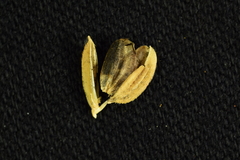 Tilletia horridae0pathogen
- Gene
- ThSCSP_12e0
- Outcome
- expression of ThSCSP_12e0
- Direction
- up-regulatede0
Organisms pictured · Representative pictures of the matched species, not figures from the paper.

Verbatim
e0“The expression of ThSCSP_12 was induced and up-regulated during T. horrida infection.”
e1“Nicotiana benthamiana”
Claim · model-written summary
ThSCSP_12 localized in the cytoplasm and nucleus of plant cells.
- Taxon
- Nicotiana benthamianaNicotiana benthamianae1
- Gene
- ThSCSP_12e0
- Outcome
- localized in both the cytoplasm and nucleus of plant cellse0
Organisms pictured · Representative pictures of the matched species, not figures from the paper.
Verbatim
e0“ThSCSP_12 localized in both the cytoplasm and nucleus of plant cells”
e1“Nicotiana benthamiana”
Claim · model-written summary
Nuclear localization of ThSCSP_12 was required for cell death.
- Taxon
- Nicotiana benthamianaNicotiana benthamianae2
- Gene
- ThSCSP_12e1
- Outcome
- cell deathe0
- Qualifier
- nuclear localizatione0
Organisms pictured · Representative pictures of the matched species, not figures from the paper.
Verbatim
e0“nuclear localization of this protein is required to induce cell death”
e1“ThSCSP_12 localized in both the cytoplasm and nucleus of plant cells”
e2“Nicotiana benthamiana”
Claim · model-written summary
ThSCSP_12-induced cell death depended on RAR1.
- Taxon
- Nicotiana benthamianaNicotiana benthamianae1
- Gene
- RAR1e0
- Outcome
- cell deathe0
Organisms pictured · Representative pictures of the matched species, not figures from the paper.
Verbatim
e0“the ability of ThSCSP_12 to trigger cell death in N. benthamiana depends on the (RAR1) protein required for Mla12 resistance”
e1“Nicotiana benthamiana”
Claim · model-written summary
ThSCSP_12-induced cell death did not depend on SGT1, HSP90 or SERK3.
- Taxon
- Nicotiana benthamianaNicotiana benthamianae2
- Gene
- SGT1e0
- Outcome
- cell deathe1
Organisms pictured · Representative pictures of the matched species, not figures from the paper.
Verbatim
e0“but not on the suppressor of the G2 allele of Skp1 (SGT1), heat shock protein 90 (HSP90), or somatic embryogenesis receptor-like kinase (SERK3)”
e1“the ability of ThSCSP_12 to trigger cell death in N. benthamiana”
e2“Nicotiana benthamiana”
Claim · model-written summary
ThSCSP_12 induced a defense response in Nicotiana leaves.
- Taxon
- Nicotiana benthamianaNicotiana benthamianae1
- Gene
- ThSCSP_12e0
- Outcome
- defense responsee0
Organisms pictured · Representative pictures of the matched species, not figures from the paper.
Verbatim
e0“ThSCSP_12 induced a defense response in N. benthamiana leaves”
e1“Nicotiana benthamiana”
Claim · model-written summary
Heterologous expression suppressed multiple defense-related genes in host plants.
- Taxon
- Nicotiana benthamianaNicotiana benthamianae1
- Treatment
- heterologous expressione0
- Outcome
- expression of multiple defense-related genese0
- Direction
- suppressede0
Not reportedComparator
Organisms pictured · Representative pictures of the matched species, not figures from the paper.
Verbatim
e0“the expression of multiple defense-related genes was suppressed in response to heterologous expression in host plants”
e1“Nicotiana benthamiana”
The same questions in other papers
pathogen product · disease · Nicotiana benthamianaPositive and negative results
5 papers in the same direction as this paper · 4 in the opposite direction
- negative
- positive
- positive
6 papers more in this group
See all 10 papers →overexpression · molecular: expression · Nicotiana benthamianaPositive and negative results
5 papers in the same direction as this paper · 5 in the opposite direction
- positive
- positive
- positive
7 papers more in this group
See all 11 papers →Claims are grouped by organism, treatment and what was measured or targeted. A paper counts as positive when any of its claims in the group is positive.