Abstract
MicroRNAs (miRNAs) are short, non-coding RNAs that regulate gene expression at the post-transcriptional level. In plants, miRNAs participate in diverse developmental processes and adaptive responses to biotic and abiotic stress. MiR827 has long been recognized to be involved in plant responses to phosphate starvation. In rice, the miR827 regulates the expression of OsSPX-MFS1 and OsSPX-MFS2, these genes encoding vacuolar phosphate transporters. In this study, we demonstrated that miR827 plays a role in resistance to infection by the fungus Magnaporthe oryzae in rice. We show that MIR827 overexpression enhances susceptibility to infection by M. oryzae which is associated to a weaker induction of defense gene expression during pathogen infection. Conversely, CRISPR/Cas9-induced mutations in the MIR827 gene completely abolish miR827 production and confer resistance to M. oryzae infection. This resistance is accompanied by a reduction of leaf Pi content compared to wild-type plants, whereas Pi levels increase in leaves of the blast-susceptible miR827 overexpressor plants. In wild-type plants, miR827 accumulation in leaves decreases during the biotrophic phase of the infection process. Taken together, our data indicates that silencing MIR827 confers resistance to M. oryzae infection in rice while further supporting interconnections between Pi signaling and immune signaling in plants. Unravelling the role of miR827 during M. oryzae infection provides knowledge to improve blast resistance in rice by CRISPR/Cas9-editing of MIR827.
Abstract from the paper’s OpenAlex record; open copy licensed cc-by. Read at the source ↗
The text the model read, with the source record’s inline markup (italics, sub- and superscripts) rendered and its character entities decoded; quote offsets refer to the raw text.
Claims 7
Claim · model-written summary
MIR827 overexpression increased rice susceptibility to M. oryzae infection.
- Treatment
- MIR827 overexpressione0
- Interactor
- M. oryzae
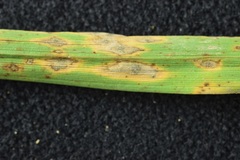 Pyricularia oryzaee0pathogen
- Gene
- MIR827e0
- Outcome
- susceptibility to infection by M. oryzaee0
- Direction
- enhancese0
Not reportedTaxonComparator
Organisms pictured · Representative pictures of the matched species, not figures from the paper.
Verbatim
e0“MIR827 overexpression enhances susceptibility to infection by M. oryzae”
Claim · model-written summary
MIR827 overexpression was associated with weaker defense gene induction during infection.
- Taxon
- rice
 Oryza sativat0
- Outcome
- defense gene expressione0
- Direction
- weaker inductione0
- Qualifier
- during pathogen infectione0
Not reportedGene
Organisms pictured · Representative pictures of the matched species, not figures from the paper.

Verbatim
e0“associated to a weaker induction of defense gene expression during pathogen infection”
t0“rice”
Claim · model-written summary
CRISPR/Cas9-induced MIR827 mutations completely abolished miR827 production in rice.
- Taxon
- riceOryza sativat0
- Treatment
- CRISPR/Cas9-induced mutations in the MIR827 genee0
- Gene
- MIR827e0
- Outcome
- miR827 productione0
- Direction
- completely abolishe0
Not reportedComparator
Organisms pictured · Representative pictures of the matched species, not figures from the paper.
Verbatim
e0“CRISPR/Cas9-induced mutations in the MIR827 gene completely abolish miR827 production”
t0“rice”
Claim · model-written summary
CRISPR/Cas9-induced MIR827 mutations conferred resistance to M. oryzae infection in rice.
- Taxon
- riceOryza sativat0
- Treatment
- CRISPR/Cas9-induced mutations in the MIR827 genee0
- Interactor
- M. oryzaePyricularia oryzaee0pathogen
- Gene
- MIR827e0
- Outcome
- resistance to M. oryzae infectione0
- Direction
- confere0
Not reportedComparator
Organisms pictured · Representative pictures of the matched species, not figures from the paper.
Verbatim
e0“CRISPR/Cas9-induced mutations in the MIR827 gene completely abolish miR827 production and confer resistance to M. oryzae infection”
t0“rice”
Claim · model-written summary
MIR827 mutant rice had reduced leaf Pi content compared with wild type.
- Taxon
- riceOryza sativat0
- Material
- wild-type plantse0
- Outcome
- leaf Pi contente0
- Direction
- reductione0
- Comparator
- wild-type plantse0
Organisms pictured · Representative pictures of the matched species, not figures from the paper.
Verbatim
e0“This resistance is accompanied by a reduction of leaf Pi content compared to wild-type plants”
t0“rice”
Claim · model-written summary
Blast-susceptible miR827-overexpressing rice had increased leaf Pi levels.
- Taxon
- riceOryza sativat0
- Material
- miR827 overexpressor plantse0
- Organ / stage
- leavese0
- Outcome
- Pi levelse0
- Direction
- increasee0
Organisms pictured · Representative pictures of the matched species, not figures from the paper.
Verbatim
e0“Pi levels increase in leaves of the blast-susceptible miR827 overexpressor plants”
t0“rice”
Claim · model-written summary
Wild-type rice leaf miR827 accumulation decreased during the biotrophic phase of infection.
- Taxon
- riceOryza sativat0
- Material
- wild-type plantse0
- Organ / stage
- leavese0
- Gene
- miR827e0
- Outcome
- miR827 accumulatione0
- Direction
- decreasese0
- Qualifier
- during the biotrophic phase of the infection processe0
Organisms pictured · Representative pictures of the matched species, not figures from the paper.
Verbatim
e0“In wild-type plants, miR827 accumulation in leaves decreases during the biotrophic phase of the infection process.”
t0“rice”
The same questions in other papers
loss of function · Pyricularia oryzae · Oryza sativa (rice)Positive and negative results
40 papers in the same direction as this paper · 26 in the opposite direction
- negative
- negative
- negative
63 papers more in this group
See all 67 papers →loss of function · yield · Oryza sativa (rice)Positive and negative results
61 papers in the same direction as this paper · 72 in the opposite direction
- negative
- no effect
- negative
130 papers more in this group
See all 134 papers →Claims are grouped by organism, treatment and what was measured or targeted. A paper counts as positive when any of its claims in the group is positive.