View: List Claim type Research area Organism Taxon as written Decade Paper Taxon groups are the verbatim names found in the abstracts (case-insensitive), not normalised: maize, corn and Zea mays are separate groups here. The Organism view merges them through NCBI Taxonomy.
Association observed original result measured Claim · model-written summary
Raffinose was best correlated with the frequency of daily minima at or below 1.7C in the previous 30 days.
Rafflnose concentrations e0 30 days before sampling e0 daily minima ≤ 1.7C e0 Not reported Direction
Verbatim
e0 “Rafflnose concentrations were highest during winter and were best correlated with the frequency of occurrence of daily minima ≤ 1.7C during the 30 days before sampling ”
✓ located verbatim in the source · abstract, characters 417–584 t0 “Conifer Species ”
✓ located verbatim in the source · title, characters 37–52 t1 “Conifer Species ”
✓ located verbatim in the source · title, characters 37–52 Other claims from this paper (7) Association observed original result measured Claim · model-written summary
Sucrose was best correlated with frequency of daily minima at or below 7.2C in the prior 30 days.
Sucrose concentrations e0 daily minima ≤ 7.2C e0 Not reported Direction
Verbatim
e0 “Sucrose concentrations, which also reached maximum levels during the winter, were best correlated with the frequency of occurrence of daily minima ≤ 7.2C in the prior 30 days ”
✓ located verbatim in the source · abstract, characters 586–760 t0 “Conifer Species ”
✓ located verbatim in the source · title, characters 37–52 t1 “Conifer Species ”
✓ located verbatim in the source · title, characters 37–52 Other claims from this paper (7) Observation observed original result measured Claim · model-written summary
Daily minimum air temperatures in the rice field were 23.5–25.2 °C.
Verbatim
t0 “Rice ”
✓ located verbatim in the source · title, characters 107–111 e1 “air temperatures varied between daily minima of 23.5–25.2 °C and maxima near 35.4 °C ”
✓ located verbatim in the source · abstract, characters 1158–1242 Other claims from this paper (10) Observation observed original result measured Claim · model-written summary
Daily maximum air temperatures in the rice field were near 35.4 °C.
Verbatim
t0 “Rice ”
✓ located verbatim in the source · title, characters 107–111 e1 “air temperatures varied between daily minima of 23.5–25.2 °C and maxima near 35.4 °C ”
✓ located verbatim in the source · abstract, characters 1158–1242 Other claims from this paper (10) Observation observed original result positive measured Claim · model-written summary
S. pectinata had lower EPS during temperature minima .
during seasonal and daily temperature minima e0 Verbatim
e0 “S. pectinata had greater Φ(NPQ) and lower EPS during seasonal and daily temperature minima ”
✓ located verbatim in the source · abstract, characters 1126–1216 Other claims from this paper (4) Observation observed original result positive measured Claim · model-written summary
S. pectinata had greater Φ(NPQ) during temperature minima .
during seasonal and daily temperature minima e0 Verbatim
e0 “S. pectinata had greater Φ(NPQ) and lower EPS during seasonal and daily temperature minima ”
✓ located verbatim in the source · abstract, characters 1126–1216 Other claims from this paper (4) Observation observed original result measured Claim · model-written summary
At RH 0.993-0.967, relative evaporation cycled daily from 0.6 to about 3.
RE varied in daily cycles e0 RHs of 0.993-0.967 e0 Verbatim
e0 “For RHs of 0.993-0.967, RE varied in daily cycles from 0.6 to ~3, with a period of ~24h, maxima at mid-afternoon, minima at or near dawn. ”
✓ located verbatim in the source · abstract, characters 498–635 e1 “Agapanthus praecox Willd.
✓ located verbatim in the source · abstract, characters 70–95 Other claims from this paper (8) Observation observed original result negative measured Claim · model-written summary
F 2,6-P(2) reached a minimum after deacidification began and stayed low until malic acid approached its minimum.
Verbatim
e0 “F 2,6-P(2) reached a daily minimum soon after the onset of deacidification and remained low until the malic acid pools approached their daily minima ”
✓ located verbatim in the source · abstract, characters 785–933 e1 “in the leaves of Ananas , a species which stores carbohydrate in an extrachloroplastic compartment ”
✓ located verbatim in the source · abstract, characters 373–470 Other claims from this paper (12) Observation Fructose 2,6-bisphosphate was detected in Ananas comosus . Observation Fructose 2,6-bisphosphate was detected in Bryophyllum tubiflorum . Observation Fructose 2,6-bisphosphate was detected in C3 and CAM Mesembryanthemum crystallinum . Observation In both Mesembryanthemum tissues, F 2,6-P(2) was outside chloroplasts. Association F 2,6-P(2) levels correlated with stages of the day-night CAM cycle in both Ananas and Bryophyllum . Observation F 2,6-P(2) rose rapidly then fell after dark-to-light transition. Observation F 2,6-P(2) increased later, accelerating during afternoon carbon uptake. Observation After light-to-dark transition, F 2,6-P(2) fluctuated and then was usually low. Association F 2,6-P(2) pools rose with malate synthesis, stayed high when synthesis was constant, then fell as synthesis waned. Observation F 2,6-P(2) levels were always higher in Ananas than Bryophyllum . Observation The ratio of pyrophosphate fructose-6-phosphate phosphotransferase to cytoplasmic fructose 1,6-bisphosphatase activity was far higher in Ananas . Observation The ratio of pyrophosphate fructose-6-phosphate phosphotransferase to phosphofructokinase activity was far higher in Ananas . Association observed original result measured Claim · model-written summary
Flower bud cold hardiness of apricot was correlated better with mean maximum daily temperature for the preceding 7 days than with mean minima .
mean maximum daily temperature e0 correlated better e0 Verbatim
t0 “Seasonal variation of cold hardiness in apricots ”
✓ located verbatim in the source · title, characters 0–48 e0 “cold hardiness was correlated better with mean maximum daily temperature for the 7 days before measurements than with mean minima ”
✓ located verbatim in the source · abstract, characters 215–344 Other claims from this paper (2) Observation observed original result measured Claim · model-written summary
Daily minimum carbon dioxide flux was near minus twenty during full leaf expansion.
full leaf expansion e0 Daily minima of CO 2 flux e0 −20 µmol CO 2 m −2 s −1 e0 Verbatim
e0 “Daily minima of CO 2 flux were typically around −20 µmol CO 2 m −2 s −1 during the period of full leaf expansion ”
✓ located verbatim in the source · abstract, characters 565–677 t0 “Beech forest ”
✓ located verbatim in the source · title, characters 30–42 Other claims from this paper (15) Observation observed original result measured Claim · model-written summary
Hevea laticiferous phloem pressure fluctuated daily , with minima during the day.
laticiferous phloem tissues e0 Hydrostatic pressures e0 minimum values e0 during the day e0 Verbatim
e0 “Hydrostatic pressures in laticiferous phloem tissues of Hevea brasiliensis trees exhibit a diurnal fluctuation, with minimum values occurring during the day. ”
✓ located verbatim in the source · abstract, characters 0–157 Other claims from this paper (2) Observation observed original result measured Claim · model-written summary
Most measured compounds followed a daily rhythm, peaking at midday and reaching minima at night.
high alpine plant species t0 contents of most compounds e0 maximum occurring at midday and the minimum during the night e0 Verbatim
e0 “The contents of most compounds were found to follow a diurnal rhythm, with the maximum occurring at midday and the minimum during the night. ”
✓ located verbatim in the source · abstract, characters 478–618 t0 “high alpine plant species ”
✓ located verbatim in the source · title, characters 36–61 Other claims from this paper (4) Association observed original result measured Claim · model-written summary
Reversible diurnal depressions in leaf conductance and net CO2 uptake preceded nocturnal net CO2 uptake.
Reversible diurnal depressions in leaf conductance and net CO(2) uptake e3 nocturnal net CO(2) uptake e3 Not reported Comparator Direction
Verbatim
e0 “Simultaneous measurements of net CO(2) exchange, water vapor exchange, and leaf water relations were performed in Mesembryanthemum crystallinum during the development of crassulacean acid metabolism (CAM) in response to high NaCl salinity in the rooting medium ”
✓ located verbatim in the source · abstract, characters 0–260 e3 “Reversible diurnal depressions in leaf conductance and net CO(2) uptake, with minima recorded in the middle of the photoperiods, preceded the occurrence of nocturnal net CO(2) uptake ”
✓ located verbatim in the source · abstract, characters 1902–2084 Other claims from this paper (9) Lexical search (BM25). All words must match; if nothing does, any word. Organism names also match every spelling of the same organism. No semantic search yet.
 Oryza sativa
 Sporobolus michauxianus
 Agapanthus praecox
 Ananas
 Prunus armeniaca
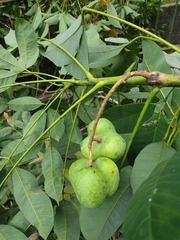 Hevea brasiliensis
 Mesembryanthemum crystallinum