View: List Claim type Research area Organism Taxon as written Decade Paper Association observed original result measured Claim · model-written summary
Parasitoid performance was most affected by host growth rate and final host weight.
host larva e0 herbivore t0 Parasitoid performance e0 larval host’s relative growth rate and the final weight of the host larva at the time of parasitoid emergence e0 Not reported Direction
Verbatim
e0 “Parasitoid performance was affected most by the larval host’s relative growth rate and the final weight of the host larva at the time of parasitoid emergence. ”
✓ located verbatim in the source · abstract, characters 709–867 t0 “food plant switching by a herbivore ”
✓ located verbatim in the source · title, characters 10–45 Other claims from this paper (9) Intervention effect observed original result no effect not significant (as stated) measured Claim · model-written summary
Field parasitoid performance did not differ statistically between sole and intercropped plots.
intercropped plot e0 parasitoid performance e0 no statistical difference e0 field experiment e0 Verbatim
e0 “In the field experiment using sentinel egg card technique no statistical difference in parasitoid performance between the sole crop and intercropped plot was observed ”
✓ located verbatim in the source · abstract, characters 545–711 t0 “brinjal ”
✓ located verbatim in the source · title, characters 137–144 Other claims from this paper (2) Observation observed original result measured Claim · model-written summary
The two parasitoid species affected each other’s performance asymmetrically through plant mediated interactions.
parasitoid species asymmetrically affected each other's performance e0 Verbatim
e0 “parasitoid species asymmetrically affected each other's performance through plant‐mediated interactions ”
✓ located verbatim in the source · abstract, characters 1376–1479 e1 “leaf material of Brassica oleracea plants ”
✓ located verbatim in the source · abstract, characters 840–881 e2 “Hyposoter ebeninus and Cotesia glomerata
✓ located verbatim in the source · abstract, characters 614–654 Other claims from this paper (1) Observation observed original result measured Claim · model-written summary
The cultivar with the highest aphid numbers had the best parasitoid performance .
parasitoid performance e2 Verbatim
e0 “we selected two white cabbage cultivars [Brassica oleracea L. var. capitata (Brassicaceae)] ”
✓ located verbatim in the source · abstract, characters 589–680 e1 “Aboveground, we quantified aphid [Brevicoryne brassicae (L.) (Hemiptera: Aphididae)] population development and parasitoid [Diaeretiella rapae (McIntosh) (Hymenoptera: Braconidae)] fitness parameters ”
✓ located verbatim in the source · abstract, characters 968–1167 e2 “The cultivar that sustained highest aphid numbers also had the best parasitoid performance ”
✓ located verbatim in the source · abstract, characters 1169–1259 Other claims from this paper (8) Recommendation author interpretation original result basis n/a Claim · model-written summary
Poor performance of a parasitoid in a simple laboratory trial may justify disregarding that species.
disregard this species e6 Verbatim
e1 “in glasshouse cucumbers ”
✓ located verbatim in the source · abstract, characters 172–195 e6 “bad performance of an aphid parasitoid species in a simple laboratory trial might be sufficient evidence to disregard this species ”
✓ located verbatim in the source · abstract, characters 1056–1186 Other claims from this paper (7) Intervention effect observed original result negative simulated Claim · model-written summary
Attack by the native generalist parasitoid had a larger influence on how effectively the agent reduced invader performance .
attack by the native generalist parasitoid e1 how effectively the agent reduced invader performance e1 Not reported Comparator
Verbatim
e0 “the biocontrol agent Eustenopus villosus (a seed predator) on the invasive, annual weed Centaurea solstitialis , both with and without the generalist parasitoid Pyemotes tritici ”
✓ located verbatim in the source · abstract, characters 565–741 e1 “attack by the native generalist parasitoid had a larger influence over how effectively the agent reduced invader performance ”
✓ located verbatim in the source · abstract, characters 2153–2277 Other claims from this paper (8) Association observed original result negative measured Claim · model-written summary
Parasitoid size of Praon volucre was negatively affected by higher temperatures.
higher temperatures e1 negatively affected e1 Verbatim
t0 “Performance of the parasitoid Praon volucre in Aulacorthum solani at five temperatures ”
✓ located verbatim in the source · title, characters 0–86 e0 “a leaf disc of lettuce ”
✓ located verbatim in the source · abstract, characters 460–482 e1 “parasitoid size was negatively affected by higher temperatures ”
✓ located verbatim in the source · abstract, characters 1274–1336 Other claims from this paper (13) Association observed original result measured Claim · model-written summary
Parasitoid performance varied with the plant species on which aphids fed.
performance of the parasitoid e0 host plant on which the aphid was feeding e0 Not reported Direction
Verbatim
e0 “the performance of the parasitoid was affected by the host plant on which the aphid was feeding. ”
✓ located verbatim in the source · abstract, characters 656–752 e1 “its endoparasitoid Diaeretiella rapae ”
✓ located verbatim in the source · abstract, characters 185–222 e2 “the aphid Myzus persicae ”
✓ located verbatim in the source · abstract, characters 156–180 e3 “Brassica napus and Brassica oleracea , two wild species Brassica nigra and Sinapis arvensis
✓ located verbatim in the source · abstract, characters 242–332 Other claims from this paper (3) Intervention effect observed original result negative measured Claim · model-written summary
Parasitoid performance was reduced under high drought stress.
high drought stress treatment e0 Not reported Comparator
Verbatim
e0 “the parasitoid s only responded consistently to the high drought stress treatment, on which their performance was reduced ”
✓ located verbatim in the source · abstract, characters 1725–1845 Other claims from this paper (8) Intervention effect observed original result measured Claim · model-written summary
Tamaron SL600 was associated with an increase of about 67% in parasitoid performance (emergence, the second of the three measures)
parasitoid performance e1 Not reported Comparator
Verbatim
e0 “evaluated against peach-potato aphid, Myzus persicae (Sulzer) and its parasitoid Aphidius matricariae Haliday ”
✓ located verbatim in the source · abstract, characters 181–290 e1 “increase of about 22, 67 and 47% respectively were found in parasitoid performance with Tamaron SL600 ”
✓ located verbatim in the source · abstract, characters 1318–1419 e2 “on Cardinal and Desiree (respectively partially resistant and susceptible potato cultivars to M. persicae ) ”
✓ located verbatim in the source · abstract, characters 291–397 Other claims from this paper (13) Lexical search (BM25). All words must match; if nothing does, any word. Organism names also match every spelling of the same organism. No semantic search yet.
 Solanum melongena
 Brassica oleracea
 Hyposoter ebeninus
 Cotesia glomerata
 Diaeretiella rapae
 Cucumis sativus
 Centaurea solstitialis
 Eustenopus villosus
 Pyemotes tritici
 Lactuca sativa
 Brassica napus
 Brassica nigra
 Mutarda arvensis
 Myzus persicae
 Solanum tuberosum
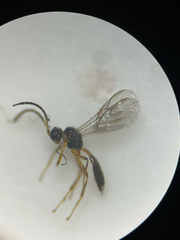 Aphidius matricariae