View: List Claim type Research area Organism Taxon as written Decade Paper Observation observed original result measured Claim · model-written summary
Aggressive C. sativus isolates released more xylanase than weakly aggressive isolates .
weakly aggressive isolates e0 Verbatim
e0 “Aggressive isolates released more xylanase of weakly aggressive isolates . ”
✓ located verbatim in the source · abstract, characters 499–572 t0 “Cochliobolus sativus
✓ located verbatim in the source · title, characters 24–44 Other claims from this paper (4) Observation observed original result measured Claim · model-written summary
Canker isolates were as aggressive as leaf isolates .
as aggressive as leaf isolates e0 leaf isolates e0 Not reported Taxon
Verbatim
e0 “Canker isolates were found to be as aggressive as leaf isolates . ”
✓ located verbatim in the source · abstract, characters 753–817 Other claims from this paper (3) Observation observed original result measured Claim · model-written summary
Highly aggressive cotton V. dahliae isolates secreted more proteins than weakly aggressive ones.
isolates e0 pathogen isolates secreted more proteins e0 weakly aggressive ones e0 Verbatim
e0 “Highly aggressive isolates secreted more proteins than the weakly aggressive ones ”
✓ located verbatim in the source · abstract, characters 1410–1491 e1 “on cotton in Henan ”
✓ located verbatim in the source · abstract, characters 75–93 Other claims from this paper (9) Observation observed original result measured Claim · model-written summary
Fifty-eight Rhizoctonia solani isolates were confirmed by Koch postulates and classified as weakly aggressive , moderately aggressive , aggressive or highly aggressive .
Rizoctonia solani t0 pathogen weakly aggressive, moderately aggressive, aggressive and highly aggressive e0 fifty-eight isolates e0 Not reported Direction
Verbatim
t0 “isolates of Rizoctonia solani causing sheath blight disease of rice ”
✓ located verbatim in the source · title, characters 42–109 e0 “The total number of fifty-eight isolates were confirmed by the proof of the Koch postulates and classified in the category as weakly aggressive , moderately aggressive , aggressive and highly aggressive ”
✓ located verbatim in the source · abstract, characters 1001–1201 Other claims from this paper (2) Observation observed original result measured Claim · model-written summary
Three Ascochyta rabiei isolates were highly aggressive , eight fairly aggressive and one less aggressive on chickpea.
highly aggressive isolates e0 Verbatim
e0 “there are three highly aggressive isolates , eight are fairly aggressive and one, is less aggressive . ”
✓ located verbatim in the source · abstract, characters 417–517 t0 “Ascochyta rabiei (Pass.) Labr. in chickpea
✓ located verbatim in the source · title, characters 26–68 Other claims from this paper (1) Observation observed original result negative measured Claim · model-written summary
Pahang isolates were more aggressive on cocoa than Perak isolates .
isolates e0 pathogen more aggressive e0 isolates from Perak e0 Verbatim
e0 “the isolates obtained from Pahang are more aggressive compared to the isolates from Perak. ”
✓ located verbatim in the source · abstract, characters 843–933 t0 “cocoa ”
✓ located after whitespace/quote normalisation · title, characters 122–127 Other claims from this paper (5) Observation observed original result negative measured Claim · model-written summary
NA2 and EU1 Phytophthora ramorum isolates were most aggressive on detached Rhododendron leaves, while NA1 isolates were least aggressive .
most aggressive e1 Verbatim
e0 “aggressive ness on detached Rhododendron leaves ”
✓ located verbatim in the source · abstract, characters 228–274 e1 “Isolates from the NA2 and EU1 lineages were the most aggressive and isolates from the NA1 group were the least aggressive . ”
✓ located verbatim in the source · abstract, characters 502–624 t0 “Phytophthora ramorum
✓ located verbatim in the source · title, characters 54–74 Other claims from this paper (3) Observation observed original result negative significant (as stated) measured Claim · model-written summary
Mint isolates were significantly more aggressive on mint than isolates from other hosts.
aggressive on mint e0 more aggressive e0 other host isolates e0 Not reported Interactor
Verbatim
e0 “Isolates originating from mint were significantly more aggressive on mint than were other host isolates ”
✓ located verbatim in the source · abstract, characters 667–770 Other claims from this paper (4) Observation observed original result negative measured Claim · model-written summary
Five R. bunodes isolates were more aggressive on poplar than the other tested isolates .
more aggressive e0 Verbatim
e0 “R. bunodes isolates R2, R3, R3A, R6 and R8 were more aggressive than the others. ”
✓ located verbatim in the source · abstract, characters 1119–1199 t0 “POPLAR ”
✓ located verbatim in the source · title, characters 54–60 Other claims from this paper (2) Observation observed original result negative measured Claim · model-written summary
Potato isolates preferred tomato leaflets and were more aggressive on them.
aggressive on them e0 more aggressive e0 Verbatim
e0 “potato isolates showed hostpreference toward tomato leaflets and were more aggressive on them ”
✓ located verbatim in the source · abstract, characters 1020–1113 Other claims from this paper (2) Lexical search (BM25). All words must match; if nothing does, any word. Organism names also match every spelling of the same organism. No semantic search yet.
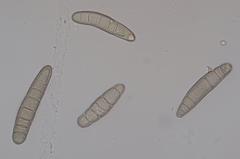 Bipolaris sorokinianat0
 Gossypium hirsutum
 Oryza sativa
 Cicer arietinum
 Ascochyta rabiei
 Theobroma cacao
 Rhododendron
 Phytophthora ramorum
 Populus
 Solanum lycopersicum
 Solanum tuberosum