View: List Claim type Research area Organism Taxon as written Decade Paper Observation observed original result positive measured Claim · model-written summary
Clone DN typically maintained higher midday leaf water potentials .
midday leaf water potentials e1 Verbatim
e0 “Populus trichocarpa x P. deltoides (TD)
✓ located verbatim in the source · abstract, characters 179–218 e1 “Clone DN typically maintained higher midday leaf water potentials ”
✓ located verbatim in the source · abstract, characters 1687–1752 Other claims from this paper (19) Observation observed original result positive measured Claim · model-written summary
Resprouts had higher midday and predawn leaf water potentials at moderate soil dryness.
midday and predawn leaf water potentials e0 Verbatim
e0 “resprouts, which had higher midday and predawn leaf water potentials ”
✓ located verbatim in the source · abstract, characters 807–875 t0 “Quercus ilex
✓ located verbatim in the source · title, characters 81–93 Other claims from this paper (7) Observation observed original result measured Claim · model-written summary
Mistletoes had more negative midday leaf water potentials during the dry season than hosts.
midday leaf water potentials e0 Verbatim
e0 “mistletoes were more drought tolerant compared with their hosts, characterized by more negative midday leaf water potentials during the dry season ”
✓ located verbatim in the source · abstract, characters 376–522 Other claims from this paper (14) Observation observed original result measured Claim · model-written summary
New flush leaves had lower midday leaf water potentials than comparably exposed old leaves.
New flush leaves e1 midday leaf water potentials e1 comparably exposed old leaves e1 Verbatim
e0 “‘Valencia’ orange [Citrus sinensis (L.) Osbeck] ”
✓ located verbatim in the source · abstract, characters 41–88 e1 “New flush leaves had lower specific leaf weights and lower midday leaf water potentials than comparably exposed old leaves ”
✓ located verbatim in the source · abstract, characters 207–329 Other claims from this paper (9) Intervention effect observed original result positive simulated Claim · model-written summary
Higher maize mucilage contents lowered midday leaf water potentials under drought in simulations.
higher mucilage contents e3 midday leaf water potentials e1 Not reported Comparator
Verbatim
e1 “enabling plants to sustain stable transpiration and lower midday leaf water potentials under drought ”
✓ located verbatim in the source · abstract, characters 1314–1414 e2 “maize (Zea mays ) ”
✓ located verbatim in the source · abstract, characters 539–555 e3 “Simulations revealed that higher mucilage contents ”
✓ located verbatim in the source · abstract, characters 967–1017 Other claims from this paper (7) Intervention effect observed original result no effect measured Claim · model-written summary
Time of grazing had no effect on predawn or midday leaf water potentials .
Time of grazing e1 predawn or midday leaf water potentials e1 Not reported Comparator
Verbatim
t0 “Crested Wheatgrass Pasture ”
✓ located verbatim in the source · title, characters 88–114 e1 “Time of grazing had no effect on either predawn or midday leaf water potentials ”
✓ located verbatim in the source · abstract, characters 2086–2165 Other claims from this paper (12) Observation observed original result measured Claim · model-written summary
Soybean leaf water potentials often fell below −11 bars at midday despite high soil water availability.
leaf water potentials e0 Verbatim
e0 “Soil water availability was high in all 3 years. However, leaf water potentials were frequently below −11 bars at midday , which we defined as a water deficit. ”
✓ located verbatim in the source · abstract, characters 551–709 t0 “Soybean ”
✓ located verbatim in the source · title, characters 57–64 Other claims from this paper (6) Observation observed original result positive measured Claim · model-written summary
CN5 maintained higher predawn and midday leaf water potentials than ST51.
predawn and midday leaf water potentials e0 Verbatim
e0 “the drought-resistant CN5 clone maintained higher leaf water status (higher predawn and midday leaf water potentials ) ”
✓ located verbatim in the source · abstract, characters 664–781 t0 “Eucalyptus globulus
✓ located verbatim in the source · title, characters 33–52 t1 “a drought-tolerant clone (CN5) and a drought-sensitive clone (ST51) ”
✓ located verbatim in the source · abstract, characters 46–113 Other claims from this paper (8) Intervention effect observed original result negative measured Claim · model-written summary
Water stress lowered predawn and midday leaf water potentials independently of light.
water stressed e0 Leaf water potentials at predawn and midday e0 independently of light environment e0 Not reported Comparator
Verbatim
e0 “Leaf water potentials at predawn and midday were lower for water stressed seedlings, independently of light environment. ”
✓ located verbatim in the source · abstract, characters 205–325 t0 “cork oak (Quercus suber L.) seedlings ”
✓ located verbatim in the source · title, characters 19–56 Other claims from this paper (6) Observation observed original result no effect measured Claim · model-written summary
Midday leaf water potentials of Quercus suber did not differ among trees.
midday leaf water potentials e7 no differences e7 Verbatim
e0 “Sap flux density in branches, leaf transpiration, stomatal conductance and leaf water potentials were measured in 16-year-old Quercus suber L. trees growing in a plantation in southern Portugal ”
✓ located verbatim in the source · abstract, characters 0–193 e7 “there were no differences in midday leaf water potentials ”
✓ located verbatim in the source · abstract, characters 1435–1492 Other claims from this paper (7) Lexical search (BM25). All words must match; if nothing does, any word. Organism names also match every spelling of the same organism. No semantic search yet.
 Populus trichocarpae0
 Quercus ilex
 Citrus sinensis
 Zea mays
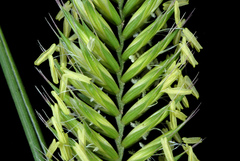 Agropyron cristatum
 Glycine max
 Eucalyptus globulus
 Quercus suber