Intervention effect 1,925,677 claims

Intervention effectobservedoriginal resultpositivemeasured

Claim · model-written summary

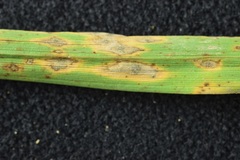
The consortium reduced the incidence rate and disease index of leaf blast and panicle blast.

Treatment
the consortiume1
Interactor
Magnaporthe oryzaePyricularia oryzaee1pathogen
Second interactor
the consortiume1biocontrol_agent
Outcome
incidence rate and disease index of leaf blast and panicle blaste1
Direction
reducede1

Not reportedTaxonComparator

Verbatim

e1

“the consortium exhibited a 67.56% inhibition rate against Magnaporthe oryzae and reduced both the incidence rate and disease index of leaf blast and panicle blast”

✓ located verbatim in the source · abstract, characters 843–1005

Title

Construction and Functional Validation of a Cross-Niche Multifunctional Microbial Consortium for Straw-Returning Agricultural Systems

Shu Jia; Hang Qu; Bo Li; et al. Microorganisms 2026. doi:10.3390/microorganisms14010135

Other claims from this paper (9)
Intervention effectobservedoriginal resultpositivemeasured

Claim · model-written summary

In field trials the consortium applied alone increased rice grain yield by 9.63% and 6.94%.

Treatment
applied alonee1
Outcome
grain yielde1
Direction
increasese1
Value
9.63% and 6.94%e1
Setting
Field trialse1

Not reportedComparator

Verbatim

e1

“Field trials revealed increases in the rice grain yield of 9.63% and 6.94% when applied alone and 6.75% and 5.18% when co-applied with straw residues”

✓ located verbatim in the source · abstract, characters 1007–1156

Title

Construction and Functional Validation of a Cross-Niche Multifunctional Microbial Consortium for Straw-Returning Agricultural Systems

Shu Jia; Hang Qu; Bo Li; et al. Microorganisms 2026. doi:10.3390/microorganisms14010135

Other claims from this paper (9)
Intervention effectobservedoriginal resultpositivemeasured

Claim · model-written summary

In field trials the consortium co-applied with straw residues increased rice grain yield by 6.75% and 5.18%.

Treatment
co-applied with straw residuese1
Outcome
grain yielde1
Direction
increasese1
Value
6.75% and 5.18%e1
Setting
Field trialse1

Not reportedComparator

Verbatim

e1

“Field trials revealed increases in the rice grain yield of 9.63% and 6.94% when applied alone and 6.75% and 5.18% when co-applied with straw residues”

✓ located verbatim in the source · abstract, characters 1007–1156

Title

Construction and Functional Validation of a Cross-Niche Multifunctional Microbial Consortium for Straw-Returning Agricultural Systems

Shu Jia; Hang Qu; Bo Li; et al. Microorganisms 2026. doi:10.3390/microorganisms14010135

Other claims from this paper (9)
Intervention effectobservedoriginal resultno effectnot significant (as stated)measured

Claim · model-written summary

F1xI4 and F2xI4 were statistically comparable for most parameters.

Taxon
Salix albaSalix albat0
Treatment
F1×I4 and F2×I4e0
Outcome
majority of the parameterse0
Direction
statistically comparablee0

Not reportedComparator

Verbatim

t0

“Salix alba”

✓ located verbatim in the source · title, characters 94–104
e0

“F1×I4 and F2×I4 were statistically comparable for the majority of the parameters”

✓ located verbatim in the source · abstract, characters 1074–1154

Title

Metal-mobilizing bacteria enhance phytoremediation efficiency, growth, and nutrient uptake in Salix alba under controlled conditions

Aayushi Singla; Rajni Sharma; Sapna Thakur; et al. Bioremediation Journal 2026. doi:10.1080/10889868.2025.2611956

Other claims from this paper (11)
Intervention effectauthor interpretationoriginal resultpositivemeasured

Claim · model-written summary

Inoculants allow improved phytoremediation with a 25% lower fertilizer input.

Taxon
Salix albaSalix albat0
Outcome
fertilizer inpute0
Direction
lowere0
Value
25%e0

Not reportedTreatmentComparator

Verbatim

t0

“Salix alba”

✓ located verbatim in the source · title, characters 94–104
e0

“allow for improved, sustainable phytoremediation with a 25% lower fertilizer input”

✓ located verbatim in the source · abstract, characters 1481–1563

Title

Metal-mobilizing bacteria enhance phytoremediation efficiency, growth, and nutrient uptake in Salix alba under controlled conditions

Aayushi Singla; Rajni Sharma; Sapna Thakur; et al. Bioremediation Journal 2026. doi:10.1080/10889868.2025.2611956

Other claims from this paper (11)
Intervention effectobservedoriginal resultpositivemeasured

Claim · model-written summary

Rice-husk-derived silica controlled populations of S. zeamais in stored maize grains within 12 days of exposure.

Taxon
maizeZea mayse0
Treatment
silicae0
Interactor
S. zeamaisSitophilus zeamaise0pest
Outcome
populations of S. zeamaise0
Direction
controllede0
Qualifier
within 12 days of exposuree0

Not reportedComparator

Verbatim

e0

“The silica, which had some surface functional groups, controlled the populations of S. zeamais in stored maize grains within 12 days of exposure”

✓ located verbatim in the source · abstract, characters 600–744

Title

Use of essential and vegetable oil-impregnated rice husk silica to control Sitophilus zeamais (Motschulsky) on stored maize (Zea Mays L.) seeds

Bertrand Zing Zing; Winy Virgile Nanfa Guemfo; Christian Toumo Nana; et al. Bulletin of the National Research Centre/Bulletin of the National Research Center 2026. doi:10.1186/s42269-026-01388-w

Other claims from this paper (5)
Intervention effectobservedoriginal resultpositivemeasured

Claim · model-written summary

Compounding the silica with neem and rosemary oils produced a synergistic effect in controlling pests in stored maize grains.

Taxon
maizeZea mayse0
Treatment
neem and rosemary oilse0
Outcome
controlling the pestse0
Direction
synergistice0
Comparator
silicae0

Verbatim

e0

“Compounding the silica with neem and rosemary oils further maintained these functional groups and produced a synergistic effect in controlling the pests in stored maize grains”

✓ located verbatim in the source · abstract, characters 746–921

Title

Use of essential and vegetable oil-impregnated rice husk silica to control Sitophilus zeamais (Motschulsky) on stored maize (Zea Mays L.) seeds

Bertrand Zing Zing; Winy Virgile Nanfa Guemfo; Christian Toumo Nana; et al. Bulletin of the National Research Centre/Bulletin of the National Research Center 2026. doi:10.1186/s42269-026-01388-w

Other claims from this paper (5)
Intervention effectobservedoriginal resultmixedmeasured

Claim · model-written summary

The effect of the formulation on stored maize pests was only comparable to synthetic pesticides after 5 days of application.

Taxon
maizeZea mayst0
Outcome
only comparablee0
Direction
comparablee0
Qualifier
after 5 days of applicatione0
Comparator
synthetic pesticidese0

Not reportedTreatment

Verbatim

t0

“stored maize”

✓ located verbatim in the source · title, characters 111–123
e0

“These results were only comparable to those obtained with the use of synthetic pesticides after 5 days of application”

✓ located verbatim in the source · abstract, characters 923–1040

Title

Use of essential and vegetable oil-impregnated rice husk silica to control Sitophilus zeamais (Motschulsky) on stored maize (Zea Mays L.) seeds

Bertrand Zing Zing; Winy Virgile Nanfa Guemfo; Christian Toumo Nana; et al. Bulletin of the National Research Centre/Bulletin of the National Research Center 2026. doi:10.1186/s42269-026-01388-w

Other claims from this paper (5)
Intervention effectobservedoriginal resultpositivemeasured

Claim · model-written summary

Silica derived from rice husk ash and impregnated with neem and rosemary oils retained more than 85% of the germinative capacity of stored maize grains even after prolonged storage.

Taxon
maizeZea mayse0
Treatment
silica derived from rice husk ash and impregnated with neem and rosemary oilse0
Outcome
germinative capacitye0
Direction
retainede0
Value
more than 85%e0

Not reportedComparator

Verbatim

e0

“silica derived from rice husk ash and impregnated with neem and rosemary oils could be a promising alternative to synthetic pesticides for storing maize grains, as it retained more than 85% of their germinative capacity even after prolonged storage”

✓ located verbatim in the source · abstract, characters 1202–1450

Title

Use of essential and vegetable oil-impregnated rice husk silica to control Sitophilus zeamais (Motschulsky) on stored maize (Zea Mays L.) seeds

Bertrand Zing Zing; Winy Virgile Nanfa Guemfo; Christian Toumo Nana; et al. Bulletin of the National Research Centre/Bulletin of the National Research Center 2026. doi:10.1186/s42269-026-01388-w

Other claims from this paper (5)
Intervention effectobservedoriginal resultpositivemeasured

Claim · model-written summary

For Ksenia winter wheat the highest yields were recorded with the fertilizer complex Fon + Polydon Bio Profi.

Taxon
winter wheatTriticum aestivume0
Material
Kseniae0
Treatment
Fon + Polydon Bio Profie0
Outcome
highest yieldse0
Direction
higheste0

Not reportedComparator

Verbatim

e0

“In the study of the Ksenia winter wheat variety, the highest yields were recorded with the use of the fertilizer complex Fon + Polydon Bio Profi”

✓ located verbatim in the source · abstract, characters 791–935

Title

OPTIMIZATION OF WINTER WHEAT NUTRITION IN THE ARID ZONE OF STAVROPOL TERRITORY

Natalya Gromova; Alla Bevololova; Olga Lobankova; et al. International Agricultural Journal 2026. doi:10.55186/25880209_2025_9_6_20

Other claims from this paper (14)