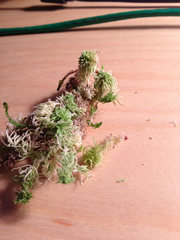
Sphagnum centrale 19 claims

species · family Sphagnaceae · green plant · NCBI Taxonomy ↗

NCBI synonyms: Sphagnum intermedium (Warnst.) Russow, 1894, non Sphagnum intermedium Hoffm., 1796

4 spellings

Sphagnum centrale
Sphagnum centraleHermannSchachner · CC0 · Wikimedia Commons ↗
Observationobservedoriginal resultmeasured

Claim · model-written summary

Sphagnum centrale had accumulation capabilities similar to Pleurozium schreberi.

Taxon
Sphagnum centraleSphagnum centralee0
Outcome
accumulation capabilitiese0
Direction
similare0
Comparator
Pleurozium schreberie0

Verbatim

e0

“The moss species Aulacomnium palustre and Sphagnum centrale were identified as having accumulation capabilities similar to the reference species Pleurozium schreberi.”

✓ located verbatim in the source · abstract, characters 837–1003

Title

ELEMENT ACCUMULATION IN BRYOPHYTESIN PEATLAND ECOSYSTEMSOF THE KALININGRAD REGION, RUSSIA

Rashid A. Baimuratov; Maksim G. Napreenko; Arina A. Shangina IKBFU's Vestnik. Series: Natural and Medical Sciences 2025. doi:10.5922/vestniknat-2025-1-4

Other claims from this paper (4)
Observationobservedoriginal resultmeasured

Claim · model-written summary

Sphagnum centrale had the lowest annual growth (15 mm), on ridges, low hummocks and carpets.

Taxon
S. centraleSphagnum centralee3
Outcome
annual growthe0
Direction
lowest growthe3
Value
15 mme3
Setting
ridges, low hummocks, and carpetse3

Verbatim

e0

“The paper presents long-term results (from 10 to 38 years) of studies of the dynamics of annual growth of 11 widespread hygro- and hydrophilic species of sphagnum mosses”

✓ located verbatim in the source · abstract, characters 404–573
e3

“the lowest growth was shown for S. divinum (17 mm), S. centrale (15 mm), S. papillosum (12 mm), and S. fuscum (8 mm), growing on ridges, low hummocks, and carpets under conditions of sharply variable conditions hydration”

✓ located verbatim in the source · abstract, characters 1007–1227

Title

Results of Long-Term Studies of Annual Growth of Mosses of the Genus Sphagnum L. in the Central Taiga of Karelia

S. I. Grabovik; L. V. Kantserova; S. R. Znamenskiy Russian Journal of Ecology 2024. doi:10.1134/s1067413624602094

Other claims from this paper (16)
Associationobservedoriginal resultsignificant (as stated)measured

Claim · model-written summary

Annual growth of S. obtusum, S. papillosum and S. centrale depends significantly on precipitation during the growing season.

Taxon
S. obtusum, S. papillosum, S. centraleSphagnum centraleSphagnum obtusumSphagnum papillosume7
Treatment
precipitation during the growing seasone7
Outcome
annual growthe7

Not reportedDirection

Verbatim

e7

“A significant dependence of annual growth on precipitation during the growing season was shown for species S. obtusum, S. papillosum, S. centrale, S. fallax, and S. subsecundum, while the significance was weak for S. divinum, S. fuscum, and S. majus”

✓ located verbatim in the source · abstract, characters 1744–1993

Title

Results of Long-Term Studies of Annual Growth of Mosses of the Genus Sphagnum L. in the Central Taiga of Karelia

S. I. Grabovik; L. V. Kantserova; S. R. Znamenskiy Russian Journal of Ecology 2024. doi:10.1134/s1067413624602094

Other claims from this paper (16)
Observationobservedoriginal resultmeasured

Claim · model-written summary

S. centrale had low growth of 15 mm.

Taxon
S. centraleSphagnum centralee0
Outcome
lowest growthe0
Direction
loweste0
Value
15 mme0

Verbatim

e0

“the lowest growth was shown for S. divinum (17 mm), S. centrale (15 mm), S. papillosum (12 mm), and S. fuscum (8 mm)”

✓ located verbatim in the source · abstract, characters 995–1111

Title

Results of long-term studies of the annual growth of mosses of the genus Sphagnum L. In the central taiga of Karelia

S. I. Grabovik; L. V. Kantserova; S. R. Znamenskiy Экология 2024. doi:10.31857/s0367059724040021

Other claims from this paper (15)
Observationobservedoriginal resultmeasured

Claim · model-written summary

Mediterranean S. centrale and S. palustre showed genetic overlap in mixed populations, in contrast with eastern North American populations.

Taxon
S. centraleSphagnum centralee1
Outcome
genetic overlappinge1
Comparator
eastern North American populationse1
Setting
mixed populationse1

Verbatim

e1

“In contrast with eastern North American populations, our analysis showed a genetic overlapping between S. centrale and S. palustre in mixed populations”

✓ located verbatim in the source · abstract, characters 151–302

Title

Sphagnum centraleandS. palustrefrom Mediterranean Basin: A Comparison with Conspecific North American Populations by Microsatellite Analysis

David Crespo Pardo; Simonetta Giordano; Maria Cristina Sorrentino; et al. Cryptogamie Bryologie 2016. doi:10.7872/cryb/v37.iss2.2016.211

Other claims from this paper (2)
Observationobservedoriginal resultmeasured

Claim · model-written summary

Five Sphagnum species were new county records in Butler County.

Taxon
S. centrale, S. cuspidatum, S. flexuosum, S. girgensohnii, and S. subtileSphagnum cuspidatumSphagnum girgensohniiSphagnum subtileSphagnum centraleSphagnum flexuosume0
Outcome
new county recordse0
Setting
Butler Countye0

Verbatim

e0

“Five new county records are reported from Butler County: S. centrale, S. cuspidatum, S. flexuosum, S. girgensohnii, and S. subtile”

✓ located verbatim in the source · abstract, characters 143–273

Title

Additions to the Sphagna of Northwestern Pennsylvania: Noteworthy Collections

David M. Krayesky; Jerry G. Chmielewski Evansia 2016. doi:10.1639/0747-9859-33.3.101

Other claims from this paper (5)
Associationobservedoriginal resultmeasured

Claim · model-written summary

The S. centrale abundance correlation values for August and September were 0.81 and 0.76.

Taxon
S. centraleSphagnum centralee0
Outcome
S. centralee0
Value
0.81 0.76e0
Setting
East European Plaint0

Not reportedDirection

Verbatim

e0

“S. centrale (0.81 0.76)”

✓ located verbatim in the source · abstract, characters 875–898
t0

“Sphagnum sect. Sphagnum species distribution in the East European Plain”

✓ located verbatim in the source · title, characters 27–98

Title

The climatic patterning of Sphagnum sect. Sphagnum species distribution in the East European Plain

Sergey Yu. Popov Arctoa 2016. doi:10.15298/arctoa.25.26

Other claims from this paper (7)
Observationobservedoriginal resultmeasured

Claim · model-written summary

Moss layer composition changed most in the drained mire forest, with S. centrale replacing earlier dominants by 1993.

Taxon
S. centraleSphagnum centralee0
Outcome
replaced by S. centralee0
Setting
area A3e0

Verbatim

e0

“Changes in moss layer were the most striking in drained transition mire forest (area A3), where Pleurozium schreberi , Sphagnum centrale and S. capillifolium dominating in 1955 were replaced by S. centrale in 1993.”

✓ located verbatim in the source · abstract, characters 904–1118

Title

About evaluation of vegetation changes on permanent sample areas in Järvselja protected compartment

Jaanus Paal; Kristiina Jürisoo; Taimi Paal Forestry Studies / Metsanduslikud Uurimused 2015. doi:10.1515/fsmu-2015-0006

Other claims from this paper (4)
Observationobservedoriginal resultmeasured

Claim · model-written summary

The upper peats resemble the present-day Sphagnum centrale community and show features of a transition bog.

Taxon
Sphagnum centraleSphagnum centralee3
Outcome
communitye3
Qualifier
displaying features of a transition boge3
Setting
Skaliska Basine0

Verbatim

e0

“The northern part of the Mazury Lake District is marked by the presence of a depression described as the Skaliska Basin”

✓ located verbatim in the source · abstract, characters 9–128
e3

“The upper part comprises peats resembling the present-day community of Sphagnum centrale, displaying features of a transition bog”

✓ located verbatim in the source · abstract, characters 1611–1740

Title

The development and genesis of a small thaw lake filling the Skaliska Basin during the Late Glacial and Holocene

Renata Stachowicz-Rybka; Andrzej Obidowicz Acta Palaeobotanica 2013. doi:10.2478/acpa-2013-0005

Other claims from this paper (2)
Observationobservedoriginal resultmeasured

Claim · model-written summary

Sphagnum centrale was identified as allopolyploid.

Taxon
Sphagnum centraleSphagnum centralee0
Outcome
allopolyploidse0

Verbatim

e0

“Sphagnum centrale and S. henryense are allopolyploids”

✓ located verbatim in the source · abstract, characters 42–95

Title

Microsatellite analysis of Sphagnum centrale, S. henryense, and S. palustre (Sphagnaceae)

Eric F. Karlin; Melissa M. Giusti; Rebecca A. Lake; et al. The Bryologist 2010. doi:10.1639/0007-2745-113.1.90

Other claims from this paper (7)