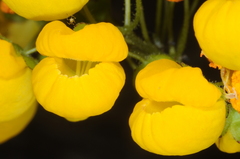
Calceolariaceae 131 claims

family · order Lamiales · 24 taxa · NCBI Taxonomy ↗

24 entries

Observationobservedoriginal resultmeasured

Claim · model-written summary

Both Calceolaria species received pollen from surrounding plants, mainly Adesmia emarginata.

Taxon
Calceolaria speciesCalceolariae0
Interactor
Adesmia emarginataAdesmia emarginatae0other
Outcome
receive pollene0

Verbatim

e0

“The two Calceolaria species were prone to receive pollen from some plants of the surrounding community, mainly Adesmia emarginata.”

✓ located verbatim in the source · abstract, characters 857–987

Title

Nototribic Pollination Reduces Heterospecific Pollen Deposition and Dampens Its Negative Impact on Seed Production in Calceolaria Species

María José Ramírez; Catalina Escanilla-Jaramillo; Maureen Murúa International Journal of Plant Sciences 2023. doi:10.1086/723602

Other claims from this paper (4)
Observationobservedoriginal resultpositivemeasured

Claim · model-written summary

Heterospecific pollen accounted for 10% of deposition in C. filicaulis.

Taxon
C. filicaulisCalceolaria filicaulise0
Outcome
total pollen deposition belonged to heterospecific plant speciese0
Direction
onlye0
Value
10%e0

Verbatim

e0

“in the nototribic species (C. filicaulis), only 10% of the total pollen deposition belonged to heterospecific plant species”

✓ located verbatim in the source · abstract, characters 997–1120

Title

Nototribic Pollination Reduces Heterospecific Pollen Deposition and Dampens Its Negative Impact on Seed Production in Calceolaria Species

María José Ramírez; Catalina Escanilla-Jaramillo; Maureen Murúa International Journal of Plant Sciences 2023. doi:10.1086/723602

Other claims from this paper (4)
Observationobservedoriginal resultnegativemeasured

Claim · model-written summary

Heterospecific pollen accounted for more than 60% of deposition in C. cavanillesii.

Taxon
C. cavanillesiiCalceolaria cavanillesiie0
Outcome
heterospecifice0
Value
more than 60%e0

Verbatim

e0

“in the sternotribic species (C. cavanillesii), more than 60% was heterospecific.”

✓ located verbatim in the source · abstract, characters 1128–1208

Title

Nototribic Pollination Reduces Heterospecific Pollen Deposition and Dampens Its Negative Impact on Seed Production in Calceolaria Species

María José Ramírez; Catalina Escanilla-Jaramillo; Maureen Murúa International Journal of Plant Sciences 2023. doi:10.1086/723602

Other claims from this paper (4)
Intervention effectobservedoriginal resultnegativemeasured

Claim · model-written summary

Adesmia emarginata pollen affected seed production more in C. cavanillesii than C. filicaulis.

Taxon
C. cavanillesiiCalceolaria cavanillesiie0
Treatment
A. emarginata pollen depositione0
Interactor
A. emarginataAdesmia emarginatae0other
Outcome
seed productione0
Comparator
C. filicaulise0

Not reportedDirection

Verbatim

e0

“seed production of C. cavanillesii was more affected by A. emarginata pollen deposition than C. filicaulis pollen.”

✓ located verbatim in the source · abstract, characters 1282–1396

Title

Nototribic Pollination Reduces Heterospecific Pollen Deposition and Dampens Its Negative Impact on Seed Production in Calceolaria Species

María José Ramírez; Catalina Escanilla-Jaramillo; Maureen Murúa International Journal of Plant Sciences 2023. doi:10.1086/723602

Other claims from this paper (4)
Mechanismauthor interpretationoriginal resultpositivebasis n/a

Claim · model-written summary

The authors infer that nototribic morphology can prevent heterospecific pollen deposition.

Taxon
CalceolariaCalceolariat0
Outcome
prepollination barrier to the deposition of heterospecific pollene0
Qualifier
Nototribic morphologye0

Verbatim

e0

“Nototribic morphology can be an effective prepollination barrier to the deposition of heterospecific pollen.”

✓ located verbatim in the source · abstract, characters 1410–1518
t0

“Calceolaria Species”

✓ located verbatim in the source · title, characters 118–137

Title

Nototribic Pollination Reduces Heterospecific Pollen Deposition and Dampens Its Negative Impact on Seed Production in Calceolaria Species

María José Ramírez; Catalina Escanilla-Jaramillo; Maureen Murúa International Journal of Plant Sciences 2023. doi:10.1086/723602

Other claims from this paper (4)
Observationobservedoriginal resultmeasured

Claim · model-written summary

Calceolaria tetragona was suitable for both Cd and Zn phytoremediation.

Taxon
Calceolaria tetragonaCalceolaria tetragonae0
Outcome
suitable for both Cd and Zne0

Verbatim

e0

“Pernettya prostrata Achyrocline alata,Ageratina fastigiate, Baccharis alnifolia, Calceolaria tetragona, Arenaria digyna, Hypericum laricifolium, Brachyotum radula, and Nicotiana thyrsiflora were suitable for both Cd and Zn”

✓ located verbatim in the source · abstract, characters 1036–1258

Title

Accumulation of As, Ag, Cd, Cu, Pb, and Zn by Native Plants Growing in Soils Contaminated by Mining Environmental Liabilities in the Peruvian Andes

Edith Cruzado-Tafur; Katarzyna Bierla; Lisard Torró; et al. Plants 2021. doi:10.3390/plants10020241

Other claims from this paper (19)
Observationobservedoriginal resultmeasured

Claim · model-written summary

Substrate pH increased with limestone dose and time.

Taxon
CalceolariaCalceolariat0
Outcome
substrate solution pHe0

Verbatim

e0

“substrate solution pH increased as limestone incorporation concentration and weeks after transplant (WAT) increased”

✓ located verbatim in the source · abstract, characters 1087–1202
t0

“Calceolaria”

✓ located verbatim in the source · title, characters 12–23

Title

Response of Calceolaria ×herbeohybrida Cultivars to Substrate pH and Corresponding Leaf Tissue Nutrient Concentration Effects

W. Garrett Owen HortScience 2019. doi:10.21273/hortsci14449-19

Other claims from this paper (9)
Observationobservedoriginal resultmeasured

Claim · model-written summary

Limestone did not affect substrate electrical conductivity.

Taxon
CalceolariaCalceolariat0
Outcome
Substrate solution electrical conductivitye0

Verbatim

e0

“Substrate solution electrical conductivity (EC) and growth indices were not influenced by limestone incorporation”

✓ located verbatim in the source · abstract, characters 1464–1577
t0

“Calceolaria”

✓ located verbatim in the source · title, characters 12–23

Title

Response of Calceolaria ×herbeohybrida Cultivars to Substrate pH and Corresponding Leaf Tissue Nutrient Concentration Effects

W. Garrett Owen HortScience 2019. doi:10.21273/hortsci14449-19

Other claims from this paper (9)
Observationobservedoriginal resultmeasured

Claim · model-written summary

Limestone did not affect growth indices.

Taxon
CalceolariaCalceolariat0
Outcome
growth indicese0

Verbatim

e0

“growth indices were not influenced by limestone incorporation”

✓ located verbatim in the source · abstract, characters 1516–1577
t0

“Calceolaria”

✓ located verbatim in the source · title, characters 12–23

Title

Response of Calceolaria ×herbeohybrida Cultivars to Substrate pH and Corresponding Leaf Tissue Nutrient Concentration Effects

W. Garrett Owen HortScience 2019. doi:10.21273/hortsci14449-19

Other claims from this paper (9)
Observationobservedoriginal resultmeasured

Claim · model-written summary

Limestone increased total plant dry mass.

Taxon
CalceolariaCalceolariat0
Outcome
total plant dry masse0

Verbatim

e0

“total plant dry mass increased”

✓ located verbatim in the source · abstract, characters 1583–1613
t0

“Calceolaria”

✓ located verbatim in the source · title, characters 12–23

Title

Response of Calceolaria ×herbeohybrida Cultivars to Substrate pH and Corresponding Leaf Tissue Nutrient Concentration Effects

W. Garrett Owen HortScience 2019. doi:10.21273/hortsci14449-19

Other claims from this paper (9)