
Claim · model-written summary
A root-tip survey identified 115 ectomycorrhizal fungal taxa from 234 Oreomunnea root tips across four sites.
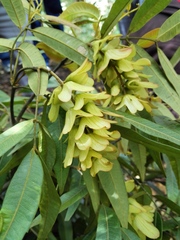 Oreomunnea
Verbatim
e0“In a survey of Oreomunnea root tips using sanger sequencing, I identified 115 EM fungal taxa from 234 EM Oreomunnea root tips collected from four sites across a soil fertility gradient.”
Title
Adriana Corrales IDEALS (University of Illinois Urbana-Champaign) 2016
Other claims from this paper (16)
- Association Oreomunnea-associated EM fungal communities showed high turnover and significant compositional variation with soil fertility.
- Observation Russula was the most abundant and diverse EM genus in the community.
- Association Russula species at sites with contrasting fertility were more phylogenetically dissimilar than expected.
- Mechanism There was no evidence that pathogen resistance generated positive feedback on Oreomunnea abundance.
- Mechanism There was no evidence that mycorrhizal networks generated positive feedback on Oreomunnea abundance.
- Association EM fungi presence was associated with lower inorganic nitrogen availability.
- Mechanism EM fungal nitrogen-cycle tightening made competition difficult for non-EM tree species.
- Intervention effect Nine years of nitrogen addition significantly changed the composition of Oreomunnea-associated EM fungal communities relative to control plots.
- Intervention effect Nitrogen addition increased the relative abundance of Laccaria.
- Intervention effect Nitrogen addition increased the relative abundance of Lactarius.
- Intervention effect Nitrogen addition strongly reduced the relative abundance of Cortinarius.
- Association Russula isotopic composition indicated greater host demand for fungal nitrogen as soil inorganic nitrogen declined.
- Association The results were consistent with increased fungal nitrogen sequestration at higher host abundance.
- Association Host abundance, nitrogen availability and fungal nitrogen transfer to the host were highly correlated.
- Mechanism Associated EM fungi facilitate Oreomunnea-dominated forest formation by altering nitrogen cycling.
- Mechanism The author predicts atmospheric nitrogen deposition could alter EM fungus–host interactions and cause ecosystem changes.
 Russula