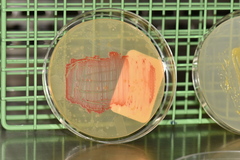
Kocuria rosea 15 claims

species · family Micrococcaceae · bacterium · NCBI Taxonomy ↗

Also written in claims: M. roseus · Micrococcus roseus SW1 — NCBI synonyms: Deinococcus erythromyxa · Kocuria erythromyxa · Kocuria rosea (Flugge 1886) Stackebrandt et al. 1995 · Micrococcus roseus · Micrococcus rubens · Pelczaria aurantia

6 spellings

Kocuria rosea
Kocuria roseaAlan Rockefeller · CC BY 4.0 · iNaturalist ↗
Observationobservedoriginal resultpositivemeasured

Claim · model-written summary

Micrococcus roseus and Staphylococcus aureus were sensitive to the different neem extracts, except the seed extracts at both concentrations.

Taxon
Azadirachta indicaAzadirachta indicat0
Treatment
the different extractse2
Interactor
M. roseusKocuria roseae2other
Second interactor
S. aureusStaphylococcus aureuse2other
Outcome
sensitivee2
Qualifier
except for the seed extracts at both concentrationse2

Verbatim

t0

“neem tree (Azadirachta indica L.)”

✓ located verbatim in the source · title, characters 109–142
e2

“Among the strains, M. roseus and S. aureus were sensitive to the different extracts except for the seed extracts at both concentrations”

✓ located verbatim in the source · abstract, characters 748–883

Title

Preliminary studies on the anti-bacterial effects of water, acetone and ether extracts of different parts of neem tree (Azadirachta indica L.) and neem seed

Arasaratnam, V. Malaysian Journal of Microbiology 2026. doi:10.21161/mjm.230399

Other claims from this paper (6)
Observationobservedoriginal resultpositivemeasured

Claim · model-written summary

Kocuria rosea EH15 had the highest phosphate dissolution, 3.70 μg/mL.

Taxon
Rehmannia glutinosa LiboschRehmannia glutinosat0
Interactor
Kocuria rosea (EH15)Kocuria roseae0symbiont
Outcome
phosphorus dissolution activitye0
Direction
higheste0
Value
3.70 μg/mLe0

Verbatim

e0

“Kocuria rosea (EH15) having the highest phosphorus dissolution activity (3.70 μg/mL)”

✓ located verbatim in the source · abstract, characters 414–498
t0

“Rehmannia glutinosa Libosch”

✓ located verbatim in the source · title, characters 38–65

Title

Isolation of endophytic bacteria from Rehmannia glutinosa Libosch and their potential to promote plant growth

Shanshan Wang; Baoyu Ji; Xiuhong Su; et al. The Journal of General and Applied Microbiology 2020. doi:10.2323/jgam.2019.12.001

Other claims from this paper (12)
Observationobservedoriginal resultpositivemeasured

Claim · model-written summary

EH15 produced 15.36 mg/L IAA with L-tryptophan.

Taxon
Rehmannia glutinosa LiboschRehmannia glutinosat0
Interactor
K. rosea (EH15)Kocuria roseae0symbiont
Outcome
IAA amounte0
Value
15.36 and 7.98 mg/Le0

Verbatim

e0

“The strain K. rosea (EH15) was capable of producing the highest IAA amount (15.36 and 7.98 mg/L) in Luria Bertani (LB) broth containing 0.2% L-tryptophan and lacking L-tryptophan, respectively”

✓ located verbatim in the source · abstract, characters 737–929
t0

“Rehmannia glutinosa Libosch”

✓ located verbatim in the source · title, characters 38–65

Title

Isolation of endophytic bacteria from Rehmannia glutinosa Libosch and their potential to promote plant growth

Shanshan Wang; Baoyu Ji; Xiuhong Su; et al. The Journal of General and Applied Microbiology 2020. doi:10.2323/jgam.2019.12.001

Other claims from this paper (12)
Intervention effectobservedoriginal resultpositivemeasured

Claim · model-written summary

Co-inoculation yielded greater mean cadmium uptake than single inoculations.

Taxon
sunflowerHelianthus annuuse1
Treatment
co-inoculatione0
Interactor
Bacillus safensisBacillus safensise0symbiont
Second interactor
Kocuria roseaKocuria roseae0symbiont
Outcome
Cd uptakee0
Direction
bettere0
Value
13.04 mg pot−1e0
Qualifier
10.68 and 12.58 mg pot−1e0
Comparator
singular inoculatione0

Verbatim

e0

“in average of Cd treatments, the performance of co-inoculation in Cd uptake (13.04 mg pot−1) was better than singular inoculation (10.68 and 12.58 mg pot−1 for Bacillus safensis and Kocuria rosea, respectively).”

✓ located verbatim in the source · abstract, characters 1035–1246
e1

“sunflower growth”

✓ located verbatim in the source · abstract, characters 70–86

Title

Effects of plant growth-promoting bacteria on the phytoremediation of cadmium-contaminated soil by sunflower

Arash Mohammadzadeh; Mojtaba Tavakoli; Babak Motesharezadeh; et al. Archives of Agronomy and Soil Science 2016. doi:10.1080/03650340.2016.1235781

Other claims from this paper (7)
Intervention effectobservedoriginal resultpositivesignificant (as stated)measured

Claim · model-written summary

M. roseus increased maize shoot dry weight at both Ni levels.

Taxon
maizeZea mayst0
Treatment
M. roseuse0
Interactor
M. roseusKocuria roseae0symbiont
Outcome
shoot dry weighte0
Direction
increasede0
Comparator
non-inoculated plantse0

Verbatim

e0

“At each level of Ni contamination, shoot dry weight and nutrients uptake significantly increased in M. roseus and B. mycoides treatments compared to non-inoculated plants”

✓ located verbatim in the source · abstract, characters 306–476
t0

“maize”

✓ located verbatim in the source · title, characters 66–71

Title

Role of Ni-resistant rhizobacteria in the growth and Ni-uptake of maize in a calcareous soil

Elham Malekzadeh; Hossein Ali Alikhani; G. R. Savaghebi-Firoozabadi; et al. Iran agricultural research 2016. doi:10.22099/iar.2016.3767

Other claims from this paper (19)
Intervention effectobservedoriginal resultpositivesignificant (as stated)measured

Claim · model-written summary

M. roseus increased maize nutrient uptake at both Ni levels.

Taxon
maizeZea mayst0
Treatment
M. roseuse0
Interactor
M. roseusKocuria roseae0symbiont
Outcome
nutrients uptakee0
Direction
increasede0
Comparator
non-inoculated plantse0

Verbatim

e0

“At each level of Ni contamination, shoot dry weight and nutrients uptake significantly increased in M. roseus and B. mycoides treatments compared to non-inoculated plants”

✓ located verbatim in the source · abstract, characters 306–476
t0

“maize”

✓ located verbatim in the source · title, characters 66–71

Title

Role of Ni-resistant rhizobacteria in the growth and Ni-uptake of maize in a calcareous soil

Elham Malekzadeh; Hossein Ali Alikhani; G. R. Savaghebi-Firoozabadi; et al. Iran agricultural research 2016. doi:10.22099/iar.2016.3767

Other claims from this paper (19)
Intervention effectobservedoriginal resultpositivemeasured

Claim · model-written summary

M. roseus increased maize biomass by 90% at 500 mg Ni kg -1.

Taxon
maizeZea mayst0
Treatment
M. roseuse0
Interactor
M. roseusKocuria roseae0symbiont
Outcome
plant biomasse0
Direction
enhancede0
Value
90%e0
Qualifier
500 mg Ni kg -1e0
Comparator
non-inoculated plantse0

Verbatim

e0

“The highest plant growth promoting effect was found for B. mycoides at the level of 250 mg Ni kg -1 and for M. roseus at the level of 500 mg Ni kg -1 which enhanced plant biomass by 33.2% and 90%, respectively, compared to non-inoculated plants”

✓ located verbatim in the source · abstract, characters 478–722
t0

“maize”

✓ located verbatim in the source · title, characters 66–71

Title

Role of Ni-resistant rhizobacteria in the growth and Ni-uptake of maize in a calcareous soil

Elham Malekzadeh; Hossein Ali Alikhani; G. R. Savaghebi-Firoozabadi; et al. Iran agricultural research 2016. doi:10.22099/iar.2016.3767

Other claims from this paper (19)
Intervention effectobservedoriginal resultpositivesignificant (as stated)measured

Claim · model-written summary

M. roseus increased maize shoot Ni uptake at both contamination levels.

Taxon
maizeZea mayst0
Treatment
M. roseuse0
Interactor
M. roseusKocuria roseae0symbiont
Outcome
shoot Ni uptakee0
Direction
increasede0
Qualifier
250 and 500 mg Ni kg -1e0
Comparator
non-inoculated plantse0

Verbatim

e0

“At the levels of 250 and 500 mg Ni kg -1 , shoot Ni uptake of plants inoculated with B. mycoides or M. roseus significantly increased compared to non-inoculated plants”

✓ located verbatim in the source · abstract, characters 724–891
t0

“maize”

✓ located verbatim in the source · title, characters 66–71

Title

Role of Ni-resistant rhizobacteria in the growth and Ni-uptake of maize in a calcareous soil

Elham Malekzadeh; Hossein Ali Alikhani; G. R. Savaghebi-Firoozabadi; et al. Iran agricultural research 2016. doi:10.22099/iar.2016.3767

Other claims from this paper (19)
Intervention effectobservedoriginal resultpositivesignificant (as stated)measured

Claim · model-written summary

M. roseus decreased maize root Ni uptake at 250 mg Ni kg -1.

Taxon
maizeZea mayst0
Treatment
M. roseuse0
Interactor
M. roseusKocuria roseae0symbiont
Outcome
Root Ni uptakee0
Direction
decreasede0
Qualifier
250 mg Ni kg -1e0
Comparator
control plantse0

Verbatim

e0

“Root Ni uptake of plants inoculated with B. mycoides and M. roseus significantly decreased at the level of 250 mg Ni kg -1 and increased at the level of 500 mg Ni kg -1 compared to control plants”

✓ located verbatim in the source · abstract, characters 893–1088
t0

“maize”

✓ located verbatim in the source · title, characters 66–71

Title

Role of Ni-resistant rhizobacteria in the growth and Ni-uptake of maize in a calcareous soil

Elham Malekzadeh; Hossein Ali Alikhani; G. R. Savaghebi-Firoozabadi; et al. Iran agricultural research 2016. doi:10.22099/iar.2016.3767

Other claims from this paper (19)
Intervention effectobservedoriginal resultpositivesignificant (as stated)measured

Claim · model-written summary

M. roseus increased maize root Ni uptake at 500 mg Ni kg -1.

Taxon
maizeZea mayst0
Treatment
M. roseuse0
Interactor
M. roseusKocuria roseae0symbiont
Outcome
Root Ni uptakee0
Direction
increasede0
Qualifier
500 mg Ni kg -1e0
Comparator
control plantse0

Verbatim

e0

“Root Ni uptake of plants inoculated with B. mycoides and M. roseus significantly decreased at the level of 250 mg Ni kg -1 and increased at the level of 500 mg Ni kg -1 compared to control plants”

✓ located verbatim in the source · abstract, characters 893–1088
t0

“maize”

✓ located verbatim in the source · title, characters 66–71

Title

Role of Ni-resistant rhizobacteria in the growth and Ni-uptake of maize in a calcareous soil

Elham Malekzadeh; Hossein Ali Alikhani; G. R. Savaghebi-Firoozabadi; et al. Iran agricultural research 2016. doi:10.22099/iar.2016.3767

Other claims from this paper (19)