Cuphea leptopoda 8 claims

species · family Lythraceae · green plant · NCBI Taxonomy ↗

Also written in claims: C. leptopoda Hemsley

3 spellings

Cuphea leptopoda
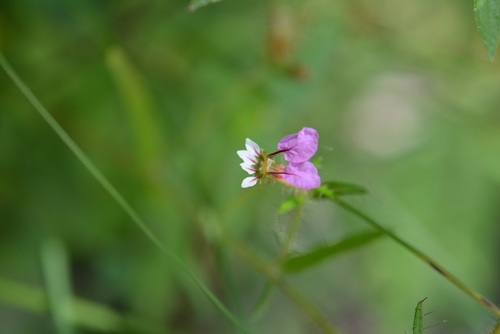
Cuphea leptopodaNeptalí Ramírez Marcial · CC BY 4.0 · iNaturalist ↗
Observationobservedoriginal resultmeasured

Claim · model-written summary

Compact growth habit was identified in populations of Cuphea leptopoda.

Taxon
Cuphea leptopoda HemsleyCuphea leptopodae0
Outcome
compact growth habite0

Verbatim

e0

“Plants with a compact growth habit have been identified in populations of Cuphea leptopoda Hemsley.”

✓ located verbatim in the source · abstract, characters 9–108

Title

Nature and Inheritance of Compact Plant Habit in Cuphea leptopoda Hemsley

Anson E. Thompson HortScience 1989. doi:10.21273/hortsci.24.2.368

Other claims from this paper (5)
Observationobservedoriginal resultmeasured

Claim · model-written summary

A single recessive gene designated si conditioned the primary morphological effect.

Taxon
Cuphea leptopoda HemsleyCuphea leptopodat0
Gene
sie0
Outcome
primary morphological effecte0

Verbatim

e0

“The primary morphological effect has been shown to be conditioned by a single recessive gene, designated si for shortened internodes.”

✓ located verbatim in the source · abstract, characters 109–242
t0

“Cuphea leptopoda Hemsley”

✓ located verbatim in the source · title, characters 49–73

Title

Nature and Inheritance of Compact Plant Habit in Cuphea leptopoda Hemsley

Anson E. Thompson HortScience 1989. doi:10.21273/hortsci.24.2.368

Other claims from this paper (5)
Mechanismobservedoriginal resultnegativemeasured

Claim · model-written summary

Short internodes in compact plants reduced main stem length.

Taxon
Cuphea leptopoda HemsleyCuphea leptopodat0
Outcome
length of the main steme0
Direction
reducede0
Qualifier
Short internodese0

Verbatim

e0

“Short internodes on compact plants result in reduced length of the main stem”

✓ located verbatim in the source · abstract, characters 243–319
t0

“Cuphea leptopoda Hemsley”

✓ located verbatim in the source · title, characters 49–73

Title

Nature and Inheritance of Compact Plant Habit in Cuphea leptopoda Hemsley

Anson E. Thompson HortScience 1989. doi:10.21273/hortsci.24.2.368

Other claims from this paper (5)
Mechanismobservedoriginal resultnegativemeasured

Claim · model-written summary

Short internodes reduced the number and length of primary and secondary branches.

Taxon
Cuphea leptopoda HemsleyCuphea leptopodat0
Outcome
number and length of both primary and secondary branchese0
Direction
reducede0
Qualifier
Short internodese0

Verbatim

e0

“Short internodes on compact plants result in reduced length of the main stem, reduced number and length of both primary and secondary branches”

✓ located verbatim in the source · abstract, characters 243–385
t0

“Cuphea leptopoda Hemsley”

✓ located verbatim in the source · title, characters 49–73

Title

Nature and Inheritance of Compact Plant Habit in Cuphea leptopoda Hemsley

Anson E. Thompson HortScience 1989. doi:10.21273/hortsci.24.2.368

Other claims from this paper (5)
Mechanismobservedoriginal resultnegativemeasured

Claim · model-written summary

Short internodes reduced flowering through fewer flowers per node.

Taxon
Cuphea leptopoda HemsleyCuphea leptopodat0
Outcome
floweringe0
Direction
reducede0
Qualifier
decrease in number of flowers per nodee0

Verbatim

e0

“reduced flowering resulting from a decrease in number of flowers per node on the main stem and branches”

✓ located verbatim in the source · abstract, characters 391–494
t0

“Cuphea leptopoda Hemsley”

✓ located verbatim in the source · title, characters 49–73

Title

Nature and Inheritance of Compact Plant Habit in Cuphea leptopoda Hemsley

Anson E. Thompson HortScience 1989. doi:10.21273/hortsci.24.2.368

Other claims from this paper (5)
Recommendationauthor interpretationoriginal resultpositivebasis n/a

Claim · model-written summary

The authors suggest compact habit and concentrated flowering may have value in new interspecific hybrids.

Taxon
Cuphea leptopoda HemsleyCuphea leptopodat0
Outcome
horticultural and agronomic value in new interspecific hybridse0
Qualifier
maye0

Verbatim

e0

“The compact growth habit and more concentrated flowering of the shortened-internode plants may have horticultural and agronomic value in new interspecific hybrids being developed.”

✓ located verbatim in the source · abstract, characters 496–675
t0

“Cuphea leptopoda Hemsley”

✓ located verbatim in the source · title, characters 49–73

Title

Nature and Inheritance of Compact Plant Habit in Cuphea leptopoda Hemsley

Anson E. Thompson HortScience 1989. doi:10.21273/hortsci.24.2.368

Other claims from this paper (5)
Observationobservedoriginal resultpositivemeasured

Claim · model-written summary

Cuphea leptopoda had fewer than 10% of leaves with intumescences.

Taxon
C. leptopoda HemsleyCuphea leptopodae1
Outcome
leaves with intumescencese1
Value
fewer than 10%e1

Verbatim

e1

“Cuphea koehneana Rose, C. inflata S.A. Graham, C. lanceolata Ait., and C. leptopoda Hemsley had fewer than 10% of the leaves with intumescences”

✓ located verbatim in the source · abstract, characters 225–368

Title

Differences in Leaf Intumescences between Cuphea Species

Casimir A. Jaworski; Max H. Bass; Sharad C. Phatak; et al. HortScience 1988. doi:10.21273/hortsci.23.5.908

Other claims from this paper (7)
Observationobservedoriginal resultmeasured

Claim · model-written summary

C. leptopoda accession 264 had n = 8 whereas the other three accessions had n = 10.

Taxon
C. leptopodaCuphea leptopodae0
Material
accession 264e0
Outcome
number of chromosomese0
Value
n = 8e0
Qualifier
n = 10e0
Comparator
the other three accessionse0

Verbatim

e0

“All accessions within a species were found to have the same number of chromosomes with the exception of C. leptopoda accession 264, which had n = 8, while the other three accessions were n = 10.”

✓ located verbatim in the source · abstract, characters 102–296

Title

Meiotic analysis of 14 Cuphea species and two interspecific hybrids

A. C. Gathman; D. T. Ray Journal of Heredity 1987. doi:10.1093/oxfordjournals.jhered.a110394

Other claims from this paper (4)