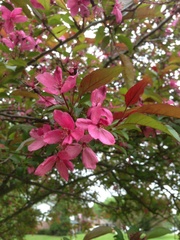
Magnolia hypoleuca 22 claims

species · family Magnoliaceae · green plant · NCBI Taxonomy ↗

3 spellings

Magnolia hypoleuca
Magnolia hypoleucaE-190 · CC BY-SA 3.0 · Wikimedia Commons ↗
Observationauthor interpretationoriginal resultmeasured

Claim · model-written summary

Mistletoe infection was probably described for the first time in four named hybrid or species hosts.

Taxon
Aesculus ×marylandica, Fraxinus biltmoreana, Magnolia hypoleuca ×tripetala or Malus ×moerlandsiiMagnolia hypoleucaFraxinus biltmoreanaMalus ×moerlandsiiAesculus ×marilandicae0
Interactor
Viscum album L.Viscum albumt0parasite
Outcome
described for the first time evere0
Qualifier
probablye0

Verbatim

e0

“In Aesculus ×marylandica, Fraxinus biltmoreana, Magnolia hypoleuca ×tripetala or Malus ×moerlandsii, it was probably described for the first time ever”

✓ located verbatim in the source · abstract, characters 1325–1475
t0

“Viscum album L.”

✓ located verbatim in the source · title, characters 23–38

Title

Extent of infection by Viscum album L. and changes in its occurrence on ornamental woody species in the locality of Lednice (Czech Republic)

Pavel Bulíř Folia Horticulturae 2017. doi:10.1515/fhort-2017-0012

Other claims from this paper (8)
Observationobservedoriginal resultmeasured

Claim · model-written summary

Distribution and population status of Magnolia hypoleuca on Kunashir Island is described.

Taxon
Magnolia hypoleucaMagnolia hypoleucae0
Outcome
distribution and population statust0
Setting
Kunashir Islandt0

Verbatim

t0

“distribution and population status of highly endangered plant species on Kunashir Island”

✓ located verbatim in the source · title, characters 15–103
e0

“Hydrocotyle ramiflora, Bothrocaryum controversum, Daphniphyllum humile, Rhododendron tschonoskii, Schizophragma hydrangeoides, Magnolia hypoleuca, Amitostigma kinoshitae, Tilia maximowicziana and Athyriopsis japonica on the Kunashir Island is described”

✓ located verbatim in the source · abstract, characters 0–252

Title

Additamenta on distribution and population status of highly endangered plant species on Kunashir Island (Southern Kurils)

Polina A. Volkova; Yu. O. Kopylov-Guskov; Daria Zakharchenko Wulfenia 2015

Other claims from this paper (8)
Observationobservedoriginal resultmeasured

Claim · model-written summary

Euseius finlandicus dominated with more than 70% of mites each year.

Taxon
Magnolia hypoleucaMagnolia hypoleucat0
Interactor
Euseius finlandicusEuseius finlandicuse0biocontrol_agent
Outcome
mite specimense0
Direction
most dominante0
Value
more than 70%e0

Verbatim

e0

“Euseius finlandicus was the most dominant species and formed more than 70% of the mite specimens collected during each year.”

✓ located verbatim in the source · abstract, characters 255–379
t0

“Magnolia hypoleuca”

✓ located verbatim in the source · title, characters 47–65

Title

Diversity and abundance of phytoseiid mites on Magnolia hypoleuca Siebold et Zuccarini, a candidate source of natural enemies in natural vegetation

Shingo Toyoshima; Hiroshi Amano Applied Entomology and Zoology 2006. doi:10.1303/aez.2006.349

Other claims from this paper (5)
Observationobservedoriginal resultmeasured

Claim · model-written summary

Amblyseius orientalis was consistently the second dominant mite.

Taxon
Magnolia hypoleucaMagnolia hypoleucat0
Interactor
Amblyseius orientalisAmblyseius orientalise0biocontrol_agent
Outcome
second dominant speciese0

Verbatim

e0

“Amblyseius orientalis was also found consistently as the second dominant species.”

✓ located verbatim in the source · abstract, characters 380–461
t0

“Magnolia hypoleuca”

✓ located verbatim in the source · title, characters 47–65

Title

Diversity and abundance of phytoseiid mites on Magnolia hypoleuca Siebold et Zuccarini, a candidate source of natural enemies in natural vegetation

Shingo Toyoshima; Hiroshi Amano Applied Entomology and Zoology 2006. doi:10.1303/aez.2006.349

Other claims from this paper (5)
Observationobservedoriginal resultmeasured

Claim · model-written summary

Euseius finlandicus density increased from spring to more than 10 adult females per leaf in autumn.

Taxon
Magnolia hypoleucaMagnolia hypoleucat0
Organ / stage
leafe0
Interactor
E. finlandicusEuseius finlandicuse0biocontrol_agent
Outcome
densitye0
Direction
increasede0
Value
more than 10 adult females per leafe0

Verbatim

e0

“E. finlandicus was found in low numbers in spring, and its density increased gradually to more than 10 adult females per leaf in autumn.”

✓ located verbatim in the source · abstract, characters 462–598
t0

“Magnolia hypoleuca”

✓ located verbatim in the source · title, characters 47–65

Title

Diversity and abundance of phytoseiid mites on Magnolia hypoleuca Siebold et Zuccarini, a candidate source of natural enemies in natural vegetation

Shingo Toyoshima; Hiroshi Amano Applied Entomology and Zoology 2006. doi:10.1303/aez.2006.349

Other claims from this paper (5)
Observationobservedoriginal resultmeasured

Claim · model-written summary

Amblyseius orientalis seasonal dynamics varied by year and site.

Taxon
Magnolia hypoleucaMagnolia hypoleucat0
Interactor
A. orientalisAmblyseius orientalise0biocontrol_agent
Outcome
seasonal dynamics of A. orientalise0
Qualifier
depending on the survey years and sitese0

Verbatim

e0

“the seasonal dynamics of A. orientalis showed some variation depending on the survey years and sites”

✓ located verbatim in the source · abstract, characters 608–708
t0

“Magnolia hypoleuca”

✓ located verbatim in the source · title, characters 47–65

Title

Diversity and abundance of phytoseiid mites on Magnolia hypoleuca Siebold et Zuccarini, a candidate source of natural enemies in natural vegetation

Shingo Toyoshima; Hiroshi Amano Applied Entomology and Zoology 2006. doi:10.1303/aez.2006.349

Other claims from this paper (5)
Observationobservedoriginal resultmeasured

Claim · model-written summary

Amblyseius orientalis preyed well on Panonychus ulmi.

Taxon
Magnolia hypoleucaMagnolia hypoleucat0
Interactor
Panonychus ulmiPanonychus ulmie0pest
Second interactor
A. orientalisAmblyseius orientalise0biocontrol_agent
Outcome
good predatory ability on Panonychus ulmie0

Verbatim

e0

“A. orientalis showed a good predatory ability on Panonychus ulmi”

✓ located verbatim in the source · abstract, characters 710–774
t0

“Magnolia hypoleuca Siebold et Zuccarini, a candidate source of natural enemies in natural vegetation”

✓ located verbatim in the source · title, characters 47–147

Title

Diversity and abundance of phytoseiid mites on Magnolia hypoleuca Siebold et Zuccarini, a candidate source of natural enemies in natural vegetation

Shingo Toyoshima; Hiroshi Amano Applied Entomology and Zoology 2006. doi:10.1303/aez.2006.349

Other claims from this paper (5)
Observationobservedoriginal resultmeasured

Claim · model-written summary

Amblyseius orientalis developed and reproduced well on Panonychus ulmi in the laboratory.

Taxon
Magnolia hypoleucaMagnolia hypoleucat0
Interactor
Panonychus ulmiPanonychus ulmie0pest
Second interactor
A. orientalisAmblyseius orientalise0biocontrol_agent
Outcome
developed and reproduced welle0
Setting
laboratorye0

Verbatim

e0

“A. orientalis showed a good predatory ability on Panonychus ulmi, and it developed and reproduced well on this prey in the laboratory.”

✓ located verbatim in the source · abstract, characters 710–844
t0

“Magnolia hypoleuca Siebold et Zuccarini, a candidate source of natural enemies in natural vegetation”

✓ located verbatim in the source · title, characters 47–147

Title

Diversity and abundance of phytoseiid mites on Magnolia hypoleuca Siebold et Zuccarini, a candidate source of natural enemies in natural vegetation

Shingo Toyoshima; Hiroshi Amano Applied Entomology and Zoology 2006. doi:10.1303/aez.2006.349

Other claims from this paper (5)
Observationobservedoriginal resultmeasured

Claim · model-written summary

Magnolia hypoleuca had a short leafy period.

Taxon
Magnolia hypoleuca Siebold & Zucc.Magnolia hypoleucae0
Outcome
leafy periode0
Direction
shorte0

Verbatim

e0

“The mid-successional or gap-phase species, Magnolia hypoleuca Siebold & Zucc., had a short leafy period and high P(sat) and NRMR.”

✓ located verbatim in the source · abstract, characters 667–796

Title

Seasonal and yearly variations in light use and nitrogen use by seedlings of four deciduous broad-leaved tree species invading larch plantations

S. Kitaoka; T. Koike Tree Physiology 2005. doi:10.1093/treephys/25.4.467

Other claims from this paper (12)
Observationobservedoriginal resultmeasured

Claim · model-written summary

Magnolia hypoleuca had high light-saturated photosynthesis and nitrogen remobilization.

Taxon
Magnolia hypoleuca Siebold & Zucc.Magnolia hypoleucae0
Outcome
P(sat) and NRMRe0
Direction
highe0

Verbatim

e0

“The mid-successional or gap-phase species, Magnolia hypoleuca Siebold & Zucc., had a short leafy period and high P(sat) and NRMR.”

✓ located verbatim in the source · abstract, characters 667–796

Title

Seasonal and yearly variations in light use and nitrogen use by seedlings of four deciduous broad-leaved tree species invading larch plantations

S. Kitaoka; T. Koike Tree Physiology 2005. doi:10.1093/treephys/25.4.467

Other claims from this paper (12)