Abstract
Origanum vulgare L. (family Lamiaceae) is a perennial herbaceous species, originating from Mediterranean regions and Asia, widely cultivated as culinary herb and for therapeutic purposes. During spring-summer 2009, 3-4% of potted plants, randomly distributed in protected nurseries of Albenga area (Liguria region), were noted to be stunted and showing a bright yellow leaf mosaic (“calico” type). Mother-plants growing in the same nurseries for cutting production were symptomless. Preliminary electron microscopy observations of leaf-dips prepared from symptomatic and asymptomatic plants, revealed the presence of bacilliform virus-like particles in only symptomatic samples. Symptoms observed on herbaceous hosts mechanically inoculated with crude sap of a single affected plant (isolate Orv-1), were: chloro-necrotic lesions in Chenopodium murale, Beta vulgaris, Phaseolus vulgaris and Vigna unguiculata; systemic mosaic in Capsicum annuum and Nicotiana benthamiana; systemic mosaic and necrotic line-patterns in N. tabacum “Samsun”. The virus was serologically identified as an isolate of Alfalfa mosaic virus (AMV) by applying DAS-ELISA technique and molecularly using AMV-specific oligonucleotides pair, designed to retrotrascribe and amplify the coat protein (CP) gene. Restriction profile obtained after BamHI digestion of the putative CP gene amplicon, identified Orv-1 as an AMV subgroup I isolate (Parrella et al., 2000). A large set of oligonucleotides were used to amplify and sequence the whole RNA3 segment. Sequence analysis revealed that Orv-1 RNA3 was 2038 nucleotides in length, containing two open reading frames (ORFs) identified by sequence comparisons as coding the putative movement proteins (MP) and the CP. The first ORF consisted of 867 residues, coding for the 31 kDa putative MP, the second consisted of 657 residues, coding for the 24 kDa putative CP. Orv-1 RNA3 showed the highest percentage of identity with the RNA3 of the 425 Madison isolate (Acc. n. K02703) also belonging to AMV subgroup I. Phylogenetic relationships of Orv-1 isolate with members of AMV subgroups I and II, clearly showed that both CP and MP nucleotide sequences of this O. vulgare isolate clustered within the subgroup I, confirming preliminary results obtained by restriction analysis of the CP gene. Further works are in progress in order to sequence the entire genome of the Orv-1 AMV isolate. Although AMV was already reported to infect O. vulgare, first in Argentina (Feldman and Gracia, 1977) and then in New Zealand (Fletcher, 1987), to our knowledge this is the first record of AMV infecting this aromatic plant in Italy. This finding confirms an increasing diffusion of AMV in Liguria region, especially in aromatic crops.
Abstract from the paper’s OpenAlex record, shown for indexing and research. Copyright remains with the authors or the publisher. Read at the source ↗
The text the model read, with the source record’s inline markup (italics, sub- and superscripts) rendered and its character entities decoded; quote offsets refer to the raw text.
Claims 15
Claim · model-written summary
Three to four percent of potted Origanum vulgare plants in Albenga nurseries were stunted and showed yellow leaf mosaic.
- Taxon
- ORIGANUM VULGARE
 Origanum vulgaret0
- Interactor
- ALFALFA MOSAIC VIRUS
 Alfamovirus AMVt1pathogen
- Outcome
- stunted and showing a bright yellow leaf mosaice0
- Value
- 3-4%e0
- Setting
- protected nurseries of Albenga area (Liguria region)e0
Organisms pictured · Representative pictures of the matched species, not figures from the paper.


Verbatim
t0“ORIGANUM VULGARE”
t1“ALFALFA MOSAIC VIRUS”
e0“3-4% of potted plants, randomly distributed in protected nurseries of Albenga area (Liguria region), were noted to be stunted and showing a bright yellow leaf mosaic (“calico” type)”
Claim · model-written summary
Mother plants in the same nurseries were symptomless.
- Taxon
- ORIGANUM VULGAREOriganum vulgaret0
- Interactor
- ALFALFA MOSAIC VIRUSAlfamovirus AMVt1pathogen
- Outcome
- symptomlesse0
- Setting
- same nurseriese0
Organisms pictured · Representative pictures of the matched species, not figures from the paper.
Verbatim
t0“ORIGANUM VULGARE”
t1“ALFALFA MOSAIC VIRUS”
e0“Mother-plants growing in the same nurseries for cutting production were symptomless”
Claim · model-written summary
Bacilliform virus-like particles were found only in symptomatic leaf samples.
- Taxon
- ORIGANUM VULGAREOriganum vulgaret0
- Interactor
- ALFALFA MOSAIC VIRUSAlfamovirus AMVt1pathogen
- Outcome
- presence of bacilliform virus-like particlese0
- Qualifier
- only symptomatic samplese0
Organisms pictured · Representative pictures of the matched species, not figures from the paper.
Verbatim
t0“ORIGANUM VULGARE”
t1“ALFALFA MOSAIC VIRUS”
e0“revealed the presence of bacilliform virus-like particles in only symptomatic samples”
Claim · model-written summary
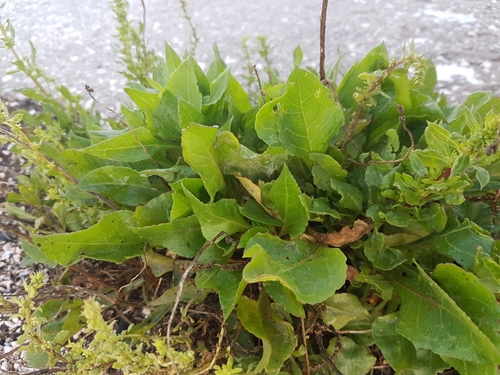
Inoculated Chenopodium murale, Beta vulgaris, and Phaseolus vulgaris showed chloro-necrotic lesions.
- Taxon
- Chenopodium murale, Beta vulgaris, Phaseolus vulgaris and Vigna unguiculata
 Phaseolus vulgaris
 Vigna unguiculata
 Chenopodiastrum murale
 Beta vulgarise0
- Treatment
- mechanically inoculated with crude sap of a single affected plant (isolate Orv-1)e0
- Interactor
- isolate Orv-1e0pathogen
- Outcome
- chloro-necrotic lesionse0
Not reportedComparatorDirection
Organisms pictured · Representative pictures of the matched species, not figures from the paper.


Verbatim
e0“Symptoms observed on herbaceous hosts mechanically inoculated with crude sap of a single affected plant (isolate Orv-1), were: chloro-necrotic lesions in Chenopodium murale, Beta vulgaris, Phaseolus vulgaris and Vigna unguiculata”
Claim · model-written summary
Inoculated Capsicum annuum and Nicotiana benthamiana developed systemic mosaic.
- Taxon
- Capsicum annuum and Nicotiana benthamiana
 Capsicum annuum
 Nicotiana benthamianae0
- Treatment
- mechanically inoculated with crude sap of a single affected plant (isolate Orv-1)e0
- Interactor
- isolate Orv-1e0pathogen
- Outcome
- systemic mosaice0
Not reportedComparatorDirection
Organisms pictured · Representative pictures of the matched species, not figures from the paper.


Verbatim
e0“Symptoms observed on herbaceous hosts mechanically inoculated with crude sap of a single affected plant (isolate Orv-1), were: chloro-necrotic lesions in Chenopodium murale, Beta vulgaris, Phaseolus vulgaris and Vigna unguiculata; systemic mosaic in Capsicum annuum and Nicotiana benthamiana”
Claim · model-written summary
Inoculated N. tabacum Samsun developed systemic mosaic and necrotic line patterns.
- Taxon
- N. tabacum
 Nicotiana tabacume0
- Material
- “Samsun”e0
- Treatment
- mechanically inoculated with crude sap of a single affected plant (isolate Orv-1)e0
- Interactor
- isolate Orv-1e0pathogen
- Outcome
- systemic mosaic and necrotic line-patternse0
Not reportedComparatorDirection
Organisms pictured · Representative pictures of the matched species, not figures from the paper.

Verbatim
e0“Symptoms observed on herbaceous hosts mechanically inoculated with crude sap of a single affected plant (isolate Orv-1), were: chloro-necrotic lesions in Chenopodium murale, Beta vulgaris, Phaseolus vulgaris and Vigna unguiculata; systemic mosaic in Capsicum annuum and Nicotiana benthamiana; systemic mosaic and necrotic line-patterns in N. tabacum “Samsun””
Claim · model-written summary
The virus isolated from Origanum vulgare was identified as Alfalfa mosaic virus.
- Taxon
- ORIGANUM VULGAREOriganum vulgaret0
- Interactor
- Alfalfa mosaic virusAlfamovirus AMVe0pathogen
- Outcome
- identified as an isolate of Alfalfa mosaic viruse0
Organisms pictured · Representative pictures of the matched species, not figures from the paper.
Verbatim
t0“ORIGANUM VULGARE”
e0“The virus was serologically identified as an isolate of Alfalfa mosaic virus (AMV) by applying DAS-ELISA technique and molecularly using AMV-specific oligonucleotides pair”
Claim · model-written summary
The restriction profile classified Orv-1 as an AMV subgroup I isolate.
- Taxon
- ORIGANUM VULGAREOriganum vulgaret0
- Interactor
- AMVe0pathogen
- Gene
- CP genee0
- Outcome
- Orv-1 as an AMV subgroup I isolatee0
Organisms pictured · Representative pictures of the matched species, not figures from the paper.
Verbatim
t0“ORIGANUM VULGARE”
e0“Restriction profile obtained after BamHI digestion of the putative CP gene amplicon, identified Orv-1 as an AMV subgroup I isolate”
Claim · model-written summary
The Orv-1 RNA3 segment measured 2038 nucleotides and contained two open reading frames.
- Taxon
- ORIGANUM VULGAREOriganum vulgaret0
- Interactor
- Orv-1e0pathogen
- Outcome
- Orv-1 RNA3e0
- Value
- 2038 nucleotidese0
Organisms pictured · Representative pictures of the matched species, not figures from the paper.
Verbatim
t0“ORIGANUM VULGARE”
e0“Orv-1 RNA3 was 2038 nucleotides in length, containing two open reading frames (ORFs)”
Claim · model-written summary
The first Orv-1 RNA3 open reading frame comprised 867 residues and coded for a 31 kDa putative movement protein.
- Taxon
- ORIGANUM VULGAREOriganum vulgaret0
- Gene
- putative MPe0
- Outcome
- first ORFe0
- Value
- 867 residuese0
- Qualifier
- 31 kDae0
Organisms pictured · Representative pictures of the matched species, not figures from the paper.
Verbatim
t0“ORIGANUM VULGARE”
e0“The first ORF consisted of 867 residues, coding for the 31 kDa putative MP”
Claim · model-written summary
The second Orv-1 RNA3 open reading frame comprised 657 residues and coded for a 24 kDa putative coat protein.
- Taxon
- ORIGANUM VULGAREOriganum vulgaret0
- Gene
- putative CPe0
- Outcome
- the seconde0
- Value
- 657 residuese0
- Qualifier
- 24 kDae0
Organisms pictured · Representative pictures of the matched species, not figures from the paper.
Verbatim
t0“ORIGANUM VULGARE”
e0“the second consisted of 657 residues, coding for the 24 kDa putative CP”
Claim · model-written summary
Orv-1 RNA3 had its highest identity with the RNA3 of isolate 425 Madison.
- Taxon
- ORIGANUM VULGAREOriganum vulgaret0
- Interactor
- Orv-1e0pathogen
- Outcome
- percentage of identitye0
- Direction
- higheste0
- Comparator
- 425 Madison isolatee0
Organisms pictured · Representative pictures of the matched species, not figures from the paper.
Verbatim
t0“ORIGANUM VULGARE”
e0“Orv-1 RNA3 showed the highest percentage of identity with the RNA3 of the 425 Madison isolate”
Claim · model-written summary
Orv-1 coat and movement protein nucleotide sequences clustered within AMV subgroup I.
- Taxon
- O. vulgareOriganum vulgaree0
- Gene
- CP and MPe0
- Outcome
- clustered within the subgroup Ie0
Organisms pictured · Representative pictures of the matched species, not figures from the paper.
Verbatim
t0“ORIGANUM VULGARE”
e0“both CP and MP nucleotide sequences of this O. vulgare isolate clustered within the subgroup I”
Claim · model-written summary
This is reported as the first record of AMV infecting this aromatic plant in Italy.
- Taxon
- ORIGANUM VULGAREOriganum vulgaret0
- Interactor
- AMVe0pathogen
- Outcome
- first record of AMV infecting this aromatic plante0
- Setting
- Italye0
Organisms pictured · Representative pictures of the matched species, not figures from the paper.
Verbatim
t0“ORIGANUM VULGARE”
e0“this is the first record of AMV infecting this aromatic plant in Italy”
Claim · model-written summary
The finding suggests increasing AMV diffusion in Liguria, especially aromatic crops.
Verbatim
e0“This finding confirms an increasing diffusion of AMV in Liguria region, especially in aromatic crops”
The same questions in other papers
inoculation · disease · Capsicum annuum (sweet pepper)Positive and negative results
11 papers in the same direction as this paper · 7 in the opposite direction
- positive
- positive
- positive
15 papers more in this group
See all 19 papers →inoculation · disease · Beta vulgaris (beet)Positive and negative results
16 papers in the same direction as this paper · 7 in the opposite direction
- positive
- positive
- positive
20 papers more in this group
See all 24 papers →inoculation · disease · Vigna unguiculata (cowpea)Positive and negative results
16 papers in the same direction as this paper · 18 in the opposite direction
- positive
- positive
- positive
31 papers more in this group
See all 35 papers →inoculation · disease · Nicotiana benthamianaPositive and negative results
31 papers in the same direction as this paper · 8 in the opposite direction
- positive
- positive
- positive
36 papers more in this group
See all 40 papers →inoculation · disease · Phaseolus vulgaris (common bean)Positive and negative results
39 papers in the same direction as this paper · 28 in the opposite direction
- positive
- positive
- positive
64 papers more in this group
See all 68 papers →inoculation · disease · Nicotiana tabacum (tobacco)Positive and negative results
49 papers in the same direction as this paper · 37 in the opposite direction
- positive
- positive
- positive
83 papers more in this group
See all 87 papers →inoculation · disease · Chenopodiastrum murale (nettle-leaf goosefoot)Results agree
1 paper in the same direction as this paper
- negative
Claims are grouped by organism, treatment and what was measured or targeted. A paper counts as positive when any of its claims in the group is positive.