Abstract
Soil microbiomes are fundamental to plant health, mediating nutrient cycling, stress tolerance, and pathogen defense. However, soil-borne pathogens such as Bipolaris sorokiniana severely constrain wheat productivity. Despite growing interest, the mechanisms by which beneficial bacterial inoculation reshapes rhizosphere microbial communities to enhance disease resistance remain poorly understood. Here, we isolated three bacterial strains, Streptomyces virginiae CMAA1738, Paenibacillus ottowii CMAA1739, and Pseudomonas inefficax CMAA1741, with antagonistic activity against B. sorokiniana, and evaluated their effects on wheat under controlled conditions. Through plant bioassays, bacterial inoculation reduced disease severity by ~60% and promoted root growth. Metataxonomic and metagenomic analyses revealed shifts in the structure and functional potential of the rhizosphere microbiome. Structural equation modeling indicated that inoculation was the primary driver of microbiome restructuring and disease suppression. Notably, inoculation restored the diversity of plant growth-promoting genes and biosynthetic gene clusters reduced by pathogen infection, enriching functions associated with stress tolerance, nutrient metabolism, and secondary metabolite production. In addition, Random Forest analysis revealed that variation in disease severity under pathogen pressure was associated with differences in bacterial community composition. Together, these findings demonstrate that bacterial inoculation can restructure the rhizosphere microbiome and restore key functional traits linked to plant resilience.
Abstract from the paper’s OpenAlex record; open copy licensed cc-by. Read at the source ↗
The text the model read, with the source record’s inline markup (italics, sub- and superscripts) rendered and its character entities decoded; quote offsets refer to the raw text.
Claims 8
Claim · model-written summary
Three bacterial strains had antagonistic activity against B. sorokiniana.
- Taxon
- wheat
 Triticum aestivumt0
- Interactor
- B. sorokiniana
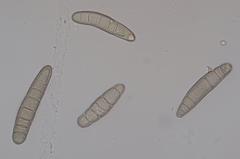 Bipolaris sorokinianae0pathogen
- Second interactor
- Streptomyces virginiae CMAA1738Streptomyces virginiaee0biocontrol_agent
- Outcome
- antagonistic activity against B. sorokinianae0
- Qualifier
- Paenibacillus ottowii CMAA1739, and Pseudomonas inefficax CMAA1741e0
Organisms pictured · Representative pictures of the matched species, not figures from the paper.

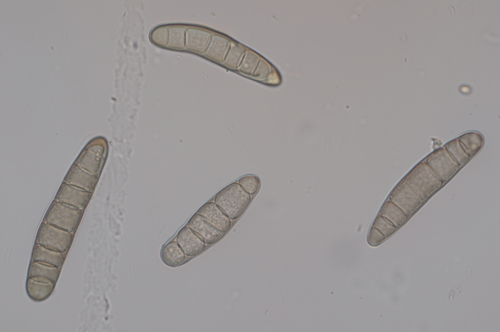
Verbatim
e0“Streptomyces virginiae CMAA1738, Paenibacillus ottowii CMAA1739, and Pseudomonas inefficax CMAA1741, with antagonistic activity against B. sorokiniana”
t0“wheat”
Claim · model-written summary
Bacterial inoculation reduced wheat disease severity by about 60%.
- Taxon
- wheatTriticum aestivumt0
- Treatment
- bacterial inoculatione0
- Interactor
- Bipolaris sorokinianaBipolaris sorokinianae1pathogen
- Outcome
- disease severitye0
- Direction
- reducede0
- Value
- ~60%e0
Not reportedComparator
Organisms pictured · Representative pictures of the matched species, not figures from the paper.
Verbatim
e0“bacterial inoculation reduced disease severity by ~60%”
t0“wheat”
e1“Bipolaris sorokiniana”
Claim · model-written summary
Bacterial inoculation promoted wheat root growth.
- Taxon
- wheatTriticum aestivumt0
- Organ / stage
- roote0
- Treatment
- bacterial inoculatione0
- Outcome
- root growthe0
- Direction
- promotede0
Not reportedComparator
Organisms pictured · Representative pictures of the matched species, not figures from the paper.
Verbatim
e0“bacterial inoculation reduced disease severity by ~60% and promoted root growth”
t0“wheat”
Claim · model-written summary
Bacterial inoculation shifted rhizosphere microbiome structure and functional potential.
- Taxon
- wheatTriticum aestivumt0
- Treatment
- bacterial inoculatione0
- Outcome
- structure and functional potential of the rhizosphere microbiomee1
- Direction
- shiftse1
Not reportedComparator
Organisms pictured · Representative pictures of the matched species, not figures from the paper.
Verbatim
e0“Through plant bioassays, bacterial inoculation”
e1“revealed shifts in the structure and functional potential of the rhizosphere microbiome”
t0“wheat”
Claim · model-written summary
Structural equation modeling identified inoculation as the primary driver of microbiome restructuring and disease suppression.
- Taxon
- wheatTriticum aestivumt0
- Treatment
- inoculatione0
- Outcome
- microbiome restructuring and disease suppressione0
Not reportedDirection
Organisms pictured · Representative pictures of the matched species, not figures from the paper.
Verbatim
e0“inoculation was the primary driver of microbiome restructuring and disease suppression”
t0“wheat”
Claim · model-written summary
Inoculation restored diversity of plant growth-promoting genes and biosynthetic gene clusters reduced by pathogen infection.
- Taxon
- wheatTriticum aestivumt0
- Treatment
- inoculatione0
- Outcome
- diversity of plant growth-promoting genes and biosynthetic gene clusterse0
- Direction
- restorede0
- Qualifier
- reduced by pathogen infectione0
Not reportedComparator
Organisms pictured · Representative pictures of the matched species, not figures from the paper.
Verbatim
e0“inoculation restored the diversity of plant growth-promoting genes and biosynthetic gene clusters reduced by pathogen infection”
t0“wheat”
Claim · model-written summary
Inoculation enriched functions associated with stress tolerance, nutrient metabolism, and secondary metabolite production.
- Taxon
- wheatTriticum aestivumt0
- Treatment
- inoculatione0
- Outcome
- functions associated with stress tolerance, nutrient metabolism, and secondary metabolite productione0
- Direction
- enrichinge0
Not reportedComparator
Organisms pictured · Representative pictures of the matched species, not figures from the paper.
Verbatim
e0“inoculation restored the diversity of plant growth-promoting genes and biosynthetic gene clusters reduced by pathogen infection, enriching functions associated with stress tolerance, nutrient metabolism, and secondary metabolite production”
t0“wheat”
Claim · model-written summary
Under pathogen pressure, disease severity varied with bacterial community composition.
- Taxon
- wheatTriticum aestivumt0
- Interactor
- bacterial communitye0symbiont
- Outcome
- variation in disease severitye0
- Qualifier
- under pathogen pressuree0
Not reportedDirection
Organisms pictured · Representative pictures of the matched species, not figures from the paper.
Verbatim
e0“variation in disease severity under pathogen pressure was associated with differences in bacterial community composition”
t0“wheat”
The same questions in other papers
inoculation · tolerance: abiotic · Triticum aestivum (wheat)Positive and negative results
10 papers in the same direction as this paper · 1 in the opposite direction
- no effect
- positive
- positive
8 papers more in this group
See all 12 papers →inoculation · Bipolaris sorokiniana · Triticum aestivum (wheat)Positive and negative results
9 papers in the same direction as this paper · 4 in the opposite direction
- negative
- no effect
- negative
10 papers more in this group
See all 14 papers →inoculation · molecular: expression · Triticum aestivum (wheat)Positive and negative results
37 papers in the same direction as this paper · 9 in the opposite direction
- no effect
- no effect
- no effect
43 papers more in this group
See all 47 papers →inoculation · soil: biology · Triticum aestivum (wheat)Positive and negative results
57 papers in the same direction as this paper · 7 in the opposite direction
- negative
- negative
- no effect
61 papers more in this group
See all 65 papers →inoculation · growth · Triticum aestivum (wheat)Positive and negative results
475 papers in the same direction as this paper · 55 in the opposite direction · 1 reporting no difference from an alternative
- no effect
- no effect
- no effect
528 papers more in this group
See all 532 papers →Claims are grouped by organism, treatment and what was measured or targeted. A paper counts as positive when any of its claims in the group is positive.