View: List Claim type Research area Organism Taxon as written Decade Paper Mechanism hypothesis original result basis n/a Claim · model-written summary
Autumn initiation probably fits these far northern grasses better to their environment.
Autumn initiation e5 probably better fits them to their environment e5 Verbatim
t0 “Alaskan Gramineae ”
✓ located verbatim in the source · title, characters 21–38 e5 “Autumn initiation is a phenomenon of these far northern grasses that probably better fits them to their environment ”
✓ located verbatim in the source · abstract, characters 411–526 Other claims from this paper (5) Mechanism author interpretation original result measured Claim · model-written summary
The third heterosis hypothesis, a faster hybrid growth rate, fits all aspects of the nutrient-dependent heterosis phenomenon remarkably well.
fits all aspects of the nutrient-dependent heterosis phenomenon e0 remarkably well e0 Verbatim
e0 “The third hypothesis fits all aspects of the nutrient-dependent heterosis phenomenon remarkably well ”
✓ located verbatim in the source · abstract, characters 1450–1550 e1 “tomato yield ”
✓ located verbatim in the source · abstract, characters 105–117 Other claims from this paper (4) Mechanism author interpretation original result measured Claim · model-written summary
Lower abundance of herbivores on introduced plants fits the enemy release hypothesis.
Lower abundance of herbivores e2 enemy release hypothesis e2 Verbatim
e1 “introduced Chinese tallow tree (Sapium sebiferum ) ”
✓ located verbatim in the source · abstract, characters 42–91 e2 “Lower abundance of herbivores on introduced species of plants fits the enemy release hypothesis ”
✓ located verbatim in the source · abstract, characters 1228–1323 Other claims from this paper (11) Mechanism author interpretation original result measured Claim · model-written summary
The author concludes that the candidate gene fits a UV-B photoreceptor phenotype.
phenotype of a UV-B photoreceptor e0 Not reported Direction
Verbatim
e0 “I conclude that the candidate gene fits the phenotype of a UV-B photoreceptor ”
✓ located verbatim in the source · abstract, characters 822–899 t0 “Arabidopsis thaliana
✓ located verbatim in the source · title, characters 54–74 Other claims from this paper (4) Mechanism author interpretation original result measured Claim · model-written summary
Low defence-compound concentration with few herbivores fits the evolution of increased competitive ability hypothesis.
defense compounds e2 low concentration of defense compounds e2 evolution of increased competitive ability hypothesis e2 Verbatim
e1 “introduced Chinese tallow tree (Sapium sebiferum ) ”
✓ located verbatim in the source · abstract, characters 42–91 e2 “low concentration of defense compounds in the face of low number of herbivores fits the evolution of increased competitive ability hypothesis ”
✓ located verbatim in the source · abstract, characters 1329–1470 Other claims from this paper (11) Mechanism author interpretation original result measured Claim · model-written summary
A single dominant gene model also fits yellow corolla colour.
single dominant gene e0 yellow corolla phenotype e0 Verbatim
e0 “The yellow corolla phenotype also supported a single dominant gene model. ”
✓ located verbatim in the source · abstract, characters 837–910 t0 “Gossypium arboreum
✓ located verbatim in the source · title, characters 67–85 Other claims from this paper (5) Mechanism author interpretation original result basis n/a Claim · model-written summary
The pattern fits a slow development of rice exploitation from wild foraging to full cultivation.
slow development of rice exploitation e5 from wild foraging to agriculture involving full cultivation e5 Verbatim
t0 “Approaching rice domestication in South Asia ”
✓ located verbatim in the source · title, characters 0–44 e5 “This pattern fits with a model of the slow development of rice exploitation from wild foraging to agriculture involving full cultivation ”
✓ located verbatim in the source · abstract, characters 1133–1269 Other claims from this paper (6) Mechanism author interpretation original result basis n/a Claim · model-written summary
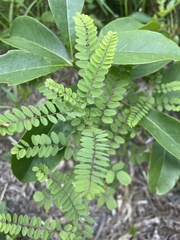
The 3.5-fold germination increase at pyrogenic temperatures suggests Amorpha georgiana is highly fire-adapted and fits obligate pyrogenic dormancy release.
highly fire-adapted e1 obligate pyrogenic dormancy release e1 Verbatim
t0 “Amorpha georgiana
✓ located verbatim in the source · title, characters 68–85 e1 “The 3.5-fold increase in germination at pyrogenic temperatures suggests the response is highly fire-adapted and fits the definition of obligate pyrogenic dormancy release ”
✓ located verbatim in the source · abstract, characters 1689–1859 Other claims from this paper (9) Mechanism author interpretation original result simulated Claim · model-written summary
Modelling suggests that SA binds to the same site where the pyrimidine group of the NADP+ cofactor fits .
pyrimidine group of the cofactor e4 Verbatim
e0 “the A1 isomer of chloroplastic glyceraldehyde 3-phosphate dehydrogenase (GAPA1) from Arabidopsis thaliana binds SA with a KD of 16.7 nM ”
✓ located verbatim in the source · abstract, characters 647–782 e4 “modelling suggests that SA binds to the very site where the pyrimidine group of the cofactor fits ”
✓ located verbatim in the source · abstract, characters 1843–1940 Other claims from this paper (8) Mechanism hypothesis original result basis n/a Claim · model-written summary
The compilospecies model fits the evolution of Armeria filicaulis , though less closely than for A. villosa .
evolution of this species e6 compilospecies model e6 Verbatim
e1 “A new subspecies of the Betic-Riffean species Armeria filicaulis is formally described ”
✓ located verbatim in the source · abstract, characters 0–86 e6 “The patterns detected (and inferred events) in A. filicaulis throughout its area suggest that the compilospecies model fits the evolution of this species ”
✓ located verbatim in the source · abstract, characters 921–1074 Other claims from this paper (5) Lexical search (BM25). All words must match; if nothing does, any word. Organism names also match every spelling of the same organism. No semantic search yet.
 Solanum lycopersicum
 Triadica sebifera
 Arabidopsis thaliana
 Gossypium arboreum
 Oryza sativa
 Amorpha georgiana