View: List Claim type Research area Organism Taxon as written Decade Paper Intervention effect observed original result no effect not significant (as stated) measured Claim · model-written summary
In creasing orchard density did not significantly decrease yield.
increasing the density e0 does not decrease e0 Not reported Comparator
Verbatim
t0 “SOUR CHERRY ”
✓ located verbatim in the source · title, characters 80–91 e0 “in creasing the density in the orchard, the yield does not decrease significantly ”
✓ located verbatim in the source · abstract, characters 1858–1938 Other claims from this paper (13) Association observed original result negative significant (as stated) measured Claim · model-written summary
In creasing nutsedge density was associated with a significant linear decrease in seed cotton yield
Increasing nutsedge density e0 seed cotton yield e0 Verbatim
t0 “yellow nutsedge (Cyperus esculentus ) density on cotton (Gossypium hirsutum ) ”
✓ located verbatim in the source · title, characters 29–104 e0 “In creasing nutsedge density caused a significant linear decrease in seed cotton yield ”
✓ located verbatim in the source · abstract, characters 230–315 Other claims from this paper (9) Mechanism author interpretation original result measured Claim · model-written summary
Conditions in ducing more cell enlargement were in terpreted to decrease sclereid density .
sclereid density e0 more cell enlargement inducing condition e0 Verbatim
e0 “more cell enlargement in ducing condition result in a decrease in the sclereid density in pear fruits. ”
✓ located verbatim in the source · abstract, characters 1347–1448 Other claims from this paper (7) Observation observed original result no effect not significant (as stated) measured Claim · model-written summary
Nutrient density unit under ORD did not decrease significantly.
nutrient density unit (NDU) e0 did not decrease e0 Verbatim
e0 “its nutrient density unit (NDU) did not decrease significantly due to the additional duck yield ”
✓ located verbatim in the source · abstract, characters 540–635 t0 “rice–duck coculture ”
✓ located verbatim in the source · title, characters 93–112 Other claims from this paper (5) Association observed original result measured Claim · model-written summary
Amylopectin content continued to decrease with in creasing machine transplanting density .
increase in machine transplanting density e4 amylopectin content e6 continued to decrease e6 Verbatim
e1 “good taste rice cultivars (GTRC) ”
✓ located verbatim in the source · abstract, characters 73–105 e4 “with the in crease in machine transplanting density ”
✓ located verbatim in the source · abstract, characters 969–1019 e6 “while the amylopectin content continued to decrease ”
✓ located verbatim in the source · abstract, characters 1021–1072 Other claims from this paper (12) Association observed original result measured Claim · model-written summary
Lipid bodies decrease in electron density when tubular ER appears in Funaria stomatal development.
Lipid bodies e3 electron density e3 when tubular ER appears e3 Verbatim
e3 “Lipid bodies decrease in electron density when tubular ER appears ”
✓ located verbatim in the source · abstract, characters 401–466 e7 “stomatal development in Funaria hygrometrica Hedw. (Musci) were characterized ”
✓ located verbatim in the source · abstract, characters 29–106 Other claims from this paper (6) Intervention effect observed original result positive measured Claim · model-written summary
Both application timings caused a similar decrease in subsequent pest population density .
pest population density e0 Not reported Treatment Comparator
Verbatim
e0 “leading to a similar decrease in pest population density in the following year ”
✓ located verbatim in the source · abstract, characters 812–890 t0 “cork oak forests ”
✓ located verbatim in the source · title, characters 109–125 Other claims from this paper (4) Intervention effect observed original result positive measured Claim · model-written summary
Management relaxation was associated with a decrease in vegetation density .
management relaxation e1 vegetation density e1 Not reported Comparator
Verbatim
t0 “mountain grasslands ”
✓ located verbatim in the source · title, characters 69–88 e1 “A higher butterfly abundance and species richness following management relaxation was mostly driven by a decrease in vegetation density and an in crease in forb cover. ”
✓ located verbatim in the source · abstract, characters 1208–1374 Other claims from this paper (2) Association observed original result measured Claim · model-written summary
In Gladiolus , K can decrease as density rises, with no depth change evident.
with increasing density e0 Verbatim
e0 “For Gladiolus it was established that K can decrease with in creasing density but no changes with depth in the canopy were evident. ”
✓ located verbatim in the source · abstract, characters 1404–1534 Other claims from this paper (5) Observation observed original result measured Claim · model-written summary
Biomass did not in crease simultaneously with density decrease in the first data set.
Biomass increase and density decrease e0 Verbatim
e0 “Biomass in crease and density decrease was not found to take place in any of these simultaneously ”
✓ located verbatim in the source · abstract, characters 534–630 t0 “Galium aparine L.
✓ located verbatim in the source · title, characters 99–116 Other claims from this paper (9) Lexical search (BM25). All words must match; if nothing does, any word. Organism names also match every spelling of the same organism. No semantic search yet.
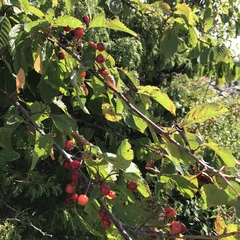 Prunus cerasust0
 Gossypium hirsutum
 Pyrus communis
 Oryza sativa
 Funaria hygrometrica
 Quercus suber
 Gladiolus
 Galium aparine