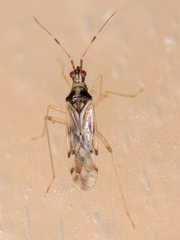
Miridae 55 claims

family · order Hemiptera · 15 taxa · NCBI Taxonomy ↗

15 entries

Observationobservedoriginal resultmeasured

Claim · model-written summary

Nesidiocoris tenuis was identified as a predator on T. absoluta in tomato fields.

Taxon
Nesidiocoris tenuisNesidiocoris tenuise0
Interactor
T. absolutaTuta absolutae0pest
Outcome
were identified on T. absolutae0
Setting
Amuda and Derbasiyah sub-district of Al-Hasake Governorate, Syriae1

Verbatim

e0

“Five parasitoids and predators were identified on T. absoluta, namely: Hemiptera (Homoptera) predators: Nesidiocoris tenuis (Miridae), Orius sp. (Anthocoridae) and Neuroptera predator Chrysopa sp. (Chrysopidae), Hymenoptera parasitoids; Bracon (Habrobracon) sp. (Braconidae) and Ratzeburgiola sp. (Eulophidae).”

✓ located verbatim in the source · abstract, characters 982–1292
e1

“Field applied research was conducted in tomato fields at Amuda and Derbasiyah sub-district of Al-Hasake Governorate, Syria, during the seasons 2016 to 2018.”

✓ located verbatim in the source · abstract, characters 606–762

Title

Investigation the Spread of Natural Enemies Associated with The Tomato Leaf Miner, Tuta absoluta in Al-Hasakeh Governorate, Syria

Amoda, El-Hasakeh, Syria; Ali Darwish; Abdel Nabi Basheer; et al. Arab Journal Of Plant Protection 2024. doi:10.22268/ajpp-001253

Other claims from this paper (4)
Associationobservedoriginal resultmeasured

Claim · model-written summary

Generalist predators correlated with Adelphocoris lineolatus.

Taxon
A. lineolatusAdelphocoris lineolatuse0
Interactor
A. lineolatusAdelphocoris lineolatuse0pest
Outcome
correlatede0

Not reportedDirection

Verbatim

e0

“A number of generalist predators were correlated with A. lineolatus and Lygus spp.”

✓ located verbatim in the source · abstract, characters 1155–1237

Title

Seasonal abundance of key alfalfa (Fabaceae) seed production pests and their natural enemies in southern Alberta, Canada

Aldo F. Ríos Martínez; Michelle Reid; Carol M. Frost; et al. The Canadian Entomologist 2024. doi:10.4039/tce.2024.21

Other claims from this paper (7)
Associationobservedoriginal resultmeasured

Claim · model-written summary

Generalist predators correlated with Lygus spp.

Taxon
Lygus spp.Lyguse0
Interactor
Lygus spp.Lyguse0pest
Outcome
correlatede0

Not reportedDirection

Verbatim

e0

“A number of generalist predators were correlated with A. lineolatus and Lygus spp.”

✓ located verbatim in the source · abstract, characters 1155–1237

Title

Seasonal abundance of key alfalfa (Fabaceae) seed production pests and their natural enemies in southern Alberta, Canada

Aldo F. Ríos Martínez; Michelle Reid; Carol M. Frost; et al. The Canadian Entomologist 2024. doi:10.4039/tce.2024.21

Other claims from this paper (7)
Observationobservedoriginal resultmeasured

Claim · model-written summary

Macrolophus pygmaeus consumed more unparasitized than parasitized Tuta absoluta eggs.

Taxon
Macrolophus pygmaeusMacrolophus pygmaeuse0
Interactor
Tuta absolutaTuta absolutae0pest
Outcome
eggs of Tuta absolutae0
Direction
moree0
Comparator
parasitizede0

Verbatim

e0

“Macrolophus pygmaeus consumed more unparasitized than parasitized eggs of Tuta absoluta”

✓ located verbatim in the source · abstract, characters 990–1077
e1

“tomato crops”

✓ located verbatim in the source · abstract, characters 67–79

Title

Feeding preference and intraguild interactions between the parasitoid Trichogramma achaeae and the predator Macrolophus pygmaeus, two biological agents of Tuta absoluta

Isabel Borges; Luisa Oliveira; Ana Durão; et al. Pest Management Science 2023. doi:10.1002/ps.7635

Other claims from this paper (5)
Observationobservedoriginal resultmeasured

Claim · model-written summary

Mixed diets showed a preference for unparasitized Tuta absoluta eggs.

Taxon
M. pygmaeusMacrolophus pygmaeuse2
Interactor
Tuta absolutaTuta absolutae1pest
Outcome
feeding preference for unparasitized eggse0

Verbatim

e0

“Under mixed diet regimes, Manly indices revealed a feeding preference for unparasitized eggs”

✓ located verbatim in the source · abstract, characters 1079–1171
e1

“single diets of Tuta absoluta eggs parasitized”

✓ located verbatim in the source · abstract, characters 369–415
e2

“voracity of M. pygmaeus females”

✓ located verbatim in the source · abstract, characters 330–361

Title

Feeding preference and intraguild interactions between the parasitoid Trichogramma achaeae and the predator Macrolophus pygmaeus, two biological agents of Tuta absoluta

Isabel Borges; Luisa Oliveira; Ana Durão; et al. Pest Management Science 2023. doi:10.1002/ps.7635

Other claims from this paper (5)
Observationauthor interpretationoriginal resultmeasured

Claim · model-written summary

Conspecific M. pygmaeus interactions suggested intraspecific competition.

Taxon
M. pygmaeusMacrolophus pygmaeuse0
Outcome
possible occurrence of intraspecific competitione0

Verbatim

e0

“Conspecific interactions between M. pygmaeus, in contrast to Trichogramma achaeae, revealed the possible occurrence of intraspecific competition”

✓ located verbatim in the source · abstract, characters 1374–1518

Title

Feeding preference and intraguild interactions between the parasitoid Trichogramma achaeae and the predator Macrolophus pygmaeus, two biological agents of Tuta absoluta

Isabel Borges; Luisa Oliveira; Ana Durão; et al. Pest Management Science 2023. doi:10.1002/ps.7635

Other claims from this paper (5)
Associationobservedoriginal resultsignificant (as stated)measured

Claim · model-written summary

Nesidiocoris tenuis population correlated negatively with sunshine hours (r=-0.65*).

Taxon
Nesidiocoris tenuisNesidiocoris tenuise0
Treatment
sunshine hourse0
Interactor
snake gourdTrichosanthes cucumerinat0host
Outcome
populatione0
Direction
negativee0
Value
r=-0.65*e0

Verbatim

e0

“mirid bug, Nesidiocoris tenuis (Reuter) population exhibited significant negative correlation with sunshine hours (r=-0.65*)”

✓ located verbatim in the source · abstract, characters 1131–1255
t0

“snake gourd”

✓ located verbatim in the source · title, characters 66–77

Title

Pest spectrum and population dynamics of major pests occurring on snake gourd (Trichosanthes cucumerina var. anguina )

K.N. Sharath; K.S. Jagadish; K. Muralimohan; et al. Pest Management in Horticultural Ecosystems 2021. doi:10.5958/0974-4541.2021.00009.6

Other claims from this paper (7)
Observationobservedoriginal resultmeasured

Claim · model-written summary

Reproductive and development rates of D. hesperus were higher on E. kuehniella eggs than on potato psyllid nymphs.

Taxon
Dicyphus hesperusDicyphus hesperust0
Outcome
reproductive and development ratese0
Direction
highere0
Qualifier
E. kuehniella eggse0

Verbatim

t0

“Dicyphus hesperus”

✓ located verbatim in the source · title, characters 16–33
e0

“Although reproductive and development rates were higher on E. kuehniella eggs”

✓ located verbatim in the source · abstract, characters 535–612

Title

The potential ofDicyphus hesperusas a biological control agent of potato psyllid and sweetpotato whitefly in tomato

F.J. Calvo; A. Torres; E.J. González; et al. Bulletin of Entomological Research 2018. doi:10.1017/s0007485318000020

Other claims from this paper (4)
Observationobservedoriginal resultpositivemeasured

Claim · model-written summary

D. hesperus fed on B. cockerelli nymphs had an intrinsic rate of natural increase (rm) of 0.069 ± 0.0001.

Taxon
Dicyphus hesperusDicyphus hesperust0
Interactor
B. cockerelliBactericera cockerellie0pest
Outcome
intrinsic rate of natural increasee0
Value
0.069 ± 0.0001e1

Verbatim

t0

“Dicyphus hesperus”

✓ located verbatim in the source · title, characters 16–33
e0

“the predator exhibited a good intrinsic rate of natural increase (rm) when feeding on B. cockerelli nymphs”

✓ located verbatim in the source · abstract, characters 614–720
e1

“rm: B. cockerelli 0.069 ± 0.0001; E. kuehniella 0.078 ± 0.0001”

✓ located verbatim in the source · abstract, characters 722–784

Title

The potential ofDicyphus hesperusas a biological control agent of potato psyllid and sweetpotato whitefly in tomato

F.J. Calvo; A. Torres; E.J. González; et al. Bulletin of Entomological Research 2018. doi:10.1017/s0007485318000020

Other claims from this paper (4)
Observationobservedoriginal resultmeasured

Claim · model-written summary

D. hesperus fed on E. kuehniella eggs had an intrinsic rate of natural increase (rm) of 0.078 ± 0.0001.

Taxon
Dicyphus hesperusDicyphus hesperust0
Interactor
E. kuehniellaEphestia kuehniellae1other
Outcome
intrinsic rate of natural increasee0
Value
0.078 ± 0.0001e1

Verbatim

t0

“Dicyphus hesperus”

✓ located verbatim in the source · title, characters 16–33
e0

“the predator exhibited a good intrinsic rate of natural increase (rm) when feeding on B. cockerelli nymphs”

✓ located verbatim in the source · abstract, characters 614–720
e1

“rm: B. cockerelli 0.069 ± 0.0001; E. kuehniella 0.078 ± 0.0001”

✓ located verbatim in the source · abstract, characters 722–784

Title

The potential ofDicyphus hesperusas a biological control agent of potato psyllid and sweetpotato whitefly in tomato

F.J. Calvo; A. Torres; E.J. González; et al. Bulletin of Entomological Research 2018. doi:10.1017/s0007485318000020

Other claims from this paper (4)