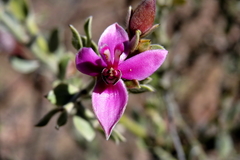
Krameriaceae 96 claims

family · order Zygophyllales · 10 taxa · NCBI Taxonomy ↗

10 entries

Observationobservedoriginal resultmeasured

Claim · model-written summary

C. xanthomelaena obtained floral oil from Krameria sp.

Taxon
Krameria sp.Krameriae0
Interactor
C. xanthomelaenae0pollinator
Outcome
obtain this resourcee0

Verbatim

e0

“C. xanthomelaena also interacted with Angelonia cornigera and Krameria sp. to obtain this resource.”

✓ located verbatim in the source · abstract, characters 1410–1509

Title

Range and trophic niche overlap of two sympatric species of floral oil collecting bees in a fragment of dry forest

Herbeson O. J. Martins; Marcos C. Dórea; Vinina S. Ferreira; et al. Frontiers in Bee Science 2024. doi:10.3389/frbee.2024.1383589

Other claims from this paper (9)
Observationobservedoriginal resultmeasured

Claim · model-written summary

Several parasitic genera prefer Caribbean dry forests, thickets and coastal vegetation.

Taxon
KrameriaKrameriae0
Outcome
preferred ecosystemse0
Setting
Caribbean Regione0

Verbatim

e0

“Dry forests and thickets, and coastal vegetation of the Caribbean Region are the preferred ecosystems for Krameria (Krameriaceae), Sanguisuga , Acanthosyris (Cervantesiaceae), Maracanthus (Loranthaceae), Ximenia (Ximeniaceae), Lennoa (Ehretiaceae), and Anisantherina (Orobanchaceae)”

✓ located verbatim in the source · abstract, characters 999–1281

Title

The Remarkable Diversity of Parasitic Flowering Plants in Colombia

Favio González; Natalia Pabón-Mora The Botanical Review 2023. doi:10.1007/s12229-023-09294-w

Other claims from this paper (15)
Observationobservedoriginal resultmeasured

Claim · model-written summary

The listed lineages show obligate root hemiparasitism.

Taxon
KrameriaKrameriae0
Outcome
root obligate hemiparasitice0

Verbatim

e0

“the root obligate hemiparasitic Krameria , Gaiadendron (Loranthaceae), and all Cervantesiaceae, Opiliaceae, Schoepfiaceae, Strombosiaceae and Ximeniaceae”

✓ located verbatim in the source · abstract, characters 1656–1809

Title

The Remarkable Diversity of Parasitic Flowering Plants in Colombia

Favio González; Natalia Pabón-Mora The Botanical Review 2023. doi:10.1007/s12229-023-09294-w

Other claims from this paper (15)
Observationobservedoriginal resultmeasured

Claim · model-written summary

Krameria plastomes have essentially intact coding sequences.

Taxon
KrameriaKrameriae0
Outcome
essentially intact coding sequencese0

Verbatim

e0

“We find that Krameria plastomes have essentially intact coding sequences”

✓ located verbatim in the source · abstract, characters 1144–1216

Title

Plastid Genomes of the Hemiparasitic GenusKrameria(Zygophyllales) Are Intact and Exhibit Little Relaxation in Selection

Arjan Banerjee; Adam C. Schneider; Saša Stefanović International Journal of Plant Sciences 2022. doi:10.1086/719959

Other claims from this paper (5)
Mechanismobservedoriginal resultmeasured

Claim · model-written summary

The unexpected increase in Krameria plastome size is due to accumulation of elevated numbers of tandem repeats in the intergenic spaces of the large and small single-copy regions.

Taxon
KrameriaKrameriat0
Outcome
increase in their sizese1
Qualifier
tandem repeats in the intergenic spacese1

Verbatim

e1

“the unexpected increase in their sizes is due to the accumulation of elevated numbers of tandem repeats in the intergenic spaces of the large and small single-copy regions”

✓ located verbatim in the source · abstract, characters 1226–1397
t0

“Plastid Genomes of the Hemiparasitic GenusKrameria”

✓ located verbatim in the source · title, characters 0–50

Title

Plastid Genomes of the Hemiparasitic GenusKrameria(Zygophyllales) Are Intact and Exhibit Little Relaxation in Selection

Arjan Banerjee; Adam C. Schneider; Saša Stefanović International Journal of Plant Sciences 2022. doi:10.1086/719959

Other claims from this paper (5)
Observationobservedoriginal resultmeasured

Claim · model-written summary

Photosynthetic genes in Krameria are maintained under purifying selection, with dN/dS values commensurate with those of autotrophic plant lineages.

Taxon
KrameriaKrameriat0
Gene
Photosynthetic genese2
Outcome
maintained under purifying selectione2
Qualifier
dN/dS values commensurate with those observed in lineages of autotrophic plantse2

Verbatim

e2

“Photosynthetic genes are maintained under purifying selection with dN/dS values commensurate with those observed in lineages of autotrophic plants”

✓ located verbatim in the source · abstract, characters 1399–1545
t0

“Plastid Genomes of the Hemiparasitic GenusKrameria”

✓ located verbatim in the source · title, characters 0–50

Title

Plastid Genomes of the Hemiparasitic GenusKrameria(Zygophyllales) Are Intact and Exhibit Little Relaxation in Selection

Arjan Banerjee; Adam C. Schneider; Saša Stefanović International Journal of Plant Sciences 2022. doi:10.1086/719959

Other claims from this paper (5)
Observationobservedoriginal resultmeasured

Claim · model-written summary

Krameria has the largest and the most intact plastid genomes reported to date from parasitic angiosperms.

Taxon
KrameriaKrameriae3
Outcome
largest and the most intact plastid genomese3

Verbatim

e3

“Krameria contains both the largest and the most intact plastid genomes reported to date from parasitic angiosperms”

✓ located verbatim in the source · abstract, characters 1559–1673

Title

Plastid Genomes of the Hemiparasitic GenusKrameria(Zygophyllales) Are Intact and Exhibit Little Relaxation in Selection

Arjan Banerjee; Adam C. Schneider; Saša Stefanović International Journal of Plant Sciences 2022. doi:10.1086/719959

Other claims from this paper (5)
Observationauthor interpretationoriginal resultbasis n/a

Claim · model-written summary

The authors suggest that Krameria plants are still reliant on photosynthesis as an important part of their nutrient acquisition strategy.

Taxon
KrameriaKrameriat0
Outcome
still reliant on photosynthesis as an important part of their nutrient acquisition strategye4

Verbatim

e4

“Our results suggest that these plants are still reliant on photosynthesis as an important part of their nutrient acquisition strategy”

✓ located verbatim in the source · abstract, characters 1675–1808
t0

“Plastid Genomes of the Hemiparasitic GenusKrameria”

✓ located verbatim in the source · title, characters 0–50

Title

Plastid Genomes of the Hemiparasitic GenusKrameria(Zygophyllales) Are Intact and Exhibit Little Relaxation in Selection

Arjan Banerjee; Adam C. Schneider; Saša Stefanović International Journal of Plant Sciences 2022. doi:10.1086/719959

Other claims from this paper (5)
Observationauthor interpretationoriginal resultbasis n/a

Claim · model-written summary

The authors suggest that plastid genomes of Krameria remain evolutionarily stable.

Taxon
KrameriaKrameriae5
Outcome
remain evolutionarily stablee5

Verbatim

e5

“plastid genomes of Krameria remain evolutionarily stable”

✓ located verbatim in the source · abstract, characters 1818–1874

Title

Plastid Genomes of the Hemiparasitic GenusKrameria(Zygophyllales) Are Intact and Exhibit Little Relaxation in Selection

Arjan Banerjee; Adam C. Schneider; Saša Stefanović International Journal of Plant Sciences 2022. doi:10.1086/719959

Other claims from this paper (5)
Observationobservedoriginal resultmeasured

Claim · model-written summary

Krameria lappacea achieved an extraction yield of 17.6%.

Taxon
Krameria lappaceaKrameria lappaceae1
Outcome
extraction yielde1
Value
17.6%e1

Verbatim

e1

“the species Krameria lappacea, whose extraction yield (economic factor) achieved 17.6%”

✓ located verbatim in the source · abstract, characters 467–553

Title

Antifungal Efficacy and Convenience of Krameria lappacea for the Development of Botanical Fungicides and New Alternatives of Antifungal Treatment

Martin Zabka Agronomy 2022. doi:10.3390/agronomy12112599

Other claims from this paper (6)