Cephalozia bicuspidata 15 claims

species · family Cephaloziaceae · green plant · NCBI Taxonomy ↗

NCBI synonyms: Jungermannia bicuspidata

6 spellings

Cephalozia bicuspidata
Cephalozia bicuspidataHermannSchachner · Public domain · Wikimedia Commons ↗
Observationobservedoriginal resultmeasured

Claim · model-written summary

Rhizoscyphus ericae forms nutritional mutualisms with Cephalozia bicuspidata rhizoids.

Taxon
Cephalozia bicuspidataCephalozia bicuspidatae0
Organ / stage
rhizoidse0
Interactor
R. ericaeHyaloscypha hepaticicolae0symbiont
Outcome
nutritional mutualismse0

Verbatim

e0

“R. ericae forms nutritional mutualisms with the rhizoids of Cephalozia bicuspidata”

✓ located verbatim in the source · abstract, characters 1774–1856

Title

Advances in understanding of mycorrhizal-like associations in bryophytes

SILVIA PRESSEL; MARTIN I. BIDARTONDO; KATIE J. FIELD; et al. Bryophyte Diversity and Evolution 2021. doi:10.11646/bde.43.1.20

Other claims from this paper (7)
Observationobservedoriginal resultmeasured

Claim · model-written summary

Fungal-acquired phosphorus was transferred to the liverwort Cephalozia bicuspidata.

Taxon
Cephalozia bicuspidataCephalozia bicuspidatae1
Interactor
Pezoloma ericaeHyaloscypha hepaticicolae2symbiont
Outcome
transfer of fungal-acquired P to the liverworte0

Verbatim

e0

“transfer of fungal-acquired P to the liverwort”

✓ located verbatim in the source · abstract, characters 903–949
e1

“Cephalozia bicuspidata”

✓ located verbatim in the source · abstract, characters 462–484
e2

“Pezoloma ericae”

✓ located verbatim in the source · abstract, characters 137–152

Title

From rhizoids to roots? Experimental evidence of mutualism between liverworts and ascomycete fungi

Jill Kowal; Silvia Pressel; Jeffrey G Duckett; et al. Annals of Botany 2017. doi:10.1093/aob/mcx126

Other claims from this paper (5)
Observationobservedoriginal resultmeasured

Claim · model-written summary

Liverwort-fixed carbon was transferred to the fungus.

Taxon
Cephalozia bicuspidataCephalozia bicuspidatae1
Interactor
Pezoloma ericaeHyaloscypha hepaticicolae2symbiont
Outcome
liverwort-fixed C to the funguse0

Verbatim

e0

“of liverwort-fixed C to the fungus”

✓ located verbatim in the source · abstract, characters 954–988
e1

“Cephalozia bicuspidata”

✓ located verbatim in the source · abstract, characters 462–484
e2

“Pezoloma ericae”

✓ located verbatim in the source · abstract, characters 137–152

Title

From rhizoids to roots? Experimental evidence of mutualism between liverworts and ascomycete fungi

Jill Kowal; Silvia Pressel; Jeffrey G Duckett; et al. Annals of Botany 2017. doi:10.1093/aob/mcx126

Other claims from this paper (5)
Intervention effectobservedoriginal resultpositivemeasured

Claim · model-written summary

Fungus-colonized liverworts showed increased growth compared with liverworts without Pezoloma ericae.

Taxon
Cephalozia bicuspidataCephalozia bicuspidatae1
Treatment
fungus-colonizede0
Interactor
Pezoloma ericaeHyaloscypha hepaticicolae2symbiont
Outcome
growthe0
Direction
increasede0
Comparator
without P. ericaee3

Verbatim

e0

“increased growth in fungus-colonized liverworts”

✓ located verbatim in the source · abstract, characters 999–1046
e3

“with and without P. ericae”

✓ located verbatim in the source · abstract, characters 724–750
e1

“Cephalozia bicuspidata”

✓ located verbatim in the source · abstract, characters 462–484
e2

“Pezoloma ericae”

✓ located verbatim in the source · abstract, characters 137–152

Title

From rhizoids to roots? Experimental evidence of mutualism between liverworts and ascomycete fungi

Jill Kowal; Silvia Pressel; Jeffrey G Duckett; et al. Annals of Botany 2017. doi:10.1093/aob/mcx126

Other claims from this paper (5)
Observationobservedoriginal resultmeasured

Claim · model-written summary

Six named liverwort taxa show distinct affinity for human disturbed habitats.

Taxon
Cephalozia bicuspidata, Nardia scalaris, Solenostoma gracillimum, Scapania curta, S. umbrosa and Lophozia sudeticaCephalozia bicuspidataNardia scalarisSolenostoma gracillimumScapania curtaScapania umbrosaBarbilophozia sudeticae0
Outcome
distinct hemerophilous featurese0

Verbatim

e0

“Cephalozia bicuspidata, Nardia scalaris, Solenostoma gracillimum, Scapania curta, S. umbrosa and Lophozia sudetica display distinct hemerophilous features”

✓ located verbatim in the source · abstract, characters 345–499

Title

The effects of hikers' paths on the distribution of liverworts in the Tatra Mountains (Western Carpathians).

Piotr Górski Cryptogamie Bryologie 2009

Other claims from this paper (9)
Observationobservedoriginal resultmeasured

Claim · model-written summary

Cephalozia bicuspidata leads on tourist trails.

Taxon
Cephalozia bicuspidataCephalozia bicuspidatae0
Outcome
Leading plant speciese0
Setting
on tourist trailse0

Verbatim

e0

“Leading plant species are Cephalozia bicuspidata in typical synanthropic habitats (on tourist trails)”

✓ located verbatim in the source · abstract, characters 501–602

Title

The effects of hikers' paths on the distribution of liverworts in the Tatra Mountains (Western Carpathians).

Piotr Górski Cryptogamie Bryologie 2009

Other claims from this paper (9)
Observationobservedoriginal resultmeasured

Claim · model-written summary

A community with Cephalozia bicuspidata has a new floristic combination.

Taxon
Cephalozia bicuspidataCephalozia bicuspidatae0
Outcome
new floristic combinationse0

Verbatim

e0

“formation of plant communities with new floristic combinations (community with Cephalozia bicuspidata)”

✓ located verbatim in the source · abstract, characters 1138–1240

Title

The effects of hikers' paths on the distribution of liverworts in the Tatra Mountains (Western Carpathians).

Piotr Górski Cryptogamie Bryologie 2009

Other claims from this paper (9)
Observationobservedoriginal resultmeasured

Claim · model-written summary

Mniaecia remained extracellular in the resynthesized association with Cephalozia.

Taxon
Cephalozia bicuspidata (L.) Dumort.Cephalozia bicuspidatae1
Interactor
MniaeciaMniaeciae0parasite
Outcome
remained extracellulare0

Verbatim

e0

“Mniaecia remained extracellular”

✓ located verbatim in the source · abstract, characters 367–398
e1

“Cephalozia bicuspidata (L.) Dumort.”

✓ located verbatim in the source · abstract, characters 122–157

Title

The parasitic ascomyceteMniaecia jungermanniaeinduces the formation of giant perichaetia and apogamous sporophytes in leafy liverworts

Silvia Pressel; Jeffrey G Duckett Canadian Journal of Botany 2006. doi:10.1139/b06-004

Other claims from this paper (7)
Observationobservedreview summarybasis n/a

Claim · model-written summary

Mniacea jungermanniae does not colonize host rhizoids.

Taxon
Cephalozia bicuspidataCephalozia bicuspidatae0
Interactor
Mniacea jungermanniaee0symbiont
Outcome
does not colonize the rhizoidse0

Verbatim

e0

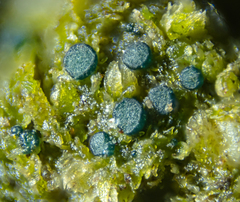
“Mniacea jungermanniae, that forms blue-green apothecia on the stems of Cephalozia bicuspidata, does not colonize the rhizoids of its hepatic hosts”

✓ located verbatim in the source · abstract, characters 3737–3883

Title

In vitro cultivation of bryophytes: a review of practicalities, problems, progress and promise

Jeffrey G. Duckett; Jane Burch; Paul W. Fletcher; et al. Journal of Bryology 2004. doi:10.1179/174328213x13789822578469

Other claims from this paper (19)
Observationobservedoriginal resultmeasured

Claim · model-written summary

Liverworts with underground axes could regenerate better to around 12 cm and were found at 24–30 cm depth.

Taxon
Kurzia pauciflora (Dicks.) Grolle, K. sylvatica (Evans) Grolle, Odontoschisma sphagni (Dicks.) Dum., O. denudatum (Mart.) Dum., Cladopodiella fluitans (Nees) Buch, Cephalozia bicuspidata (L.) Dum. and C. connivens (Dicks.) Lindb.Cephalozia bicuspidataOdontoschisma denudatumFuscocephaloziopsis connivensOdontoschisma fluitansOdontoschisma sphagniKurzia paucifloraKurzia sylvaticae0
Organ / stage
underground axese0
Outcome
regeneratee0
Direction
much bettere0
Value
12 cme0
Qualifier
24–30 cm depthe0

Verbatim

e0

“Other species such as Kurzia pauciflora (Dicks.) Grolle, K. sylvatica (Evans) Grolle, Odontoschisma sphagni (Dicks.) Dum., O. denudatum (Mart.) Dum., Cladopodiella fluitans (Nees) Buch, Cephalozia bicuspidata (L.) Dum. and C. connivens (Dicks.) Lindb. which have underground axes, may regenerate poorly at the surface, much better down to 12 cm or so, and arc still found at 24–30 cm depth”

✓ located verbatim in the source · abstract, characters 442–831

Title

Regeneration of bog liverworts

J. G. DUCKETT; R. S. CLYMO New Phytologist 1988. doi:10.1111/j.1469-8137.1988.tb00244.x

Other claims from this paper (5)