Abstract
Factors responsible for a decline in wheat yields in some paddocks in the Gunnedah (northern New South Wales) area were investigated in a series of field experiments. Yield decline is not apparent on soils cultivated for less than 10 years, and barley and sorghum crops are not affected. Plant nutrition apparently is not a major factor in the decline, because, although there was a small response to zinc application in 1 experiment, wheat yields were not significantly increased by the application of N, P, K, Cu, Mg, B, Mn, Mo or S in a paddock where the yield of wheat was half that of the surrounding barley crop. Fumigation of the soil with methyl bromide increased wheat cv. Timgalen yield by 78% to equal that of barley cv. Clipper in a second experiment. Large numbers of root lesion nematodes (Pratylenchus thornei) were associated with unfumigated wheat plots, with smaller numbers present on barley plots. In a third experiment, the grain yields of all of the 9 cereal genotypes tested were increased when sown with 4 kg/ha of aldicarb. The relative yield increase associated with aldicarb showed good correlation with the reputed tolerance of the genotypes to P. thornei. Pratylenchus thornei occurred to a depth of 120 cm. Aldicarb did not affect P. thornei numbers below 15 cm, while methyl bromide controlled P. thornei to depths of 30-90 cm. Aldicarb virtually eliminated P. thornei from the surface 10 cm of soil, but had no effect on the incidence of the fungal diseases common root rot (Bipolaris sorokiniana) or crown rot (Fusarium graminearum). Soil fumigation with methyl bromide controlled B. sorokiniana and F. graminearum as well as P. thornei and gave yields 9% higher than did treatment with aldicarb. In another experiment, ethylene dibromide (2.7-10.8 L/ha) had no consistent effect on the yield of wheat or numbers of P. thornei while terbufos (0.6 and 1.2 kg/ha) gave a small reduction in P. thornei numbers and a small increase in yield. These data indicate that P. thornei is at least partially responsible for wheat yield decline in parts of northern New South Wales.
Abstract from the paper’s OpenAlex record, shown for indexing and research. Copyright remains with the authors or the publisher. Read at the source ↗
The text the model read, with the source record’s inline markup (italics, sub- and superscripts) rendered and its character entities decoded; quote offsets refer to the raw text.
Claims 19
Claim · model-written summary
Wheat yield decline was absent on soils cultivated for less than 10 years.
- Taxon
- wheat
 Triticum aestivumt0
- Outcome
- Yield declinee0
- Qualifier
- soils cultivated for less than 10 yearse0
Organisms pictured · Representative pictures of the matched species, not figures from the paper.

Verbatim
e0“Yield decline is not apparent on soils cultivated for less than 10 years”
t0“wheat yield decline”
Claim · model-written summary
Barley and sorghum crops were unaffected by yield decline.
- Taxon
- barley and sorghum
 Hordeum vulgare
 Sorghume0
- Outcome
- not affectede0
Organisms pictured · Representative pictures of the matched species, not figures from the paper.


Verbatim
e0“barley and sorghum crops are not affected”
Claim · model-written summary
Zinc application gave a small wheat yield response in one experiment.
Not reportedTaxonComparator
Verbatim
e0“there was a small response to zinc application in 1 experiment”
Claim · model-written summary
Applications of multiple nutrients did not significantly increase wheat yield.
- Taxon
- wheatTriticum aestivume0
- Treatment
- application of N, P, K, Cu, Mg, B, Mn, Mo or Se0
- Outcome
- wheat yieldse0
- Direction
- not significantly increasede0
Not reportedComparator
Organisms pictured · Representative pictures of the matched species, not figures from the paper.
Verbatim
e0“wheat yields were not significantly increased by the application of N, P, K, Cu, Mg, B, Mn, Mo or S”
Claim · model-written summary
Methyl bromide fumigation increased Timgalen wheat yield by 78%, equalling Clipper barley.
- Taxon
- wheatTriticum aestivume0
- Material
- Timgalene0
- Treatment
- Fumigation of the soil with methyl bromidee0
- Outcome
- yielde0
- Direction
- increasede0
- Value
- 78%e0
- Comparator
- barley cv. Clippere0
Organisms pictured · Representative pictures of the matched species, not figures from the paper.
Verbatim
e0“Fumigation of the soil with methyl bromide increased wheat cv. Timgalen yield by 78% to equal that of barley cv. Clipper”
Claim · model-written summary
More Pratylenchus thornei were associated with unfumigated wheat plots than barley plots.
- Taxon
- wheatTriticum aestivume0
- Treatment
- unfumigatede0
- Interactor
- Pratylenchus thorneiPratylenchus thorneie0pest
- Outcome
- Large numbers of root lesion nematodes (Pratylenchus thornei)e0
- Direction
- Large numberse0
- Comparator
- barley plotse0
Organisms pictured · Representative pictures of the matched species, not figures from the paper.
Verbatim
e0“Large numbers of root lesion nematodes (Pratylenchus thornei) were associated with unfumigated wheat plots, with smaller numbers present on barley plots”
Claim · model-written summary
Aldicarb increased grain yields of all nine tested cereal genotypes.
- Taxon
- cereale0
- Material
- 9 cereal genotypese0
- Treatment
- 4 kg/ha of aldicarbe0
- Outcome
- grain yieldse0
- Direction
- increasede0
Not reportedComparator
Verbatim
e0“the grain yields of all of the 9 cereal genotypes tested were increased when sown with 4 kg/ha of aldicarb”
Claim · model-written summary
Yield response to aldicarb correlated with genotype tolerance to P. thornei.
- Treatment
- aldicarbe0
- Interactor
- P. thorneiPratylenchus thorneie0pest
- Outcome
- relative yield increasee0
Not reportedTaxonDirection
Verbatim
e0“The relative yield increase associated with aldicarb showed good correlation with the reputed tolerance of the genotypes to P. thornei”
Claim · model-written summary
Pratylenchus thornei occurred to 120 cm depth.
- Interactor
- Pratylenchus thorneiPratylenchus thorneie0pest
- Outcome
- Pratylenchus thornei occurrede0
- Value
- 120 cme0
Not reportedTaxon
Verbatim
e0“Pratylenchus thornei occurred to a depth of 120 cm”
Claim · model-written summary
Aldicarb did not affect deep P. thornei numbers.
- Treatment
- Aldicarbe0
- Interactor
- P. thorneiPratylenchus thorneie0pest
- Outcome
- P. thornei numberse0
- Direction
- did not affecte0
- Qualifier
- below 15 cme0
Not reportedTaxonComparator
Verbatim
e0“Aldicarb did not affect P. thornei numbers below 15 cm”
Claim · model-written summary
Methyl bromide controlled P. thornei at 30–90 cm depth.
- Treatment
- methyl bromidee0
- Interactor
- P. thorneiPratylenchus thorneie0pest
- Outcome
- P. thorneie0
- Direction
- controllede0
- Value
- 30-90 cme0
Not reportedTaxonComparator
Verbatim
e0“methyl bromide controlled P. thornei to depths of 30-90 cm”
Claim · model-written summary
Aldicarb nearly eliminated surface P. thornei.
- Treatment
- Aldicarbe0
- Interactor
- P. thorneiPratylenchus thorneie0pest
- Outcome
- P. thorneie0
- Direction
- virtually eliminatede0
- Qualifier
- surface 10 cm of soile0
Not reportedTaxonComparator
Verbatim
e0“Aldicarb virtually eliminated P. thornei from the surface 10 cm of soil”
Claim · model-written summary
Aldicarb did not affect common root rot or crown rot incidence.
- Interactor
- Bipolaris sorokiniana
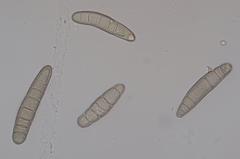 Bipolaris sorokinianae0pathogen
- Second interactor
- Fusarium graminearum
 Fusarium graminearume0pathogen
- Outcome
- incidence of the fungal diseases common root rot (Bipolaris sorokiniana) or crown rot (Fusarium graminearum)e0
- Direction
- no effecte0
Not reportedTaxonTreatmentComparator
Organisms pictured · Representative pictures of the matched species, not figures from the paper.
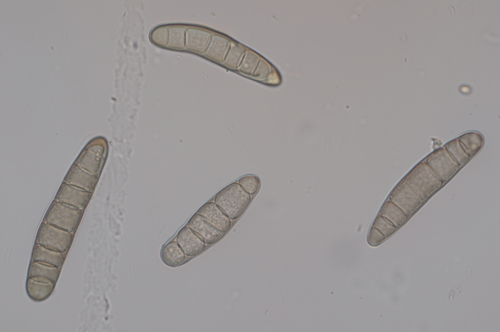

Verbatim
e0“had no effect on the incidence of the fungal diseases common root rot (Bipolaris sorokiniana) or crown rot (Fusarium graminearum)”
Claim · model-written summary
Methyl bromide controlled two fungal pathogens and P. thornei.
- Treatment
- Soil fumigation with methyl bromidee0
- Interactor
- P. thorneiPratylenchus thorneie0pest
- Second interactor
- B. sorokinianaBipolaris sorokinianae0pathogen
- Outcome
- B. sorokiniana and F. graminearum as well as P. thorneie0
- Direction
- controllede0
Not reportedTaxonComparator
Organisms pictured · Representative pictures of the matched species, not figures from the paper.
Verbatim
e0“Soil fumigation with methyl bromide controlled B. sorokiniana and F. graminearum as well as P. thornei”
Claim · model-written summary
Methyl bromide produced 9% higher yields than aldicarb.
Not reportedTaxonTreatment
Verbatim
e0“gave yields 9% higher than did treatment with aldicarb”
Claim · model-written summary
Ethylene dibromide had no consistent effect on wheat yield or P. thornei numbers.
- Taxon
- wheatTriticum aestivume0
- Treatment
- ethylene dibromide (2.7-10.8 L/ha)e0
- Interactor
- P. thorneiPratylenchus thorneie0pest
- Outcome
- yield of wheat or numbers of P. thorneie0
- Direction
- no consistent effecte0
Not reportedComparator
Organisms pictured · Representative pictures of the matched species, not figures from the paper.
Verbatim
e0“ethylene dibromide (2.7-10.8 L/ha) had no consistent effect on the yield of wheat or numbers of P. thornei”
Claim · model-written summary
Terbufos slightly reduced P. thornei numbers.
- Treatment
- terbufos (0.6 and 1.2 kg/ha)e0
- Interactor
- P. thorneiPratylenchus thorneie0pest
- Outcome
- P. thornei numberse0
- Direction
- reductione0
Not reportedTaxonComparator
Verbatim
e0“terbufos (0.6 and 1.2 kg/ha) gave a small reduction in P. thornei numbers”
Claim · model-written summary
Terbufos slightly increased wheat yield.
Not reportedTaxonComparator
Verbatim
e0“terbufos (0.6 and 1.2 kg/ha) gave a small reduction in P. thornei numbers and a small increase in yield”
Claim · model-written summary
The authors concluded that P. thornei partly causes regional wheat yield decline.
- Taxon
- wheatTriticum aestivume0
- Interactor
- P. thorneiPratylenchus thorneie0pest
- Outcome
- wheat yield declinee0
- Qualifier
- at least partiallye0
- Setting
- northern New South Walese0
Organisms pictured · Representative pictures of the matched species, not figures from the paper.
Verbatim
e0“P. thornei is at least partially responsible for wheat yield decline in parts of northern New South Wales”
The same questions in other papers
molybdenum atom · yield · Triticum aestivum (wheat)Results differ
6 papers in the same direction as this paper · 19 in the opposite direction
- positive
- positive
- positive
22 papers more in this group
See all 26 papers →magnesium atom · yield · Triticum aestivum (wheat)Results differ
8 papers in the same direction as this paper · 27 in the opposite direction
- positive
- positive
- positive
32 papers more in this group
See all 36 papers →manganese atom · yield · Triticum aestivum (wheat)Results differ
3 papers in the same direction as this paper · 61 in the opposite direction
- positive
- positive
- positive
61 papers more in this group
See all 65 papers →copper atom · yield · Triticum aestivum (wheat)Results differ
11 papers in the same direction as this paper · 63 in the opposite direction
- positive
- positive
- positive
71 papers more in this group
See all 75 papers →bromomethane · yield · Triticum aestivum (wheat)Positive and negative results
3 papers in the same direction as this paper · 1 in the opposite direction
- negative
- positive
- positive
1 paper more in this group
See all 5 papers →bromomethane · Pratylenchus thornei · Triticum aestivum (wheat)Results agree
1 paper in the same direction as this paper
- positive
terbufos · yield · Triticum aestivum (wheat)Results agree
1 paper in the same direction as this paper
- positive
aldicarb · Pratylenchus thornei · Triticum aestivum (wheat)Results agree
2 papers in the same direction as this paper
- positive
- positive
8 of 13 groups shown: named compounds and organisms first, then groups whose results differ (checked claim by claim), then those with positive and negative results, then the smaller groups.
Claims are grouped by organism, treatment and what was measured or targeted. A paper counts as positive when any of its claims in the group is positive.