Abstract
Salinity is an environmental stress that causes decline in crop yield. Avicennia officinalis and other mangroves have adaptations such as ultrafiltration at the roots aided by apoplastic cell wall barriers to thrive in saline conditions. We studied a cytochrome P450 gene from A. officinalis, AoCYP94B1, and its putative ortholog in Arabidopsis (Arabidopsis thaliana), AtCYP94B1, which are involved in apoplastic barrier formation. Both genes were induced by 30 min of salt treatment in the roots. Heterologous expression of AoCYP94B1 in the atcyp94b1 Arabidopsis mutant and wild-type rice (Oryza sativa) conferred increased NaCl tolerance to seedlings by enhancing root suberin deposition. Histochemical staining and gas chromatography-tandem mass spectrometry quantification of suberin precursors confirmed the role of CYP94B1 in suberin biosynthesis. Using chromatin immunoprecipitation and yeast one-hybrid and luciferase assays, we identified AtWRKY33 as the upstream regulator of AtCYP94B1 in Arabidopsis. In addition, atwrky33 mutants exhibited reduced suberin and salt-sensitive phenotypes, which were rescued by expressing 35S::AtCYP94B1 in the atwrky33 background. This further confirmed that AtWRKY33-mediated regulation of AtCYP94B1 is part of the salt tolerance mechanism. Our findings may help efforts aimed at generating salt-tolerant crops.
Abstract from the paper’s OpenAlex record; open copy licensed cc-by. Read at the source ↗
The text the model read, with the source record’s inline markup (italics, sub- and superscripts) rendered and its character entities decoded; quote offsets refer to the raw text.
Claims 9
Claim · model-written summary
AoCYP94B1 was induced by salt in roots.
- Taxon
- Avicennia officinalis
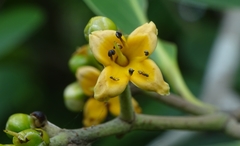 Avicennia officinalist0
- Organ / stage
- rootse0
- Treatment
- 30 min of salt treatmente0
- Outcome
- inducede0
- Direction
- inducede0
Not reportedGeneComparator
Organisms pictured · Representative pictures of the matched species, not figures from the paper.

Verbatim
e0“Both genes were induced by 30 min of salt treatment in the roots”
t0“Avicennia officinalis”
Claim · model-written summary
AoCYP94B1 expression increased NaCl tolerance in Arabidopsis seedlings.
- Taxon
- Arabidopsis
 Arabidopsise0
- Material
- atcyp94b1 Arabidopsis mutante0
- Treatment
- Heterologous expression of AoCYP94B1e0
- Gene
- AoCYP94B1e0
- Outcome
- NaCl tolerancee0
- Direction
- increasede0
Not reportedComparator
Organisms pictured · Representative pictures of the matched species, not figures from the paper.

Verbatim
e0“Heterologous expression of AoCYP94B1 in the atcyp94b1 Arabidopsis mutant and wild-type rice (Oryza sativa) conferred increased NaCl tolerance to seedlings by enhancing root suberin deposition”
Claim · model-written summary
AoCYP94B1 expression increased NaCl tolerance in rice seedlings.
- Taxon
- rice
 Oryza sativae0
- Material
- wild-type ricee0
- Treatment
- Heterologous expression of AoCYP94B1e0
- Gene
- AoCYP94B1e0
- Outcome
- NaCl tolerancee0
- Direction
- increasede0
Not reportedComparator
Organisms pictured · Representative pictures of the matched species, not figures from the paper.

Verbatim
e0“Heterologous expression of AoCYP94B1 in the atcyp94b1 Arabidopsis mutant and wild-type rice (Oryza sativa) conferred increased NaCl tolerance to seedlings by enhancing root suberin deposition”
Claim · model-written summary
AoCYP94B1 expression enhanced root suberin deposition in Arabidopsis.
- Taxon
- ArabidopsisArabidopsise0
- Gene
- AoCYP94B1e0
- Outcome
- root suberin depositione0
- Qualifier
- enhancinge0
Organisms pictured · Representative pictures of the matched species, not figures from the paper.
Verbatim
e0“Heterologous expression of AoCYP94B1 in the atcyp94b1 Arabidopsis mutant and wild-type rice (Oryza sativa) conferred increased NaCl tolerance to seedlings by enhancing root suberin deposition”
Claim · model-written summary
CYP94B1 participates in suberin biosynthesis.
- Taxon
- Arabidopsis thalianaArabidopsis thalianat0
- Gene
- CYP94B1e0
- Outcome
- suberin biosynthesise0
Organisms pictured · Representative pictures of the matched species, not figures from the paper.
Verbatim
e0“Histochemical staining and gas chromatography-tandem mass spectrometry quantification of suberin precursors confirmed the role of CYP94B1 in suberin biosynthesis”
t0“Arabidopsis (Arabidopsis thaliana)”
Claim · model-written summary
AtWRKY33 regulates AtCYP94B1 upstream in Arabidopsis.
- Taxon
- ArabidopsisArabidopsise0
- Gene
- AtWRKY33e0
- Outcome
- upstream regulator of AtCYP94B1e0
Organisms pictured · Representative pictures of the matched species, not figures from the paper.
Verbatim
e0“we identified AtWRKY33 as the upstream regulator of AtCYP94B1 in Arabidopsis”
Claim · model-written summary
atwrky33 mutants had reduced suberin.
- Taxon
- Arabidopsis thalianaArabidopsis thalianat0
- Material
- atwrky33 mutantse0
- Outcome
- suberine0
- Direction
- reducede0
Organisms pictured · Representative pictures of the matched species, not figures from the paper.
Verbatim
e0“atwrky33 mutants exhibited reduced suberin and salt-sensitive phenotypes”
t0“Arabidopsis (Arabidopsis thaliana)”
Claim · model-written summary
atwrky33 mutants were salt sensitive.
- Taxon
- Arabidopsis thalianaArabidopsis thalianat0
- Material
- atwrky33 mutantse0
- Outcome
- salt-sensitive phenotypese0
Organisms pictured · Representative pictures of the matched species, not figures from the paper.
Verbatim
e0“atwrky33 mutants exhibited reduced suberin and salt-sensitive phenotypes”
t0“Arabidopsis (Arabidopsis thaliana)”
Claim · model-written summary
AtCYP94B1 expression rescued atwrky33 suberin and salt phenotypes.
- Taxon
- Arabidopsis thalianaArabidopsis thalianat0
- Treatment
- expressing 35S::AtCYP94B1e0
- Outcome
- reduced suberin and salt-sensitive phenotypese0
- Direction
- rescuede0
- Comparator
- atwrky33 mutantse0
Organisms pictured · Representative pictures of the matched species, not figures from the paper.
Verbatim
e0“atwrky33 mutants exhibited reduced suberin and salt-sensitive phenotypes, which were rescued by expressing 35S::AtCYP94B1 in the atwrky33 background”
t0“Arabidopsis (Arabidopsis thaliana)”
The same questions in other papers
overexpression · disease · Oryza sativa (rice)Positive and negative results
23 papers in the same direction as this paper · 7 in the opposite direction
- negative
- negative
- negative
27 papers more in this group
See all 31 papers →overexpression · disease · ArabidopsisPositive and negative results
55 papers in the same direction as this paper · 10 in the opposite direction
- positive
- negative
- negative
62 papers more in this group
See all 66 papers →Claims are grouped by organism, treatment and what was measured or targeted. A paper counts as positive when any of its claims in the group is positive.