View: List Claim type Research area Organism Taxon as written Decade Paper Observation observed original result negative measured Claim · model-written summary
Grain temperature reached 37°C, 27°C above air temperature .
27°C. above air temperature e0 air temperature e0 Verbatim
e0 “The temperature reached 37°C, 27°C. above air temperature ”
✓ located verbatim in the source · abstract, characters 480–537 t0 “Wheat ”
✓ located verbatim in the source · title, characters 51–56 Other claims from this paper (18) Association observed original result measured Claim · model-written summary
Threshold temperature was positively correlated with average temperature .
average temperature e0 threshold temperature e0 positively correlated e0 Verbatim
e0 “threshold temperature shows significant spatial heterogeneity and is positively correlated with the average temperature ”
✓ located verbatim in the source · abstract, characters 1000–1119 t0 “Pine Wilt Disease ”
✓ located verbatim in the source · title, characters 48–65 Other claims from this paper (4) Observation observed original result positive measured Claim · model-written summary
Hongli is tolerant to low temperature , high temperature and diseases.
tolerance to low temperature,high temperature and diseases e2 Verbatim
e1 “winter squash(C.maxima ) ”
✓ located verbatim in the source · abstract, characters 144–167 e2 “tolerance to low temperature ,high temperature and diseases ”
✓ located verbatim in the source · abstract, characters 425–483 Other claims from this paper (10) Observation observed original result negative measured Claim · model-written summary
Lr29 displayed temperature sensitivity, with high temperature susceptibility.
temperature sensitive e2 high temperature susceptible e2 Verbatim
t0 “Leaf Rust Resistance of Wheat in China ”
✓ located verbatim in the source · title, characters 52–90 e2 “Lr29 which displayed temperature sensitive (high temperature susceptible) ”
✓ located verbatim in the source · abstract, characters 700–773 Other claims from this paper (13) Observation Lr9, Lr19, Lr24, Lr25, Lr28, Lr29, Lr38 and Lr42 expressed high resistance to Puccinia triticina in China at seedling and adult plant stages. Observation Lr12, Lr13 and Lr23 displayed adult plant resistance to Puccinia triticina but were susceptible at the seedling stage. Observation Lr34 and Lr35 showed slow rusting resistance, with a low final disease infection rating of less than 10%. Observation Lr3ka, Lr16, Lr17, Lr18, Lr39, Lr40, Lr41 and Lr43 had a high final disease infection rating (more than 40%) at the adult plant stage. Observation Lr39, Lr40 and Lr41 had effective seedling-stage resistance, with avirulence gene frequencies of more than 85%. Recommendation The genes Lr39, Lr40 and Lr41 could be considered effective resistance genes and used in the wheat improvement program in China. Observation The remaining Lr genes were ineffective against the Chinese P.triticina population at both seedling and adult plant stages and had no utilizable value in wheat breeding. Observation Of 43 tested Lr genes, 25 displayed stable or basically stable infection type across pathotypes and temperature ranges. Observation High temperature resistance was detected in 4 Lr genes. Observation Low temperature resistance was detected in 3 Lr genes. Observation Interactions among pathogen pathotype, wheat line and temperature (PHE) were detected for the other 11 Lr genes. Observation Infection types of the host-parasite interactions were not affected by temperature changes in the range of 5-30℃, except for Lr29. Observation Resistance expression of some Lr genes differed among wheat with different genetic backgrounds. Association observed original result significant (as stated) measured Claim · model-written summary
The temperature estimated from fungal temperature niches was significantly correlated with the actual temperature of the research sites, especially in summer.
Ectomycorrhizal fungal communities t0 estimated temperature e0 actual temperature of the research sites e0 Not reported Direction
Verbatim
e0 “The estimated temperature was significantly correlated with the actual temperature of the research sites, especially in summer seasons ”
✓ located verbatim in the source · abstract, characters 979–1113 t0 “Ectomycorrhizal fungal communities ”
✓ located verbatim in the source · title, characters 0–34 Other claims from this paper (3) Intervention effect observed original result no effect not significant (as stated) measured Claim · model-written summary
The numbers of haustorial mother cells and haustoria of high- temperature resistant strains were not significantly affected by high- temperature stress, unlike temperature -sensitive strains.
high-temperature resistant e0 high-temperature stress e0 number of haustorial mother cells and haustoria e0 not significantly affected e0 temperature-sensitive strains e0 Verbatim
e0 “compared with the temperature -sensitive strains, the number of haustorial mother cells and haustoria of high- temperature resistant was not significantly affected by high- temperature stress ”
✓ located verbatim in the source · abstract, characters 1013–1201 t0 “Puccinia triticina
✓ located verbatim in the source · title, characters 67–85 Other claims from this paper (5) Intervention effect observed original result positive measured Claim · model-written summary
Low- temperature storage was more effective than room- temperature storage for the formulation.
storage at low temperature e0 more effective e0 room temperature e0 Verbatim
e0 “storage at low temperature was more effective than room temperature ”
✓ located verbatim in the source · abstract, characters 406–473 t0 “Pseudomonas fluorescens
✓ located verbatim in the source · title, characters 46–69 Other claims from this paper (3) Intervention effect observed original result negative measured Claim · model-written summary
Low temperature reduced constitutive defense relative to control temperature .
low temperature e0 constitutive defense e0 control temperature e0 Verbatim
e0 “Plant responses to low temperature , compared to control temperature , were lower constitutive defense ”
✓ located verbatim in the source · abstract, characters 1008–1108 t0 “plant species ”
✓ located verbatim in the source · title, characters 48–61 e1 “30 Brassicaceae species varying in elevational distribution ”
✓ located verbatim in the source · abstract, characters 485–544 Other claims from this paper (8) Association observed original result measured Claim · model-written summary
Numbers of lesions on peanut were inversely related to temperature , falling as temperature rose.
Numbers of lesions e0 decrease inferred e0 Verbatim
e0 “Numbers of lesions were inversely related to temperature ”
✓ located verbatim in the source · abstract, characters 814–870 t0 “Peanut ”
✓ located verbatim in the source · title, characters 91–97 Other claims from this paper (9) Intervention effect observed original result negative significant (as stated) measured Claim · model-written summary
Low temperature significantly inhibited mycorrhizal dependency of cucumber (21.42% at room temperature , 5.46% at low temperature )
low temperature e1 mycorrhizal dependency e1 significantly inhibited e1 room temperature e3 greenhouse condition e0 Verbatim
e0 “Under greenhouse condition,the combined effects of AM fungi and low temperature on cucumber seedlings were investigated ”
✓ located verbatim in the source · abstract, characters 988–1107 e1 “mycorrhizal colonization abilities and mycorrhizal dependency were significantly inhibited by low temperature ”
✓ located verbatim in the source · abstract, characters 1748–1857 e3 “Mycorrhizal dependency was 21.42% and 5.46% under room temperature and low temperature respectively ”
✓ located verbatim in the source · abstract, characters 2113–2212 Other claims from this paper (8) Intervention effect Low temperature significantly inhibited mycorrhizal colonization of cucumber roots by AM fungi (42.68% and 32.15% at room and low temperature) Intervention effect AM fungi inoculation significantly increased root-shoot ratio, total dry weight and fresh weight of cucumber seedlings compared with non-AMF controls, regardless of temperature Intervention effect Under low temperature, AMF-inoculated cucumber had 23.67% to 33.10% higher photosynthesis, root activity, carboxylation efficiency, chlorophyll and soluble protein contents than the control Intervention effect AMF-treated cucumber seedlings kept malondialdehyde content at a relatively low level Intervention effect AMF treatment enhanced the activities and transcript levels of antioxidant enzymes in cucumber seedlings Intervention effect AMF-inoculated cucumber seedlings showed 1.35, 1.44, 1.70 and 2.46 fold increased expression of SOD, POD, CAT and APX compared with CK1 Intervention effect Under chilling stress, AMF-inoculated cucumber under normal temperature (CK1) had 1.68, 1.37, 1.52 and 1.83 fold higher expression of SOD, G-POD, CAT and APX genes than under low temperature (CK2) Mechanism Antioxidant enzymes might play a crucial role in AMF-mediated tolerance to chilling stress in cucumber Lexical search (BM25). All words must match; if nothing does, any word. Organism names also match every spelling of the same organism. No semantic search yet.
 Triticum aestivum
 Pinus
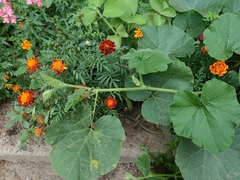 Cucurbita maxima
 Puccinia triticina
 Pseudomonas fluorescens
 Arachis hypogaea
 Cucumis sativus