View: List Claim type Research area Organism Taxon as written Decade Paper Intervention effect observed original result negative measured Claim · model-written summary
Dry conditions led to a decrease in honeysuckle fruit weight .
Dry conditions e1 the weight of the fruit e1 Not reported Comparator
Verbatim
t0 “HONEYSUCKLE ”
✓ located verbatim in the source · title, characters 27–38 e1 “Dry conditions had a negative impact on productivity, leading to shedding of the ovary, a decrease in the weight of the fruit ”
✓ located verbatim in the source · abstract, characters 1023–1148 Other claims from this paper (12) Intervention effect observed original result negative measured Claim · model-written summary
Root dry weight declined about 50% more than top dry weight under reduced aeration.
reduced soil aeration e0 top dry weight e0 Verbatim
e0 “The decrease in root dry weight associated with reduced soil aeration exceeded the decrease in top dry weight by about 50% ”
✓ located verbatim in the source · abstract, characters 452–574 t0 “pecan trees ”
✓ located verbatim in the source · title, characters 95–106 Other claims from this paper (7) Intervention effect observed original result negative measured Claim · model-written summary
Under shade, declining soil water potential reduced leaf dry weight by 20%.
a decrease in soil water potential e0 Not reported Comparator
Verbatim
e0 “Under shade, a decrease in soil water potential resulted in a 20% decrease in dry weight . ”
✓ located verbatim in the source · abstract, characters 695–784 t0 “Apple Tree ”
✓ located verbatim in the source · title, characters 32–42 Other claims from this paper (15) Intervention effect At 20°C, 75% shade reduced apple shoot growth and leaf number. Intervention effect At 25°, shading had no effect on apple shoot growth and leaf number. Intervention effect At high soil water potential, 75% shade significantly reduced total leaf area. Intervention effect At low soil water potential, shading had little effect on total leaf area. Intervention effect Under full sun, declining soil water potential reduced total leaf dry weight by 46%. Intervention effect Under full sun, rising temperature decreased total stem dry weight. Intervention effect Under shade, temperature had little effect on stem dry weight. Intervention effect At 75% shade, rising temperature decreased specific leaf weight. Intervention effect In full sun, temperature had no effect on specific leaf weight. Observation Environmental interactions did not influence specific leaf weight of new leaves. Intervention effect Leaf epicuticular wax quantity rose as soil water potential fell. Intervention effect Lower soil water potential increased the proportion of alkanes in leaf wax. Intervention effect Lower soil water potential increased the proportion of wax esters in leaf wax. Intervention effect Alkane content rose as temperature rose. Method / resource Environmental conditions changed photosynthetic functioning and masked prometryn effects, making the herbicide unreliable for measuring foliar absorption. Intervention effect observed original result negative measured Claim · model-written summary
Total dry weight tended to decrease under ozone.
ozone-fumigated e1 total dry weights e0 Not reported Comparator
Verbatim
e0 “Trends to a decrease were found in root, shoot, leaf, and total dry weight s ”
✓ located verbatim in the source · abstract, characters 1871–1946 e1 “ozone-fumigated plants ”
✓ located verbatim in the source · abstract, characters 2201–2223 t0 “Beech ”
✓ located verbatim in the source · title, characters 62–67 Other claims from this paper (15) Intervention effect observed original result negative significant (as stated) measured Claim · model-written summary
Shade above 65% decrease d total dry weight .
shading intensity more than 65% e0 total dry weight e0 Not reported Comparator
Verbatim
e0 “shading in tensity more than 65% in fact, evidently decrease the dry weight crown and total dry weight of mirabow seedling ”
✓ located verbatim in the source · abstract, characters 1381–1502 Other claims from this paper (4) Association observed original result negative measured Claim · model-written summary
Fine root dry weight showed the greatest decrease under drought in the CG5087 tree.
Fine root (<2 mm diameter) dry weight e1 greatest decrease e1 Verbatim
e0 “we assessed the drought tolerance of 1-year-old apple (Malus domestica Borkh.) trees exposed to extreme water stress, focusing on growth and physiological responses ”
✓ located verbatim in the source · abstract, characters 15–179 e1 “Fine root (<2 mm diameter) dry weight showed the greatest decrease in the CG5087 tree ”
✓ located verbatim in the source · abstract, characters 1182–1267 Other claims from this paper (15) Association observed original result negative measured Claim · model-written summary
Relative dry weight yield decrease with in creasing salinity was about 10 to 15% per dS m-1, varying among clones.
increasing salinity e5 relative decrease in dry weight yield e5 about 10 to 15% per dS m-1 e5 Verbatim
e1 “Clones of eight hybrid poplar (Populus spp.) crosses were tested for salt tolerance ”
✓ located verbatim in the source · abstract, characters 648–731 e5 “the relative decrease in dry weight yield with in creasing salinity varied among clones and ranged from about 10 to 15% per dS m-1 ”
✓ located verbatim in the source · abstract, characters 1383–1512 Other claims from this paper (12) Intervention effect observed original result negative measured Claim · model-written summary
Dry weight fell disproportionately as removal rose from 20% to 30%.
Verbatim
e0 “a disproportionately large decrease in dry weight occurred as LAR in creased from 20% to 30% ”
✓ located verbatim in the source · abstract, characters 703–794 e1 “sour cherry (Prunus cerasus L.) ”
✓ located verbatim in the source · abstract, characters 58–89 Other claims from this paper (8) Intervention effect observed original result negative significant (as stated) measured Claim · model-written summary
Drought decrease d chlorophyll, fresh and dry weight , and biomass.
chlorophyll, fresh/dry weight, biomass e0 Not reported Taxon Comparator
Verbatim
e0 “The drought promoted a significant decrease in chlorophyll, fresh/ dry weight , biomass ”
✓ located verbatim in the source · abstract, characters 787–872 Other claims from this paper (10) Intervention effect Drought increased electrolyte leakage. Intervention effect Drought reduced micro- and macronutrients in both genotypes. Intervention effect Polyphenol oxidase activity and total phenolic compounds increased under drought. Intervention effect Nano-silicon improved leaf area index, chlorophyll, and biomass under severe water deficiency. Intervention effect Nano-silicon increased carbohydrates and flavonoid content about twofold. Intervention effect Nano-silicon increased TPC, anthocyanin, and antioxidative capacity about twofold. Intervention effect Increasing PEG concentration decreased absorption of P, K, and Mn. Intervention effect Increasing PEG concentration decreased absorption of Fe, Zn, and Cu. Intervention effect Nano-silicon, especially at 100 mg L −1, increased nutrient absorption. Intervention effect Nano-silicon improved qualitative and quantitative traits of Kashan more than Maragheh. Intervention effect observed original result negative measured Claim · model-written summary
Seedling dry weight of Albizia lebbeck had the highest decrease of 41% at 7 mM mercury.
7 mM mercury treatment e1 seedling dry weight e1 Highest decrease e1 Verbatim
e0 “an important arid legume tree Albizia lebbeck ”
✓ located verbatim in the source · abstract, characters 111–156 e1 “Highest decrease in seed germination (51%), seedling (34%), root length (48%) and seedling dry weight (41%) of A. lebbeck occurred at 7 mM mercury treatment ”
✓ located verbatim in the source · abstract, characters 938–1094 e2 “(1 mM, 3 mM, 5 mM and 7 mM) as compared to control ”
✓ located verbatim in the source · abstract, characters 279–329 Other claims from this paper (18) Lexical search (BM25). All words must match; if nothing does, any word. Organism names also match every spelling of the same organism. No semantic search yet.
 Carya illinoinensis
 Malus domestica
 Populus
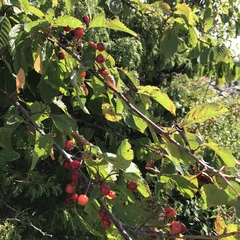 Prunus cerasus
 Albizia lebbeck