View: List Claim type Research area Organism Taxon as written Decade Paper Observation observed original result measured Claim · model-written summary
Resistant and less resistant accessions belong to Cucurbita maxima , C. maxima subsp. maxima , C. maxima subsp. andreana and C. okeechobeensis subsp. martinezii .
Verbatim
e0 “Resistant and less resistant accessions belong to the species Cucurbita maxima , C . maxima subsp. maxima , C . maxima subsp. andreana , and C . okeechobeensis subsp. martinezii ”
✓ located verbatim in the source · abstract, characters 1351–1528 Other claims from this paper (7) Observation observed original result measured Claim · model-written summary
Seed surface ultrastructure distinguishes Spergula maxima from Spergula arvensis subsp. arvensis , supporting Spergula arvensis subsp. maxima .
Spergula arvensis subsp. maxima e0 Verbatim
e0 “between Spergula maxima and Spergula arvensis subsp. arvensis , accordingly we propose — Spergula arvensis subsp. maxima
✓ located verbatim in the source · abstract, characters 1538–1657 Other claims from this paper (7) Observation observed original result measured Claim · model-written summary
Laboratory germination maxima preceded field emergence maxima by 12 to 26 days.
laboratory germination test maxima e0 field emergence maxima e0 Verbatim
e0 “laboratory germination test maxima preceded field emergence maxima by 12 to 26 d. ”
✓ located verbatim in the source · abstract, characters 1050–1131 t0 “Sweet Corn ”
✓ located verbatim in the source · title, characters 81–91 Other claims from this paper (16) Observation observed original result measured Claim · model-written summary
Five C. maxima varieties were suitable for spring cultivation.
fit for cultivating in spring e0 Verbatim
e0 “five varieties of C. maxima were fit for cultivating in spring ”
✓ located verbatim in the source · abstract, characters 126–187 t0 “Cucurbita maxima
✓ located verbatim in the source · title, characters 34–50 Other claims from this paper (5) Observation observed original result negative measured Claim · model-written summary
Ralstonia solanacearum caused Cucurbita maxima bacterial wilt.
C. maxima bacterial wilte0 Verbatim
e0 “the pathogen of C. maxima bacterial wilt was Ralstonia solanacearum ”
✓ located verbatim in the source · abstract, characters 876–943 Other claims from this paper (12) Observation observed original result measured Claim · model-written summary
Oospores were absent in C. maxima .
Verbatim
e0 “C. maxima (cv. Tripoli) ”
✓ located verbatim in the source · abstract, characters 1564–1587 Other claims from this paper (19) Observation observed original result measured Claim · model-written summary
No seedlings were found within established G. maxima infestations.
No seedlings were found e1 Verbatim
e1 “No seedlings were found within established G. maxima infestations ”
✓ located verbatim in the source · abstract, characters 522–587 Other claims from this paper (6) Observation observed original result basis n/a Claim · model-written summary
A new species, M. maxima , was described from Northern Peru.
Verbatim
e0 “M. maxima
✓ located verbatim in the source · abstract, characters 53–62 t0 “Muhlenbergia and Uniola
✓ located verbatim in the source · title, characters 21–44 e1 “Northern Peru ”
✓ located verbatim in the source · abstract, characters 103–116 Other claims from this paper (2) Observation observed original result measured Claim · model-written summary
Cucurbita maxima has twenty bivalent chromosomes.
bivalent chromosomes e0 Verbatim
e0 “Cucurbita pepo and C. maxima each has twenty bivalent chromosomes ”
✓ located verbatim in the source · abstract, characters 171–236 Other claims from this paper (10) Observation observed original result positive measured Claim · model-written summary
C. maxima showed high genotypic variability.
genotypic variability e0 Verbatim
e0 “This study proved the existence of high genotypic variability in C. maxima
✓ located verbatim in the source · abstract, characters 1087–1161 Other claims from this paper (3) Lexical search (BM25). All words must match; if nothing does, any word. Organism names also match every spelling of the same organism. No semantic search yet.
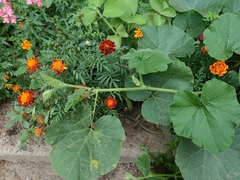 Cucurbita maximae0
 Ralstonia solanacearum
 Glyceria maxima
 Citrus maxima