View: List Claim type Research area Organism Taxon as written Decade Paper Association observed original result measured Claim · model-written summary
Some genetically similar genotypes were phenotypically different .
different phenotypically e0 Verbatim
e0 “some of genetically similar genotypes were different phenotypically . ”
✓ located verbatim in the source · abstract, characters 1338–1406 t0 “Wheat ”
✓ located verbatim in the source · title, characters 49–54 Other claims from this paper (2) Observation observed original result measured Claim · model-written summary
172 phenotypically different pathotypes were identified.
phenotypically different pathotypes e1 Verbatim
e0 “wheat to Puccinia triticina ”
✓ located verbatim in the source · abstract, characters 36–63 e1 “172 phenotypically different pathotypes were identified ”
✓ located verbatim in the source · abstract, characters 628–683 Other claims from this paper (5) Association observed original result measured Claim · model-written summary
Phenotypically abnormal trees had unique and different AFLP patterns.
phenotypically abnormal trees e0 AFLP band patterns e0 unique and different e0 Verbatim
e0 “Several phenotypically abnormal trees were characterized by unique and different AFLP band patterns. ”
✓ located verbatim in the source · abstract, characters 1065–1165 Other claims from this paper (5) Observation observed original result measured Claim · model-written summary
Thymus persicus populations were phenotypically different .
phenotypically different e0 Verbatim
e0 “The plants were phenotypically different with the highest variations in some morphological traits ”
✓ located verbatim in the source · abstract, characters 390–487 t0 “Thymus persicus
✓ located verbatim in the source · title, characters 111–126 Other claims from this paper (15) Observation observed original result measured Claim · model-written summary
Several phenotypically different accessions were indistinguishable at the molecular level.
phenotypically different accessions were indistinguishable at the molecular level e0 Verbatim
e0 “several phenotypically different accessions were indistinguishable at the molecular level ”
✓ located verbatim in the source · abstract, characters 1120–1209 t0 “PEACH (PRUNUS PERSICA L. BATSCH) ”
✓ located verbatim in the source · title, characters 13–45 Other claims from this paper (5) Observation observed original result no effect measured Claim · model-written summary
Lines 4J and 4I were phenotypically like nontransformed controls.
Lines 4J and 4I e0 phenotypically different e0 not phenotypically different e0 nontransformed control line e0 Verbatim
e0 “Lines 4J and 4I were not phenotypically different from the nontransformed control line ”
✓ located verbatim in the source · abstract, characters 684–770 t0 “Plum ”
✓ located verbatim in the source · title, characters 46–50 Other claims from this paper (10) Observation observed original result measured Claim · model-written summary
Numerous phenotypically different isolates of F. moniliforme were recovered from corn
phenotypically different isolates e2 Verbatim
t0 “naturally occurring corn isolates ”
✓ located verbatim in the source · title, characters 73–106 e2 “Numerous phenotypically different isolates of F. moniliforme were recovered from the host ”
✓ located verbatim in the source · abstract, characters 165–254 Other claims from this paper (6) Intervention effect observed original result measured Claim · model-written summary
Strawberry plants grown in compost were phenotypically very different from plants in other substrates.
Plants grown in compost e4 very different e4 Verbatim
t0 “IN STRAWBERRY 'KORONA' ”
✓ located verbatim in the source · title, characters 56–78 e4 “Plants grown in compost were phenotypically very different from the others ”
✓ located verbatim in the source · abstract, characters 1127–1201 Other claims from this paper (5) Observation observed original result measured Claim · model-written summary
Multivariate analysis different iated the pumpkin varieties into two phenotypically different groups.
differentiation of varieties e4 two phenotypically different groups e4 Verbatim
t0 “pumpkin varieties (Cucurbita maxima Duch. ex Lam.) ”
✓ located verbatim in the source · title, characters 56–106 e4 “Multivariate statistical analysis provided different iation of varieties on two phenotypically different groups ”
✓ located verbatim in the source · abstract, characters 655–765 Other claims from this paper (4) Observation observed original result measured Claim · model-written summary
Among 221 isolates, 71 phenotypically different pathotypes of Puccinia triticina were identified in Bulgaria.
phenotypically different pathotypes e1 Verbatim
e0 “Leaf rust on wheat caused by Puccinia triticina Eriks. ”
✓ located verbatim in the source · abstract, characters 0–54 e1 “Seventy-one phenotypically different pathotypes were identified ”
✓ located verbatim in the source · abstract, characters 469–532 t1 “in Bulgaria ”
✓ located verbatim in the source · title, characters 76–87 Other claims from this paper (7) Observation Pathotypes 63562, 63573 and 63762 had the highest frequency of occurrence of Puccinia triticina on wheat. Observation For the first time in this population, 25 entirely new pathotypes of Puccinia triticina were identified. Observation The genetic variability of the pathogen population was represented by 86 genetic formulae for virulence. Observation The most common virulence formula of Puccinia triticina was found in 37.9% of isolates. Observation Lr22a, Lr22b and Lr43 conferred immunity during the investigated period. Observation Lr1, Lr3ka, Lr9, Lr19, Lr25, Lr28, Lr40, Lr41, Lr42, Lr45, Lr47 and Lr50 showed very good to high efficiency. Observation Some Puccinia triticina pathotypes overcame the resistance conferred by the strong genes Lr9 and Lr19. Lexical search (BM25). All words must match; if nothing does, any word. Organism names also match every spelling of the same organism. No semantic search yet.
 Triticum aestivumt0
 Puccinia triticina
 Prunus persica
 Prunus domestica
 Zea mays subsp. mays
 Fusarium verticillioides
 Fragaria
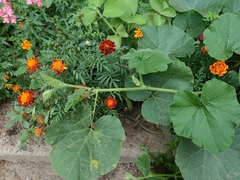 Cucurbita maxima