View: List Claim type Research area Organism Taxon as written Decade Paper Mechanism hypothesis original result basis n/a Claim · model-written summary
Immune enhancement may explain reduced parasitoid performance when hosts are reared on toxic plants.
parasitoid e7 biocontrol_agent reduced parasitoid performance e7 immune enhancement e7 Verbatim
e7 “Importantly, our data also suggest an alternative mechanism (i.e. immune enhancement) for reduced parasitoid performance when reared from hosts on toxic plants via tritrophic interactions ”
✓ located verbatim in the source · abstract, characters 1847–2034 Other claims from this paper (6) Recommendation author interpretation original result basis n/a Claim · model-written summary
Poor performance of a parasitoid in a simple laboratory trial may justify disregarding that species.
disregard this species e6 Verbatim
e1 “in glasshouse cucumbers ”
✓ located verbatim in the source · abstract, characters 172–195 e6 “bad performance of an aphid parasitoid species in a simple laboratory trial might be sufficient evidence to disregard this species ”
✓ located verbatim in the source · abstract, characters 1056–1186 Other claims from this paper (7) Mechanism author interpretation original result positive basis n/a Claim · model-written summary
Other non-GS chemicals are likely responsible for the decline in insect performance and affect the parasitoid more strongly than the host.
other non-GS chemicals e1 decline in insect performance e1 these chemicals affect the parasitoid more strongly than the host e1 Verbatim
e1 “This result suggests that, in addition to aliphatic GS, other non-GS chemicals are responsible for the decline in insect performance , and that these chemicals affect the parasitoid more strongly than the host ”
✓ located verbatim in the source · abstract, characters 1566–1774 e2 “when reared on two cultivated (CYR and STH) and three wild (KIM, OH, and WIN) populations of cabbage, Brassica oleracea ”
✓ located verbatim in the source · abstract, characters 395–514 Other claims from this paper (14) Recommendation author interpretation original result positive basis n/a Claim · model-written summary
A mixture of 2nd and 3rd instar nymphs of Aulacorthum solani is adequate for rearing Praon volucre .
a mixture of 2 nd and 3 rd instar nymphs of A. solani e1 rearing this parasitoid e1 Verbatim
t0 “Performance of the parasitoid Praon volucre in Aulacorthum solani at five temperatures ”
✓ located verbatim in the source · title, characters 0–86 e0 “a leaf disc of lettuce ”
✓ located verbatim in the source · abstract, characters 460–482 e1 “a mixture of 2 nd and 3 rd instar nymphs of A. solani is adequate for rearing this parasitoid ”
✓ located verbatim in the source · abstract, characters 1526–1619 Other claims from this paper (13) Recommendation hypothesis original result positive basis n/a Claim · model-written summary
The authors suggest that conditioning natural enemies in rearing environments may increase their activity and performance .
modifying rearing environments to condition natural enemies to target crops prior to release e3 natural enemy activity and performance e3 Verbatim
e0 “Green and yellow-leafed coleus plants, Solenostemon scutellarioides (L.) Codd, were studied ”
✓ located verbatim in the source · abstract, characters 0–91 e3 “modifying rearing environments to condition natural enemies to target crops prior to release may increase natural enemy activity and performance ”
✓ located verbatim in the source · abstract, characters 1196–1340 Other claims from this paper (2) Recommendation author interpretation original result positive basis n/a Claim · model-written summary
Releases of T. radiata made a week or more after spraying are suggested to have lower impact on its establishment and performance .
releases are made after a week from spray application e3 a lower impact on its establishment and performance e3 Verbatim
e2 “of sprays on citrus trees in the orchard ”
✓ located verbatim in the source · abstract, characters 685–725 e3 “suggesting a lower impact on its establishment and performance if releases are made after a week from spray application ”
✓ located verbatim in the source · abstract, characters 1695–1814 Other claims from this paper (13) Recommendation author interpretation original result positive basis n/a Claim · model-written summary
The authors conclude that EPNs and Trichogramma together can play a crucial role in controlling the three corn borers.
control the three corn borers e0 Verbatim
e0 “EPN and Trichogramma together can play a crucial role to control the three corn borers ”
✓ located verbatim in the source · abstract, characters 1674–1760 Other claims from this paper (8) Recommendation author interpretation original result basis n/a Claim · model-written summary
Nectar plants should be tested on multiple response variables and on both pest and natural enemy.
test multiple response variables e6 Verbatim
e6 “The contrasting effects of this set of plants illustrate the need to test multiple response variables and effects on both pest and natural enemy when seeking optimal nectar plants ”
✓ located verbatim in the source · abstract, characters 1412–1591 Other claims from this paper (10) Recommendation author interpretation original result positive basis n/a Claim · model-written summary
Cnidium monnieri and Ocimum basilicum are promising nectary plants for enhancing biological control of insect pests in maize cropping systems.
biological control of insect pest e0 maize cropping systems e0 Verbatim
e0 “C. monnieri and O. basilicum are promising nectary plants for integration into maize cropping systems to enhance biological control of insect pest
✓ located verbatim in the source · abstract, characters 2041–2187 Other claims from this paper (19) Mechanism author interpretation original result basis n/a Claim · model-written summary
Reduced leaf hydrogen peroxide and enhanced volatile emission are proposed as the mechanism behind aphid suppression on potato.
aphid suppression e7 reduced leaf hydrogen peroxide and enhanced the emission of defensive volatiles e6 Verbatim
e0 “evaluated potato plants treated with SiNPs (0.25–1 mM) at four developmental stages ”
✓ located verbatim in the source · abstract, characters 146–229 e6 “SiNPs reduced leaf hydrogen peroxide and enhanced the emission of defensive volatiles (caryophyllene, longifolene, and phenol) ”
✓ located verbatim in the source · abstract, characters 647–773 e7 “providing a mechanistic basis for the observed aphid suppression and increased parasitoid activity ”
✓ located verbatim in the source · abstract, characters 775–873 Other claims from this paper (5) Lexical search (BM25). All words must match; if nothing does, any word. Organism names also match every spelling of the same organism. No semantic search yet.
 Cucumis sativus
 Brassica oleracea
 Lactuca sativa
 Coleus scutellarioides
 Citrus
 Zea mays subsp. mays
 Ocimum basilicum
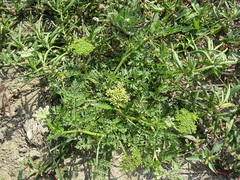 Cnidium monnieri
 Solanum tuberosum