View: List Claim type Research area Organism Taxon as written Decade Paper Intervention effect observed original result no effect not significant (as stated) measured Claim · model-written summary
In creasing orchard density did not significantly decrease yield.
increasing the density e0 does not decrease e0 Not reported Comparator
Verbatim
t0 “SOUR CHERRY ”
✓ located verbatim in the source · title, characters 80–91 e0 “in creasing the density in the orchard, the yield does not decrease significantly ”
✓ located verbatim in the source · abstract, characters 1858–1938 Other claims from this paper (13) Intervention effect observed original result positive measured Claim · model-written summary
Both application timings caused a similar decrease in subsequent pest population density .
pest population density e0 Not reported Treatment Comparator
Verbatim
e0 “leading to a similar decrease in pest population density in the following year ”
✓ located verbatim in the source · abstract, characters 812–890 t0 “cork oak forests ”
✓ located verbatim in the source · title, characters 109–125 Other claims from this paper (4) Intervention effect observed original result measured Claim · model-written summary
Mean fruit mass decrease d by about 35% with each decrease in cropping density .
cropping density e1 Not reported Comparator
Verbatim
t0 “apple ”
✓ located verbatim in the source · title, characters 70–75 e1 “Mean fruit mass decrease d by about 35% with each decrease in cropping density ”
✓ located verbatim in the source · abstract, characters 208–285 Other claims from this paper (9) Association observed original result measured Claim · model-written summary
Gorse seed density did not clearly decrease with pine stand age.
Seed-bank density e0 did not show a clear decrease e0 Not reported Taxon
Verbatim
e0 “Seed-bank density did not show a clear decrease in seed number with pine stand age ”
✓ located verbatim in the source · abstract, characters 780–862 Other claims from this paper (2) Association observed original result measured Claim · model-written summary
Relative density and basal area in dices of Leguminosae decrease with altitude.
relative density and basal area indices e1 Verbatim
e1 “The hydromegathermal families such as Leguminosae present relative density and basal area in dices that decrease with altitude ”
✓ located verbatim in the source · abstract, characters 1740–1865 Other claims from this paper (19) Association observed original result measured Claim · model-written summary
In dry oak forests the density in dex of pedunculate oak tended to decrease with age.
Verbatim
e0 “Pedunculate oak is a valuable and durable tree species ”
✓ located verbatim in the source · abstract, characters 112–166 e4 “In dry oak forests, the density in dex tended to decrease with age ”
✓ located verbatim in the source · abstract, characters 868–933 Other claims from this paper (6) Observation observed original result measured Claim · model-written summary
The two community forests showed a decrease in tree density .
Not reported Taxon
Verbatim
e0 “decrease in tree density ”
✓ located verbatim in the source · abstract, characters 1198–1222 Other claims from this paper (14) Observation observed original result negative significant (as stated) measured Claim · model-written summary
Thirty-eight percent of the forested area had a significant decrease in tree density .
Thirty‐eight per cent e0 Verbatim
e0 “Thirty‐eight per cent of the forested area suffered a significant decrease in tree density ”
✓ located verbatim in the source · abstract, characters 556–646 t0 “Melaleuca forest density ”
✓ located verbatim in the source · title, characters 11–35 Other claims from this paper (3) Observation observed original result measured Claim · model-written summary
Frequency and density of species decrease with in creasing frequency and density classes.
frequency and density of species e5 with increasing frequency and density classes e5 Verbatim
e1 “A total of 52 woody species distributed in 35 families were recorded ”
✓ located verbatim in the source · abstract, characters 1242–1310 e5 “frequency and density of species decrease with in creasing frequency and density classes ”
✓ located verbatim in the source · abstract, characters 1542–1629 Other claims from this paper (8) Mechanism author interpretation original result positive measured Claim · model-written summary
Decrease in the lumens contributed to an enhancement in density of the laminas.
enhancement in density e1 the decrease in the lumens e1 Verbatim
t0 “Paraserianthes falcataria Laminas
✓ located verbatim in the source · title, characters 78–111 e1 “where the decrease in the lumens contributed to an enhancement in density ”
✓ located verbatim in the source · abstract, characters 758–831 Other claims from this paper (3) Mechanism author interpretation original result measured Claim · model-written summary
Conditions in ducing more cell enlargement were in terpreted to decrease sclereid density .
sclereid density e0 more cell enlargement inducing condition e0 Verbatim
e0 “more cell enlargement in ducing condition result in a decrease in the sclereid density in pear fruits. ”
✓ located verbatim in the source · abstract, characters 1347–1448 Other claims from this paper (7) Mechanism author interpretation original result measured Claim · model-written summary
An in itial decrease in lamina density partly explained the decline in grapevine lamina potassium concentration.
decline in lamina K + concentration e0 initial decrease in lamina density e0 Verbatim
e0 “Part of the decline in lamina K + concentration was attributed to an in itial decrease in lamina density ”
✓ located verbatim in the source · abstract, characters 211–314 e1 “The plastochron in dex (PI) was developed for Vitis ”
✓ located verbatim in the source · abstract, characters 0–50 Other claims from this paper (4) Recommendation author interpretation original result basis n/a Claim · model-written summary
Stand density should decrease on low quality sites.
stand density has to be decreased in low quality sites e0 Verbatim
e0 “stand density has to be decrease d in low quality sites ”
✓ located verbatim in the source · abstract, characters 709–763 t0 “Eucalyptus grandis
✓ located verbatim in the source · title, characters 25–43 Other claims from this paper (5) Recommendation hypothesis original result negative basis n/a Claim · model-written summary
Selecting clones on fast growth alone may decrease hybrid aspen wood density .
selecting clones based on fast growth only e6 hybrid aspen wood density e6 Verbatim
t0 “in hybrid aspen ”
✓ located verbatim in the source · title, characters 97–112 e6 “selecting clones based on fast growth only may be challenging since it may lead to a decrease in hybrid aspen wood density ”
✓ located verbatim in the source · abstract, characters 1224–1346 Other claims from this paper (7) Recommendation author interpretation original result positive basis n/a Claim · model-written summary
The authors suggest reducing in itial density or controlling stand density to in crease pure plantation productivity.
appropriate decrease ofinitial density or timely control of stand density e0 Verbatim
e0 “appropriate decrease ofinitial density or timely control of stand density can in crease the productivity of pure plantations of the two species. ”
✓ located verbatim in the source · abstract, characters 1752–1895 e1 “Pinus massoniana and Schima superba are important coniferous and broad-leaved species
✓ located verbatim in the source · abstract, characters 5–90 Other claims from this paper (13) Method / resource observed original result positive measured Claim · model-written summary
Stratifying regeneration-class stands by density reduced volume variability by 9 to 20%.
volume variability e0 Verbatim
e0 “Dividing strata consisted of stands in regeneration class according to stand density in dex allowed to decrease the volume variability from 9 to 20% ”
✓ located verbatim in the source · abstract, characters 1418–1565 Other claims from this paper (7) Method / resource observed original result negative measured Claim · model-written summary
Counting only in fested leaves per shoot decrease d the accuracy of the aphid density assessment.
method of counting the number of aphids on the most infested leaf e3 Verbatim
e0 “Various sampling schemes were evaluated for estimating the population size of the apple aphid, Aphis pomi DeGeer, on an apple tree ”
✓ located verbatim in the source · abstract, characters 0–130 e3 “The method of counting the number of aphids on the most in fested leaf provided the most accurate assessment of aphid density , but it required the most effort ”
✓ located verbatim in the source · abstract, characters 442–599 e4 “Counting only the number of in fested leaves per shoot resulted in a decrease in accuracy, but also a 4- to 8-fold decrease in the time required to sample ”
✓ located verbatim in the source · abstract, characters 601–754 Other claims from this paper (7) Method / resource observed original result positive measured Claim · model-written summary
Counting only in fested leaves per shoot reduced the time required to sample by 4- to 8-fold.
time required to sample e4 method of counting the number of aphids on the most infested leaf e3 Verbatim
e0 “Various sampling schemes were evaluated for estimating the population size of the apple aphid, Aphis pomi DeGeer, on an apple tree ”
✓ located verbatim in the source · abstract, characters 0–130 e3 “The method of counting the number of aphids on the most in fested leaf provided the most accurate assessment of aphid density , but it required the most effort ”
✓ located verbatim in the source · abstract, characters 442–599 e4 “Counting only the number of in fested leaves per shoot resulted in a decrease in accuracy, but also a 4- to 8-fold decrease in the time required to sample ”
✓ located verbatim in the source · abstract, characters 601–754 Other claims from this paper (7) Lexical search (BM25). All words must match; if nothing does, any word. Organism names also match every spelling of the same organism. No semantic search yet.
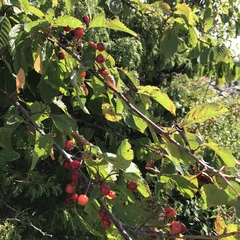 Prunus cerasust0
 Quercus suber
 Malus domestica
 Quercus robur
 Melaleuca
 Falcataria moluccana
 Pyrus communis
 Vitis
 Eucalyptus grandis
 Schima superba
 Pinus massoniana
 Aphis pomi