View: List Claim type Research area Organism Taxon as written Decade Paper Intervention effect observed original result positive significant (as stated) measured Claim · model-written summary
Stand survival in 1967 was significantly better at 98 seed s per metre than at 33 seed s per metre.
33‐seed/m rate e0 Verbatim
t0 “Crested Wheatgrass ”
✓ located verbatim in the source · title, characters 70–88 e0 “Stand survival in 1967 (when the study was terminated) was significantly better at the 98‐ seed rate than at the 33‐ seed /m rate ”
✓ located verbatim in the source · abstract, characters 486–612 Other claims from this paper (6) Intervention effect observed original result no effect measured Claim · model-written summary
Embryo dormancy alone did not improve seed survival relative to no protection.
embryo dormancy only e0 survival rate of seeds e0 Not reported Comparator
Verbatim
e0 “The survival rate of seed s was no higher when protected by embryo dormancy only ”
✓ located verbatim in the source · abstract, characters 198–277 t0 “subterranean clover seed s ”
✓ located verbatim in the source · title, characters 19–44 Other claims from this paper (5) Intervention effect observed original result negative measured Claim · model-written summary
Higher seed rate s decreased percentage survival .
seed rate was increased e0 percentage survival e0 Not reported Comparator
Verbatim
e0 “percentage survival declined as seed rate was increased ”
✓ located verbatim in the source · abstract, characters 1300–1355 t0 “The influence of date of sowing and seed rate on the production of pure‐sown red clover ”
✓ located verbatim in the source · title, characters 0–87 t1 “August and September sowings gave the lowest red clover contents in a range from 63.2 to 96.5%, the highest digestibilities within a range 61.9 to 65.0% and the lowest crude protein contents in a range 15.5 to 17.3%. ”
✓ located verbatim in the source · abstract, characters 456–672 Other claims from this paper (14) Intervention effect observed original result positive measured Claim · model-written summary
Heat-shock treatment following low-temperature irradiation strikingly decreased radiation-induced injuries ( survival rate , seed ling height, seed fertility) in the M1 generation of rice.
heat-shock treatment following irradiation e1 radiation-induced injuries e0 Not reported Comparator
Verbatim
e0 “Striking decrease of radiation-induced injuries was observed, as measured in survival rate , seed ling height and seed fertility in the M1 generation ”
✓ located verbatim in the source · abstract, characters 406–553 e1 “Effects of heat-shock treatment following irradiation at an extremely low temperature ”
✓ located verbatim in the source · abstract, characters 0–85 t0 “Rice ”
✓ located verbatim in the source · title, characters 148–152 Other claims from this paper (8) Observation observed original result negative measured Claim · model-written summary
In storage, Rhizobium meliloti survival was very low in all treatments except those with peat inoculant within the pellet.
Verbatim
e0 “Seed of Medicago truncatula and Medicago littoralis ”
✓ located verbatim in the source · abstract, characters 0–51 e4 “In storage, a very low survival rate was recorded in all treatments except those incorporating peat inoculant within the pellet ”
✓ located verbatim in the source · abstract, characters 861–988 t0 “Survival of Rhizobium meliloti applied to medic seed sown into dry soil ”
✓ located verbatim in the source · title, characters 67–138 Other claims from this paper (3) Intervention effect observed original result positive measured Claim · model-written summary
Higher seed rate s increased plant numbers but decreased survival percentage.
seed rate was increased e0 Not reported Comparator
Verbatim
e0 “plant numbers rose but percentage survival declined as seed rate was increased ”
✓ located verbatim in the source · abstract, characters 1277–1355 t0 “The influence of date of sowing and seed rate on the production of pure‐sown red clover ”
✓ located verbatim in the source · title, characters 0–87 t1 “August and September sowings gave the lowest red clover contents in a range from 63.2 to 96.5%, the highest digestibilities within a range 61.9 to 65.0% and the lowest crude protein contents in a range 15.5 to 17.3%. ”
✓ located verbatim in the source · abstract, characters 456–672 Other claims from this paper (14) Intervention effect observed original result positive measured Claim · model-written summary
Higher rate CGA 48988 pellets increased field survival and yield.
plant survival and. yield e0 1.65 g a.i./kg of seed e0 Not reported Comparator
Verbatim
e7 “root and stalk rot of soybean (Glycine max (L.) Merr.) caused by Phytophthora megasperma Drechs. var. sojae Hildebr. (Pms) ”
✓ located verbatim in the source · abstract, characters 35–157 e0 “CGA 48988, which is systemic in soybeans, increased plant survival and. yield in the field at 1.65 g a.i./kg of seed in seed pellets ”
✓ located verbatim in the source · abstract, characters 939–1071 Other claims from this paper (9) Association observed original result measured Claim · model-written summary
Seed ling emergence and second-year survival were closely related to seed ing rate .
Number of seedlings that emerged and number of plants that survived the second year e0 Not reported Direction
Verbatim
e0 “Number of seed lings that emerged and number of plants that survived the second year were closely related to seed ing rate . ”
✓ located verbatim in the source · abstract, characters 703–824 t0 “Alfalfa ”
✓ located verbatim in the source · title, characters 67–74 Other claims from this paper (9) Observation observed original result positive measured Claim · model-written summary
CC275e survived well and had a death rate similar to the lowest in two of three groups.
death rate was similar to the lowest in two out of the three groups e0 Verbatim
e0 “CC275e showed good survival , and its death rate was similar to the lowest in two out of the three groups in which it was included. ”
✓ located verbatim in the source · abstract, characters 470–600 t0 “Rhizobium trifolii
✓ located verbatim in the source · title, characters 12–30 Other claims from this paper (2) Intervention effect observed original result no effect not significant (as stated) measured Claim · model-written summary
Low rate CGA 48988 pellets did not significantly increase field survival and yield.
plant survival and yield e0 did not significantly increase e0 Not reported Comparator
Verbatim
e7 “root and stalk rot of soybean (Glycine max (L.) Merr.) caused by Phytophthora megasperma Drechs. var. sojae Hildebr. (Pms) ”
✓ located verbatim in the source · abstract, characters 35–157 e0 “Captan and CGA 48988 applied to Harosoy 63 seed s (at 0.13 and 0.33 g a.i./kg of seed , respectively) by a pelleting technique gave short-term control in the greenhouse, but did not significantly increase plant survival and yield in the field ”
✓ located verbatim in the source · abstract, characters 697–937 Other claims from this paper (9) Lexical search (BM25). All words must match; if nothing does, any word. Organism names also match every spelling of the same organism. No semantic search yet.
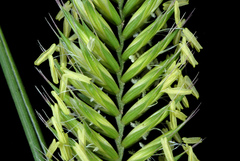 Agropyron cristatum
 Trifolium subterraneum
 Trifolium pratense
 Oryza sativa
 Medicago truncatula
 Medicago littoralis
 Sinorhizobium meliloti
 Glycine max
 Phytophthora megasperma
 Medicago sativa
 Rhizobium leguminosarum