View: List Claim type Research area Organism Taxon as written Decade Paper Observation observed original result negative measured Claim · model-written summary
Ralstonia solanacearum caused Cucurbita maxima bacterial wilt.
C. maxima bacterial wilte0 Verbatim
e0 “the pathogen of C. maxima bacterial wilt was Ralstonia solanacearum ”
✓ located verbatim in the source · abstract, characters 876–943 Other claims from this paper (12) Observation observed original result measured Claim · model-written summary
Oospores were absent in C. maxima .
Verbatim
e0 “C. maxima (cv. Tripoli) ”
✓ located verbatim in the source · abstract, characters 1564–1587 Other claims from this paper (19) Observation observed original result measured Claim · model-written summary
Spring nodular activity maxima were 8-250 times summer minima.
native Australian legumes t0 8-250 times summer minima e0 Verbatim
e0 “spring maxima 8-250 times summer minima ”
✓ located verbatim in the source · abstract, characters 455–494 t0 “Native Australian Legumes ”
✓ located verbatim in the source · title, characters 21–46 Other claims from this paper (4) Observation observed original result negative measured Claim · model-written summary
Cucurbita maxima was highly susceptible to ToLCNDV.
highly susceptible e4 Verbatim
e4 “Cucurbita maxima and C. ficifolia were also highly susceptible ”
✓ located verbatim in the source · abstract, characters 878–940 Other claims from this paper (11) Observation observed original result measured Claim · model-written summary
Powdery mildew infection was observed on Cucurbita maxima .
powdery mildew infection e0 Verbatim
e0 “A powdery mildew infection was observed on Cucurbita maxima Duchesne. ”
✓ located verbatim in the source · abstract, characters 76–145 Other claims from this paper (2) Observation observed original result negative measured Claim · model-written summary
C. maxima was highly susceptible to ToLCNDV.
highly susceptible e0 Verbatim
e0 “C. maxima was also highly susceptible. ”
✓ located verbatim in the source · abstract, characters 1350–1388 Other claims from this paper (12) Intervention effect observed original result positive measured Claim · model-written summary
Overexpression of CmWRKY22 inhibited CMV infection in C. maxima .
overexpression of CmWRKY22 e0 Not reported Comparator
Verbatim
e0 “overexpression of CmWRKY22 inhibited the CMV infection ”
✓ located verbatim in the source · abstract, characters 620–674 t0 “Cucurbita maxima
✓ located verbatim in the source · title, characters 75–91 Other claims from this paper (3) Observation observed original result positive measured Claim · model-written summary
Oospore inoculum did not produce lesions in C. maxima .
not in C. pepo or C. maxima e0 Verbatim
e0 “but not in C. pepo or C. maxima
✓ located verbatim in the source · abstract, characters 2131–2162 Other claims from this paper (19) Observation observed original result negative measured Claim · model-written summary
Bacterial wilt was observed on Cucurbita maxima in Guangdong.
Guangdong province, China e0 Verbatim
e0 “a new bacterial wilt on Cucurbita maxima was observed in Guangdong province, China ”
✓ located verbatim in the source · abstract, characters 174–256 Other claims from this paper (12) Association author interpretation original result measured Claim · model-written summary
At low nitrate, G. maxima strongly influenced the nitrate-reducing community.
presence of G. maxima e0 nitrate-reducing community e0 when the nitrate concentration was low e0 Not reported Direction
Verbatim
e0 “when the nitrate concentration was low, the presence of G. maxima greatly influenced the nitrate-reducing community. ”
✓ located verbatim in the source · abstract, characters 1057–1173 t0 “Glyceria maxima
✓ located verbatim in the source · title, characters 17–32 Other claims from this paper (5) Lexical search (BM25). All words must match; if nothing does, any word. Organism names also match every spelling of the same organism. No semantic search yet.
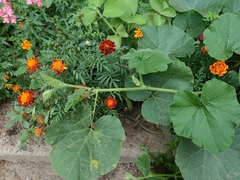 Cucurbita maximae0
 Ralstonia solanacearume0pathogen
 cucumber mosaic cucumovirus
 Glyceria maxima