View: List Claim type Research area Organism Taxon as written Decade Paper A claim can belong to several research areas, so group counts add up to more than the total.
Organism groups follow NCBI Taxonomy: the spellings of one organism are merged, a claim naming several organisms sits in each group, and claims whose value names no organism are under “not stated”.
not stated 2091 Observation observed original result measured Claim · model-written summary
Seed surface ultrastructure distinguishes Spergula maxima from Spergula arvensis subsp. arvensis , supporting Spergula arvensis subsp. maxima .
Spergula arvensis subsp. maxima e0 Verbatim
e0 “between Spergula maxima and Spergula arvensis subsp. arvensis , accordingly we propose — Spergula arvensis subsp. maxima
✓ located verbatim in the source · abstract, characters 1538–1657 Other claims from this paper (7) Observation observed original result measured Claim · model-written summary
Laboratory germination maxima preceded field emergence maxima by 12 to 26 days.
laboratory germination test maxima e0 field emergence maxima e0 Verbatim
e0 “laboratory germination test maxima preceded field emergence maxima by 12 to 26 d. ”
✓ located verbatim in the source · abstract, characters 1050–1131 t0 “Sweet Corn ”
✓ located verbatim in the source · title, characters 81–91 Other claims from this paper (16) Method / resource observed original result negative simulated Claim · model-written summary
That adjustment gave predicted maxima about 25% below observations.
predicted maxima e0 observed maxima e0 Not reported Taxon
Verbatim
e0 “predicted maxima approximately 25% less than the observed maxima ”
✓ located verbatim in the source · abstract, characters 1308–1372 Other claims from this paper (5) Observation observed original result measured Claim · model-written summary
Resistant and less resistant accessions belong to Cucurbita maxima , C. maxima subsp. maxima , C. maxima subsp. andreana and C. okeechobeensis subsp. martinezii .
Verbatim
e0 “Resistant and less resistant accessions belong to the species Cucurbita maxima , C . maxima subsp. maxima , C . maxima subsp. andreana , and C . okeechobeensis subsp. martinezii ”
✓ located verbatim in the source · abstract, characters 1351–1528 Other claims from this paper (7) Method / resource observed original result measured Claim · model-written summary
The linkage analysis revealed 20 genetic linkage groups of Cucurbita maxima .
genetic linkage groups e0 Verbatim
t0 “Cucurbita maxima
✓ located verbatim in the source · title, characters 23–39 e0 “revealed 20 genetic linkage groups of C. maxima
✓ located verbatim in the source · abstract, characters 309–356 Other claims from this paper (3) Observation observed original result measured Claim · model-written summary
Five C. maxima varieties were suitable for spring cultivation.
fit for cultivating in spring e0 Verbatim
e0 “five varieties of C. maxima were fit for cultivating in spring ”
✓ located verbatim in the source · abstract, characters 126–187 t0 “Cucurbita maxima
✓ located verbatim in the source · title, characters 34–50 Other claims from this paper (5) Observation observed original result positive measured Claim · model-written summary
C. maxima showed high genotypic variability.
genotypic variability e0 Verbatim
e0 “This study proved the existence of high genotypic variability in C. maxima
✓ located verbatim in the source · abstract, characters 1087–1161 Other claims from this paper (3) Observation observed original result measured Claim · model-written summary
All C. maxima crude extracts contained vitamin C.
Verbatim
e0 “vitamin C in all the C. maxima crude extracts. ”
✓ located verbatim in the source · abstract, characters 1149–1195 Other claims from this paper (10) Observation observed original result measured Claim · model-written summary
Marmin was isolated and identified from young fruits of Citrus maxima cv. Shatian.
Young Fruits t0 Verbatim
t0 “Young Fruits of Citrus maxima cv. Shatian ”
✓ located verbatim in the source · title, characters 28–69 e1 “marmin (II) ”
✓ located verbatim in the source · abstract, characters 401–412 Other claims from this paper (7) Observation observed original result measured Claim · model-written summary
Pollen tube growth differed for the C. moschata ×C. maxima (Fig. 6) cross.
C. moschata ×C. maxima (Fig. 6)e0 Verbatim
e0 “C. moschata ×C. maxima (Fig. 6) ”
✓ located verbatim in the source · abstract, characters 350–380 Other claims from this paper (10) Observation observed original result positive measured Claim · model-written summary
Preanthesis bud pollination produced C. pepo × C. maxima hybrids.
Bud pollination at at 7 a.m. of the day before anthesis e0 C. pepo x C. maxima e0 Not reported Direction
Verbatim
e0 “Bud pollination at at 7 a.m. of the day before anthesis ; C. pepo x C. maxima . ”
✓ located verbatim in the source · abstract, characters 1392–1470 t0 “C. pepo , C. moschata and C. maxima
✓ located verbatim in the source · title, characters 75–109 Other claims from this paper (9) Observation observed original result measured Claim · model-written summary
Cucurbita moschata and C. maxima gave an interspecific cross.
species crosses were obtained e1 between Cucurbita moschata and C. maxima e1 Verbatim
e1 “Three species crosses were obtained: (1) between Cucurbita moschata and C. maxima
✓ located verbatim in the source · abstract, characters 752–833 Other claims from this paper (18) Observation observed original result measured Claim · model-written summary
Harvest index values are approaching theoretical maxima .
approaching theoretical maxima e0 Verbatim
e0 “Values of harvest index are slowly approaching theoretical maxima ”
✓ located verbatim in the source · abstract, characters 1594–1659 t0 “Winter Wheat ”
✓ located verbatim in the source · title, characters 83–95 Other claims from this paper (7) Association observed original result positive measured Claim · model-written summary
Modules reached their maxima at intermediate density.
intermediate planting density e0 population modules e0 Verbatim
e0 “at an intermediate planting density, the population modules reached their maxima ”
✓ located verbatim in the source · abstract, characters 1293–1373 t0 “soybean and wheat intercropping populations ”
✓ located verbatim in the source · title, characters 77–120 Other claims from this paper (7) Observation observed original result measured Claim · model-written summary
mRNA maxima occurred in subjective morning and minima in subjective early night.
maxima in subjective morning and minima in subjective early night e0 Verbatim
e0 “with maxima in subjective morning and minima in subjective early night ”
✓ located verbatim in the source · abstract, characters 305–375 t0 “Wheat ”
✓ located verbatim in the source · title, characters 74–79 Other claims from this paper (6) Observation observed original result no effect measured Claim · model-written summary
Absorption maxima matched within each fertile and sterile pair.
absorption maxima e0 fertile-sterile combination e0 Verbatim
e0 “absorption maxima were identical for each fertile-sterile combination. ”
✓ located verbatim in the source · abstract, characters 262–332 t0 “Maize ”
✓ located verbatim in the source · title, characters 0–5 Other claims from this paper (5) Method / resource author interpretation original result basis n/a Claim · model-written summary
The growth-regulatory process of maize primary roots can be modelled in terms of auxin and other regulators, with cell-associated maxima and maxima propagating through the tissue.
plant growth-regulatory process e2 cell-associated maxima of regulator concentration e2 Verbatim
t0 “zea mays Primary Roots ”
✓ located verbatim in the source · title, characters 38–60 e2 “model the plant growth-regulatory process in terms of auxin and other regulators, considering both cell-associated maxima of regulator concentration and maxima which propagate through the tissue ”
✓ located verbatim in the source · abstract, characters 559–753 Other claims from this paper (1) Recommendation author interpretation original result basis n/a Claim · model-written summary
Maxima was judged suitable for drought-prone areas.
suitable for drought-prone areas e0 Verbatim
e0 “Maxima hybrid appeared to be suitable for drought-prone areas ”
✓ located verbatim in the source · abstract, characters 1977–2038 t0 “Maize ”
✓ located verbatim in the source · title, characters 18–23 Other claims from this paper (18) Observation observed original result positive measured Claim · model-written summary
C. maxima rootstocks demonstrated good compatibility with cucumber cultivars.
good compatibility e0 Verbatim
e0 “C. maxima C. moschata F1, Lagenaria and C. maxima rootstocks demonstrated good compatibility with the studied cucumber cultivars. ”
✓ located verbatim in the source · abstract, characters 918–1047 t0 “cucumber ”
✓ located verbatim in the source · title, characters 11–19 Other claims from this paper (10) Observation observed original result positive measured Claim · model-written summary
C. maxima C. moschata F1 rootstocks demonstrated good compatibility with cucumber cultivars.
C. maxima C. moschata F1e0 good compatibility e0 Verbatim
e0 “C. maxima C. moschata F1, Lagenaria and C. maxima rootstocks demonstrated good compatibility with the studied cucumber cultivars. ”
✓ located verbatim in the source · abstract, characters 918–1047 t0 “cucumber ”
✓ located verbatim in the source · title, characters 11–19 Other claims from this paper (10) Intervention effect observed original result positive measured Claim · model-written summary
C. maxima rootstocks showed great earliness of cucumber scions.
earliness of cucumber scions e0 Not reported Comparator
Verbatim
e0 “Rootstocks of Lagenaria and C. maxima and control treatments showed great earliness of cucumber scions. ”
✓ located verbatim in the source · abstract, characters 526–629 t0 “cucumber ”
✓ located verbatim in the source · title, characters 11–19 Other claims from this paper (10) Observation observed original result measured Claim · model-written summary
cuc2-3 forms fewer leaf margin hydathodes and auxin maxima .
hydathodes and auxin maxima e0 Verbatim
e0 “cuc2-3 forms fewer hydathodes and auxin maxima , visualized by DR5rev::GFP, at the leaf margin ”
✓ located verbatim in the source · abstract, characters 897–990 t0 “Arabidopsis
✓ located verbatim in the source · title, characters 38–49 Other claims from this paper (10) Observation observed original result measured Claim · model-written summary
Mutant embryos had altered auxin maxima .
mutant embryos e0 altered auxin maxima e0 Verbatim
e0 “mutant embryos were marked by altered auxin maxima ”
✓ located verbatim in the source · abstract, characters 682–732 t0 “Arabidopsis
✓ located verbatim in the source · title, characters 3–14 Other claims from this paper (7) Observation observed original result negative measured Claim · model-written summary
ROP3 mutations disrupted root auxin maxima .
auxin maxima in the root e0 Verbatim
e0 “thus disrupting auxin maxima in the root ”
✓ located verbatim in the source · abstract, characters 980–1020 t0 “Arabidopsis
✓ located verbatim in the source · title, characters 126–137 Other claims from this paper (9) Intervention effect observed original result negative measured Claim · model-written summary
Cucurbita maxima rootstock gave the poorest results for wild Cucurbita scions.
Cucurbita maxima Duch.e3 Not reported Comparator
Verbatim
t0 “Wild Species of Cucurbita ”
✓ located verbatim in the source · title, characters 47–72 e3 “Cucurbita maxima Duch. and C. moschata Duch. ex Poir. rootstocks gave the poorest results ”
✓ located verbatim in the source · abstract, characters 313–402 Other claims from this paper (5) Association observed original result measured Claim · model-written summary
PM x C. maxima showed reciprocal differences in pollen tube growth, fruit set and seed production.
pollen tube growth, fruit set and seed production e3 Not reported Direction
Verbatim
t0 “Interspecific Crosses of Cucurbita ”
✓ located verbatim in the source · title, characters 45–79 e3 “There were reciprocal differences in pollen tube growth, fruit set and seed production in C. moschata x C. maxima , PM x C. maxima and C. maxima x C. pepo ”
✓ located verbatim in the source · abstract, characters 557–710 Other claims from this paper (5) Observation observed original result measured Claim · model-written summary
The interspecific cross C. Pepo × maxima gave a pollen-tube growth percentage of 29.4%.
Verbatim
t0 “CUCURBITA ”
✓ located verbatim in the source · title, characters 70–79 e1 “C. Pepo× maxima 29.4% ”
✓ located verbatim in the source · abstract, characters 325–345 e2 “子房内に花粉管の伸長する歩合を以つて結実とみなし ”
✓ located verbatim in the source · abstract, characters 150–174 Other claims from this paper (13) Observation observed original result simulated Claim · model-written summary
The model placed stress maxima in the middle of tomatoes fruits.
Verbatim
e1 “tomatoes ”
✓ located verbatim in the source · abstract, characters 580–588 e0 “According to our model, the stress maxima develop in the middle of the analysed fruits. ”
✓ located verbatim in the source · abstract, characters 627–714 Other claims from this paper (2) Intervention effect observed original result negative measured Claim · model-written summary
Repeated pressure cycles reduced sap pressure maxima .
pressure cycles were repeated e0 Not reported Comparator
Verbatim
e0 “decreases in pressure maxima over time as pressure cycles were repeated ”
✓ located verbatim in the source · abstract, characters 529–600 t0 “tomato plants ”
✓ located verbatim in the source · title, characters 27–40 Other claims from this paper (8) Observation observed original result negative measured Claim · model-written summary
Sap pressure maxima decreased over time in all plants.
Verbatim
t0 “TOMATO PLANTS ”
✓ located verbatim in the source · title, characters 31–44 e0 “A fatigue phenomenon occurred with all plants, exhibited by decreases in pressure maxima over time ”
✓ located verbatim in the source · abstract, characters 438–536 Other claims from this paper (7) Lexical search (BM25). All words must match; if nothing does, any word. Organism names also match every spelling of the same organism. No semantic search yet.
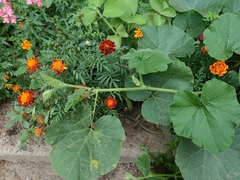 Cucurbita maxima
 Citrus maxima
 Cucurbita moschata
 Cucurbita pepo
 Triticum aestivum
 Glycine max
 Zea mays
 Cucumis sativus
 Arabidopsis
 Cucurbita
 Solanum lycopersicum